Log in
Sign up for FREE
arrow_back
Library
Unit 3 Test - Colonial Life
By Amy Hamrick
star
star
star
star
star
Share
share
Last updated over 5 years ago
25 questions
Add this activity
1
1
1
1
1
1
1
1
1
1
1
1
1
1
2
2
2
2
2
2
2
2
2
2
2
Question 1
1.
The Puritans were better prepared than the Pilgrims because they ___________.
learned how to survive in the forests of England
had raised a lot of money
arrived in the winter
brought more supplies and animals
Question 2
2.
What did people, who disagreed with the Puritans, often do?
move back to Europe
become African explorers
take over the colony
start their own colony
Question 3
3.
Which of the following was a cause of King Phillip's War?
English colonists took land that had belonged to the Wampanoag
The battle with the Pequot
Thomas Hooker's diasagreement with the Puritans
The death of Metacomet
Question 4
4.
What made the economies of New York and New Jersey strong?
weaving
hunting and gathering
trade
indigo
Question 5
5.
General James Oglethorpe wanted to put ______ to work in Georgia.
women and children
enslaved Africans
debtors
indentured servants
Question 6
6.
Why was the colony of Maryland founded?
to protect Spanish colonies
to start a French colony
to provide religious haven
to help debtors start over
Question 7
7.
Mary Musgrove helped the Creek and the Georgia colonists by ________.
becoming a translator
voting for the Tolerance Act
showing the colonists how to grow food
marrying John Rolfe
Question 8
8.
What was an apprentice supposed to learn?
a trade or craft
farming skills
reading, writing, arithmetic
good manners
Question 9
9.
Who had their passage to the colonies paid for in exchange for five to seven years of work?
Pilgrims
enslaved Africans
Puritans
indentured servants
Question 10
10.
Which colony was the first to make slavery legal?
Georgia
New York
Massachusetts
Carolinas
Question 11
11.
Most enslaved Africans lived on large plantations in the Southern colonies because _________.
they wanted to earn a living
these farms needed a lot of workers
they were offered good housing
these farms had plenty of food
Question 12
12.
New England's "cash crop" was ___________.
cotton
corn
cod
tobacco
Question 13
13.
Phyllis Wheatley was a well-known _____________.
governor
propietor
poet
musician
Question 14
14.
Who was allowed to vote in the colonial governments?
women, enslaved Africans, and Native Americans
white men who owned property
white men
all the colonists
Question 15
15.
John Locke had an idea about three natural rights. Which of the following is NOT included?
right to own property
freedom of the press
freedom
life
Question 16
16.
Shipbuilding was an important _________________ in New England.
spirituals
plantation
patroons
industry
Question 17
17.
Jonathan Edwards was one of the preachers who led the __________________.
industry
Great Awakening
assembly
plantation
Question 18
18.
Roger Williams believed that government should _______ different religious views.
debtors
spirituals
tolerate
Great Awakening
Question 19
19.
On a Southern _____________, cash crops such as tobacco and rice were grown.
plantation
assembly
patroon
industry
Question 20
20.
Some of the first settlers of Georgia were _____________.
plantation
patroons
debtors
Great Awakening
Question 21
21.
Most colonies had a lawmaking body called an ______________________.
industry
assembly
patroon
tolerate
Question 22
22.
Enslaved Africans sang _______________, which are still part of American music.
assembly
Great Awakening
spirituals
debtors
Question 23
23.
To attract settler to New Netherland, the Dutch West India Company offered land grants to wealthy __________.
patroons
spirituals
industries
debtors
Question 24
24.
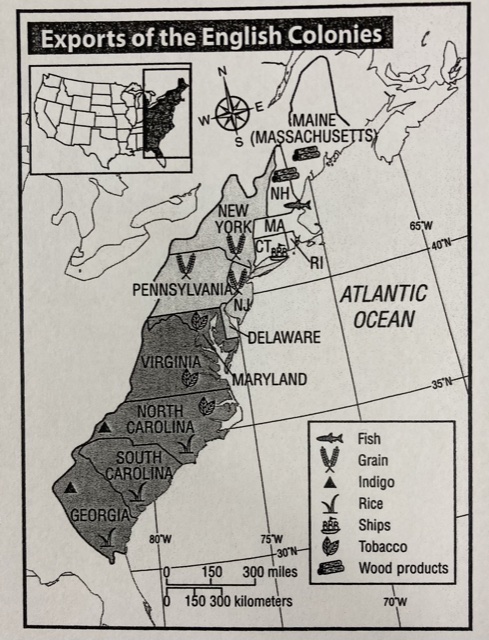
Use the historical map above to answer the question.
Which of the following was an export in New Hampshire?
indigo
ships
fish
tobacco
Question 25
25.
Use the historical map above to answer the question.
Which of the following was probably most needed in North Carolina?
hunters
crafts workers
farmers
merchants