APES Unit 2: Part 1A--Introduction to Biodiversity

Last updated over 3 years ago
5 questions
1

Endangered/Threatened Species Victory!!
Find a success story about an endangered species. Add the link and upload a photo below. Try to find one that no one else has!

What Is Biodiversity?


The term biodiversity comes from the words biological and diversity, and it means "the variety of life on Earth". It includes all living things, including plants, animals and micro-organisms, and their unique characteristics.

Species diversity is the type of biodiversity most commonly talked about, but there are several, at different "levels":
Ecosystem Diversity refers to the variety of habitats, living communities, and ecological processes.
Species Diversity refers to the variety of species in a given area.
Genetic Diversity refers to the diversity of the genetic characteristics within a species.

Why Is Biodiversity Important?
• Ecosystems depend on the combined contributions and interactions of the individual organisms within them. The loss of any species can prevent that ecosystem from operating optimally.
• An ecosystem with a high level of biodiversity is more resistant to environmental changes.
• Biodiversity provides us with food, materials and medicines. • Biodiversity provides mechanisms that regulate the air we breathe, the quality of our water, and our climate.
• Biodiversity provides us with inspiration, beauty and wonder.
1

What is Biodiversity? Explain how biodiversity can be measured in different ways.

Species Diversity

Every ecosystem contains a unique collection of species, all interacting with each other. Some ecosystems may have many more species than another. In some ecosystems, one species has grown so large that it dominates the natural community. When comparing the biodiversity of ecosystems, an ecosystem that has a large number of species, but no species greatly outnumbering the rest, would be considered to have the most species diversity. A large number of species can help an ecosystem recover from ecological threats, even if some species go extinct.
Species diversity can be further examined by comparing species richness with species evenness.

Species richness is the number of different species in a given area, regardless of how many individuals of each species exist.

Species evenness is a measure of the relative abundance, or the comparative numbers of individuals of each species present. The more even the numbers of individuals in each species in a community, the higher the species evenness in that community.

Species dominance is when the members of one or two species greatly outnumber members of other species.

You need to compare species richness and species evenness to get a true picture of species diversity in an area.
For more info on the graphic above, see this page.

Genetic Diversity

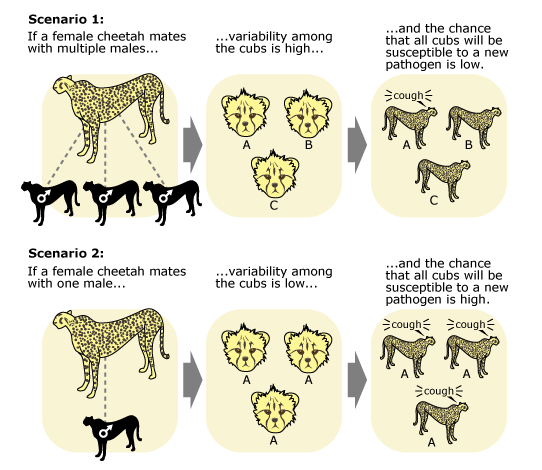
Genetic diversity describes how closely related the members of one species are in a given ecosystem. In simple terms, if all members have many similar genes, the species has low genetic diversity. Because of their small populations, endangered species may have low genetic diversity due to inbreeding. This can pose a threat to a population if it leads to inheritance of undesirable traits or makes the species more susceptible to disease. Having high genetic diversity helps species adapt to changing environments.
1

Look at the image above. How has the described mating behavior of cheetahs improved their genetic diversity? How does that increase the cheetah's chances of survival?

1

Why do you think that genetic diversity leads to resiliance and increased chances of species survival?

Ecosystem Diversity

A region may have several ecosystems, or it may have one. Wide expanses of oceans or deserts would be examples of regions with low ecological diversity. A mountain area that has lakes, forests and grasslands would have higher biodiversity, in this sense. A region with several ecosystems may be able to provide more resources to help native species survive, especially when one ecosystem is threatened by drought or disease.
1

Which of the following areas would you expect to have the highest ecosystem diversity?

Functional Diversity

The way species behave, obtain food and use the natural resources of an ecosystem is known as functional diversity. In general a species-rich ecosystem is presumed to have high functional diversity, because there are many species with many different behaviors. Understanding an ecosystem’s functional diversity can be useful to ecologists trying to conserve or restore damaged it, because knowing the behaviors and roles of species can point to gaps in a food cycle or ecological niches that are lacking species.
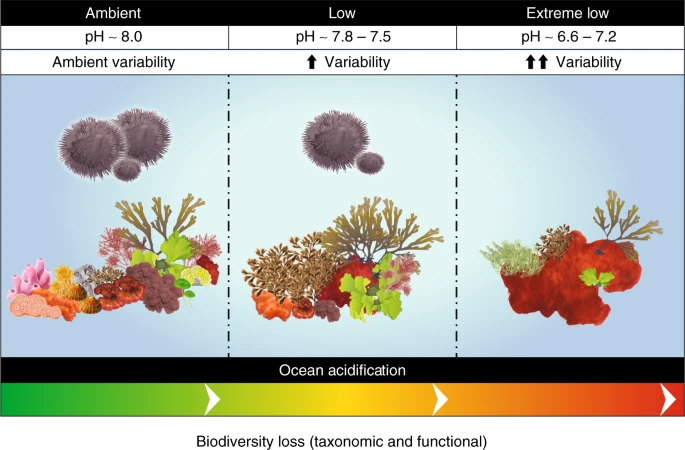
Functional Biodiversity loss as a result of ocean acidification and reduced pH.
https://www.nature.com/articles/s41467-018-07592-1
In lower water pH, certain types of corals cannot survive and build their substrate, and fewer, fleshier species dominate. Higher pH leads to a wider diversity of organisms on the coral reef.
A biodiversity index is a particular way of measuring biodiversity. There are different ways—different biodiversity indices—that are used by scientists to measure diversity. No single one will always be appropriate for the question being posed. In fact, for some conservation questions, more than one measure may have to be used.
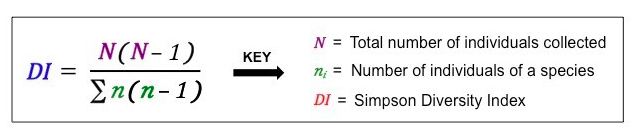
The Simpson’s reciprocal index can be used to measure the relative biodiversity of a given community.
  • It takes into account both the number of species present (richness) and the number of individuals per species (evenness)
  • A higher index value is indicative of a greater degree of biodiversity within the community


Simpson’s reciprocal index can be used to compare communities to identify intrinsic qualities:
  • A high index value suggests a stable site with many different niches and low competition (high richness and evenness)
  • A low index value suggests a site with few potential niches where only a few species dominate (low richness and evenness)
  • The index value may change in response to an ecological disturbance (such as human intervention or natural disasters)
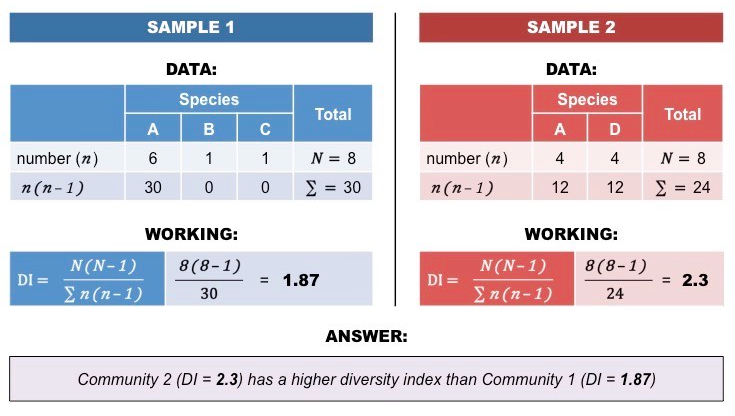
Example problem!
Here is how to solve it:
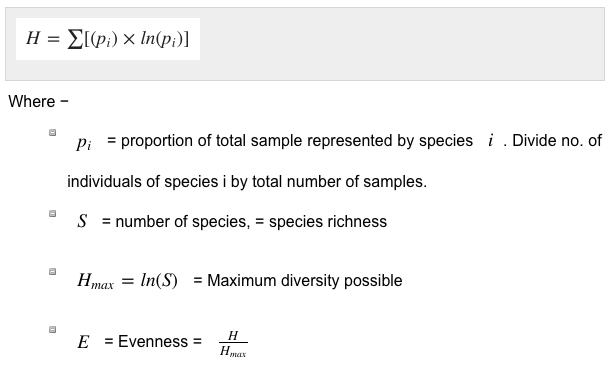
The Shannon-Wiener index is another, more complicated way to calculate biodiversity.

Problem Statement:
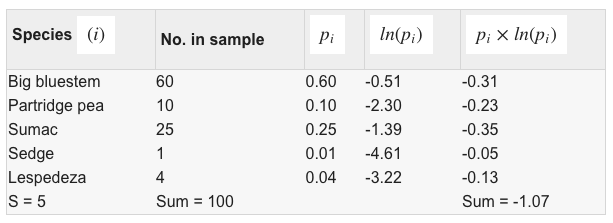
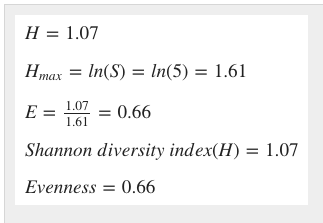
The samples of 5 species are 60,10,25,1,4. Calculate the Shannon diversity index and Evenness for these sample values.
Sample Values (S) = 60,10,25,1,4 number of species (N) = 5
First, let us calculate the sum of the given values.
sum = (60+10+25+1+4) = 100


Try to work through some of the Biodiversity concepts in this Quizlet!