Advanced Placement Environmental Science Summer Assignment and Preparation - 2022
Lower Merion High School Mrs. Stevens, Ms. Campbell & Mrs. O’Bannon
Lower Merion High School Mrs. Stevens, Ms. Campbell & Mrs. O’Bannon
Dear AP Environmental Science students, Welcome in advance to AP Environmental Science (APES). Besides making you aware and responsive to current environmental issues, a major goal in this course is to have each student score a 3 or higher on the AP exam in May 2023. Please realize this course will be taught with these goals in mind. Students who enroll in APES should be ready and willing to: 1) devote sufficient time, focus and energy to punctual, successful completion of class assignments; 2) frequently read text chapters and related articles; 3) prepare for, and successfully complete quizzes and unit tests; 4) check their email and blackboard frequently; 5) meaningfully participate in class discussions and labs; 6) write their own logical, detailed responses in their assessments; 7) conduct solo or small group presentations; 8) maintain effort throughout each quarter. Students who are not able to devote sufficient time, focus and energy to this course and its requirements should reconsider their course selection. APES is an immense field of study. Not only is it a science in the traditional sense, it is complicated by traditions, beliefs, economics, laws and ethics. If you want to succeed in APES, you’ll need to constantly embrace this interdisciplinary perspective. To prepare, we are requiring that you independently complete a summer assignment so we can complete the requisite coursework prior to the AP test in May 2023.
Course Themes The major themes of the class we will be learning about this year include:
Energy Systems and Resources - Atmosphere, soil, groundwater, and geology
The Living World - Ecosystems and Biogeochemical Cycles
Populations - Demographics, Dynamics and Growth
Land and Water Use - Agriculture, Forestry, Mining, Fishing and Global Economics
Energy Resources and Consumption- Fossil Fuels, Nuclear Energy, Conservation and Consumption
Pollution - Types of Pollution and their Impacts, Waste Disposal
Global Change - Global Warming, Loss of Biodiversity
Sustainability – How can we humans keep it all going? – Learning from nature
The summer assignment consists of 4 parts.
These must be completed prior to the first day of class and will be reviewed for a 1st quarter grade on the first day of class.
Be ready for the first quiz before the end of the first week of classes.
This will enable me to grade your work without carrying it with me, be more consistent with my grading, and keep a copy of your work after returning it to you. It will also make it easier to compare your work with your classmates'.
Directions: The documentary Home is a great introduction to this course as it addresses a wide variety of environmental topics through narration and aerial views. It is available to view for free via YouTube at HOME. As you view the video, answer the questions below.
Describe the conditions on early Earth.
What happened to the carbon that poisoned the atmosphere?
How did the agricultural revolution change the Earth?
How has Earth changed in the last 60 years since the use of oil has become more widespread?
What is most of the grain in the US used for?
What led to the dramatic decline in the biodiversity of agricultural crop species?
How have cars shaped the way housing is laid out in the US and other developed countries?
What are your thoughts on how the video portrays Dubai? Is it self-sustainable?
Rainforests are cut down to make farmland for which products/crops?
What makes the growth of Lagos different from how most other cities grow?
Where does the water from Greenland’s melting ice sheet go?
Why are the glaciers of mountains so important for the people in the lowlands?
After watching the film, what topics are you most looking forward to learning about this year? Give reasons for your answers.
What is the difference between an element and a compound? Provide two examples of each that can be found in nature.
Draw a picture of a carbon atom and include the correct number and labels for the following: protons, neutrons, electrons.
The pH scale is a logarithmic scale that measures the acidity of a solution based on its concentration of hydrogen ions (H+). What is a logarithmic scale?
Draw the pH scale and include values and some examples of solutions that are extremely basic, extremely acidic, and neutral.
What is the difference between an organic and inorganic compound? Give two examples for each.
Cells are the basic units of life. What are the differing qualities of eukaryotic and prokaryotic cells?
What does it mean to be a genetically modified organism (GMO) in terms of genes and DNA?
What is a combustion reaction? Give 2 examples of combustion reactions by writing their equations.
What is nuclear fission?
Which radioactive elements are most commonly used to produce power using nuclear fission?
How is fission different from nuclear fusion?
What is soil?
Explain the difference between physical, chemical, and biological weathering.
Describe how soil is made. Explain the connection between the rock cycle and soil formation.
What are the three different soil particle sizes? List from largest to smallest.
What is porosity? How does the type of soil particle affect porosity?
Explain the relationship between permeability and porosity. How is this related to water holding capacity?
What is the ideal soil type for plant growth?
Knowing basic units and conversions between units is also a part of the AP exam. Units of length, volume, and energy most often appear on the AP exam. Prefixes like kilo, centi, mega, milli, etc. should be known. In addition, you should be able to read scientific notation and also be able to calculate percent change.
Basic Units
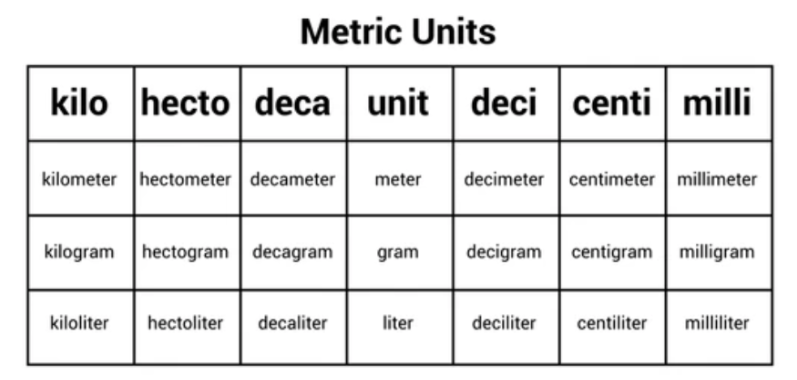
Even Bigger/Smaller Units

Do the following conversions.
2 megawatts =
35 kilowatts =
7.4 megajoules =
58.2 liters =
345 centimeters =
0.009 kilometers =
50 milliliters of H2O =
70 million
twenty-three thousand
two billion three hundred
0.0025
2.5 million
1.2 x 10³
3.6 x 10⁻⁶
450 x 109
Photo of page 2
Photo of page 3
Photo of page 4
Photo of page 5
Photo of page 6
Photo of page 7
Photo of page 8
Photo of page 9
Photo of page 10
Photo(s) of any additional pages
What is geology and why is it hard to study?
List and describe the 3 geologic layers of the earth.
What are the three types of rocks in the rock cycle?
An igneous rock, like
Describe what erosion does to rocks.
How are sedimentary rocks formed?
How are metamorphic rocks formed?
What drives the rock cycle? Explain this process in the mantle of the earth.
What is the difference between continental and oceanic crust?
What process causes the plates of the crust to move?
Explain two ways that we can measure plate movement on the surface of Earth.
Describe the three plate boundaries and any geologic features that form at the boundary:
Convergent boundaries
Divergent boundaries
Transform boundaries
Explain how geologic processes formed Hawaii.
What are three natural hazards associated with plate boundaries?
What determines the explosiveness of a volcano?
Describe how an earthquake occurs.
How are tsunamis related to earthquakes?
List and describe the soil horizons from the top down.
What is soil degradation?
Explain three examples of soil degradation.
