10.05.20 (Sync) - Isotopes and Average Atomic Mass
star
star
star
star
star
Last updated almost 6 years ago
23 Nsɛmmisa

1
1
1


1
1
1
1
1
1
1
1
1
1
1
1
1
1
1
1
1

1
1
1

Why?
We have spent the last few weeks learning about electrons in atoms. As you know, electrons can move between atoms, leading to the formation of ions. The location of electrons in atoms also leads to the two periodic trends you learned about: atomic radius and ionization energy. Next semester, you will see that the movement and of electrons, ionization energy, and atomic radius are central in how molecules are formed and how chemical reactions happen.
This week, we will be focusing on the nucleus of the atom.
Warm-Up #1
An atom of boron has a mass of 11. How many protons, neutrons, and electrons are in the atom?
Which of the following subatomic particles contribute to the mass of an atom?
Compare the periodic table from above with the perodic tables below. What additional information is provided in the box for each element?
Click on the 'Isotopes' tab in the simulation below. Use the simulation to answer questions 4-11.
(If you'd like to have the simulation open in another tab, visit Isotopes and Atomic Mass PhET)
Spend one minute playing with the 'Isotopes' tab in the simulation. What are two things that you notice?
Build an atom of Hydrogen-1, Hydrogen-2, and Hydrogen-3.
What does the number (-1, -2, or -3) in the isotope name represent?
Build a Hydrogen-1 isotope. Click between the 'Mass Number' and 'Atomic Mass (amu)' options on the scale.
Match the numbers below.
| Draggable item | arrow_right_alt | Corresponding Item |
|---|---|---|
Atomic mass of Hydrogen-2 | arrow_right_alt | 1 |
Mass number of Hydrogen-2 | arrow_right_alt | 1.00783 |
Mass number of Hydrogen-1 | arrow_right_alt | 2 |
Atomic mass of Hydrogen-1 | arrow_right_alt | 2.01410 |
Next, click on 'Boron' on the periodic table. Build an isotope of Boron-9, Boron-10, and Boron-11. Click between the 'Mass Number and 'Atomic Mass (amu)' options on the scale.
Match the numbers below
| Draggable item | arrow_right_alt | Corresponding Item |
|---|---|---|
Mass number of Boron-10 | arrow_right_alt | 9 |
Mass number of Boron-11 | arrow_right_alt | 10 |
Atomic mass of Boron-11 | arrow_right_alt | 11 |
Atomic mass of Boron-10 | arrow_right_alt | 11.00931 |
Mass number of Boron-9 | arrow_right_alt | 10.01294 |
Considering your answers to numbers 6-7, compare and contrast mass number and atomic mass.
Keep your 'Boron' isotope open. Click on the 'Abundance in Nature' tab.
Which of the following isotopes of Boron are present in nature?
Which of the following best describes the isotopes of Boron?
In your own words, define the term 'isotope'.
Click on the 'Mixtures' tab in the simulation. Use the simulation to answer questions 12-17.
Spend one minute playing with the 'Mixtures' tab in the simulation. What are two things that you notice?
Select 'My Mix' in the bottom right hand corner, then select Nitrogen on the periodic table. Which two isotopes of Nitrogen are present?
Open the 'Percent Composition' and 'Average Atomic Mass' tabs.
Drag different numbers of Nitrogen-14 and Nitrogen-15 isotopes into the black box. Look at the percent compositions and average atomic masses of your sample.
Which of the following best describes the percent composition and average atomic mass?
Select 'Nature's Mix' in the bottom right hand corner. Keep your selection on 'Nitrogen'.
Which of the following best describes the percent composition of Nitrogen isotopes in nature?
Click on the 'Neon' box and examine the sample of neon atoms.
Which of the following best describes the average atomic mass of Neon?
Compare the Average Atomic Masses of Nitrogen and Neon from the simulation to the masses of Nitrogen and Neon on the periodic table:
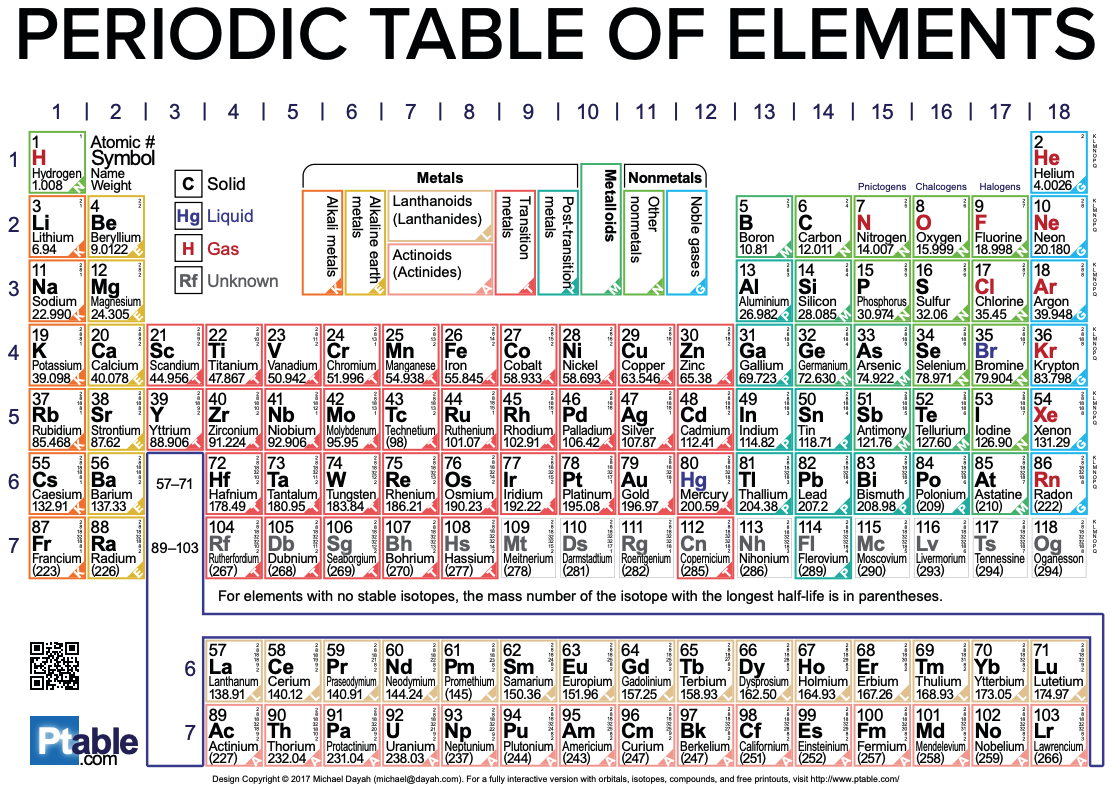
In your own words, describe how scientists determined the masses of the elements provided on the periodic table.
Using the 'Isotopes' tab, determine the atomic mass of the two most common isotopes of Lithium. Select the two most common isotopes and their atomic masses below.
Match the two most common isotopes of Lithium with their percent abundance in nature.
| Draggable item | arrow_right_alt | Corresponding Item |
|---|---|---|
Lithium-6 | arrow_right_alt | 92.41% |
Lithium-7 | arrow_right_alt | 7.59% |
Consider your answers to #18 and #19.
In the space below, calculate the average atomic mass of Lithium. You MUST show your work!
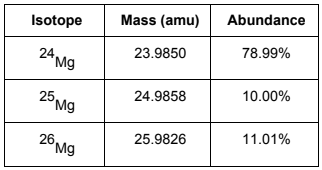
The element magnesium has three stable isotopes with the following masses and abundance. Calculate the average atomic mass of magnesium from this data. (You must show your work!)
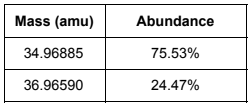
An element is a mixture of two isotopes with the following masses and abundances. Calculate the average atomic mass of the element and then identify the element. (You must show your work!)
Choose one of the videos to watch below...
What it takes to make a new element...
List two things you learned or found interesting below