01.27.21 - Physical Properties and IMAFs
star
star
star
star
star
Last updated over 5 years ago
28 Nsɛmmisa
1
1
1
1
1
1
1
1
1
1
1
1
1
1
1
1
1
1
1
1
1
1
1
1
1
1
1
1
Objectives
Students will:
predict the type of intermolecular attractive force that will form between two identical particles.
explain the differences in melting or boiling points based on the types of intermolecular forces present between particles.
Why?
So why do we care about intermolecular attractive forces? Think about water molecules. When an ice cube melts or when water boils in a pan on the stove, the covalent bonds holding the hydrogen and oxygen atoms together in the molecule remain intact. However, the attractions between water molecules, the intermolecular attractions, are affected by melting and boiling. Intermolecular attractions influence a variety of physical properties of compounds including melting points, boiling points, and solubility (ability to dissolve). In the last activity, you investigated the types of intermolecular attractive forces that cause molecules to attract. In this activity, you will investigate how these intermolecular attractive forces determine the melting point, boiling point, and solubility of a substance.
This interactive let's you change the intermolecular attractions between particles at the same temperature. While you can't actually do this in real life, this simulation will help you explore how the strength of intermolecular attractions determine if a substance is a solid, liquid, or gas at a given temperature.
Use this interactive to answer questions 1-4
Which statement best describes a substance that has weak intermolecular attractive forces between particles?
Which statement best describes a substance that has strong intermolecular attractive forces between particles?
Identify the state of matter for the substance with weak intermolecular attractions.
Identify the state of matter for the substance with strong intermolecular attractions.
The boiling point of a substance is the temperature at which the substance changes states from liquid to gas. Boiling point is a physical property that is determined by intermolecular attractions. In the interactive below, there are two tiny drops of liquid, one polar and the other non-polar. Use the interactive to answer questions 5-8
Which liquid has the lowest boiling point?
When a liquid boils, what is broken or disrupted?
Which substance has stronger intermolecular attractions?
How do intermolecular attractions affect the boiling point of a substance?
The diagram below shows two types of molecules that contain carbon atoms. In each molecule, carbon atoms are gray, hydrogen atoms are white, and oxygen atoms are red.
Use the diagram below to answer questions 9-14.
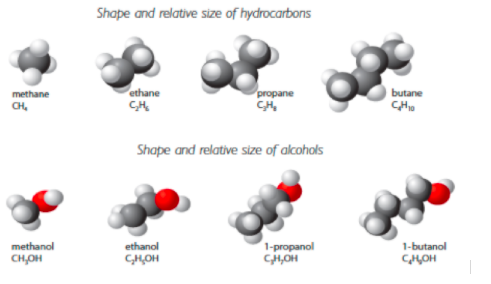
What is different about the structure of hydrocarbon molecules and alcohol molecules?
Classify the molecules as polar or nonpolar.
hydrocarbon
alcohol
Polar molecule
Nonpolar molecule
Identify the type of intermolecular forces present between each molecule listed.
hydrocarbon
alcohol
London dispersion forces
dipole-dipole attractions
hydrogen bonds
ion-ion attractions
Which compound would have a higher melting point, methane, CH4, or methanol, CH3OH? Why?
You probably know that oil and water don't mix. Did you ever wonder why? The interactive below shows polar water molecules and nonpolar oil molecules in a container together. Use the key below to identify each type of molecule.
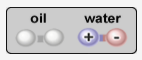
Use the button to "shake up" the oil and water mixture. Then watch to see what happens to the oil and water as you let the container "settle".
What types of intermolecular attractions are found between water molecules?
What types of intermolecular attractions are found between oil molecules?
Using what you know of intermolecular attractions, why don't oil and water mix?
Identify the combination of substances that will mix or dissolve. Select all that apply.
IMAFs play a huge role in something that we do multiple times every single day: washing our hands.
Watch the video below about surfactants, then answer questions 17-18.
According to the video, what is another term for "surfactant"?
Match the phrase below with the best term.
| Draggable item | arrow_right_alt | Corresponding Item |
|---|---|---|
"water hating" | arrow_right_alt | hydrophilic |
"water loving" | arrow_right_alt | hydrophobic |
Watch the video below about how soap interacts with the coronavirus. As you watch, consider what you learned about IMAFs in substances such as water, oil, and alcohol..
Answer questions 19-
The model from the video shown below is describing the general structure of a soap molecule.
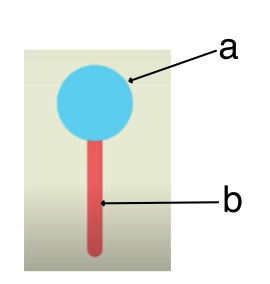
Categorize the following characteristics with the different ends of a soap molecule (a and b)
attracted to water
attracted to fats (oils)
hydrophilic end
hydrophobic end
nonpolar end
polar end
a
b
Whaich of the following best describes what soap does to the coronavirus?
The video claims that alcohol based hand sanitizers work similarly to soap in destroying the coronavirus.
Consider what you learned about alcohols in the activity above. What is the property of soap and alcohol molecules that makes them effective at "exploding" the coronavirus? (Hint: It may help to revisit the picture above #9)
Hand sanitizer is always effective at killing the coronavirus.
(Optional: Check out the How do Hand Sanitizers Work video from American Chemical Society)
Click on the link below to launch a simulation to show how salt and sugar dissolve in water. Note: This simulation won't run on an iPad or some tablets. If someone in your group can't open the simulation, please have someone in the group share their screen so all team members can see the simulation.
https://phet.colorado.edu/sims/cheerpj/sugar-and-salt-solutions/latest/sugar-and-salt-solutions.html?simulation=sugar-and-salt-solutions
What happens to salt or sodium chloride, NaCl, when it dissolves in water?
What happens to sugar, C12H22O11, when it dissolves in water?
Spend a few minutes interacting with the simulation. Make sure to look at all three screens (Macro, Micro, and Water). Then write down three observations.
What types of intermolecular attractions are found between particles NaCl?
What types of intermolecular attractions are found between sugar molecules?