Log in
Sign up for FREE
arrow_back
Library

02.17.21 HW - Double Replacement Reactions and Solubility Rules

star
star
star
star
star
Last updated about 5 years ago
23 questions
1
1
1
1
1
1
1
1
1
1
1
1
1
1
1
1
1
1
1
1
1
1
1

Double Replacement Reactions and Solubility Rules

Objectives:
  • determine the products of a double replacement reaction
  • reference the solubility rules to determine if ionic compounds are soluble or insoluble

Part 1: Review

Answer questions 1-5 to jog your memory on what double replacement reactions and the states of matter in a reaction are.
Question 1
1.

Question 2
2.

In your own words, describe what happens to the reactants in a double replacement reaction.

Question 3
3.

Question 4
4.

Question 5
5.

Draggable itemarrow_right_altCorresponding Item
arrow_right_alt
arrow_right_alt
arrow_right_alt
arrow_right_alt
Question 6
6.

Question 7
7.

Question 8
8.

Question 9
9.

Question 10
10.

Write a balanched chemical equation for the reaction that takes place between the following reactants:

copper (II) chloride + beryllium oxide

I strongly encourage you to click on the 'show your work' box below and write things out.

Remember that you will not be able to write subscripts and that you can type your formulas like this in your answer: FeCl3

Question 11
11.

Write a balanched chemical equation for the reaction that takes place between the following reactants:

sodium phosphate + lead (II) nitrate

I strongly encourage you to click on the 'show your work' box below and write things out.

Remember that you will not be able to write subscripts and that you can type your formulas like this in your answer: FeCl3

Part 3: Solubility Rules

Why?

Double replacement reactions are one of the five common types of chemical reactions. In a double replacement reaction, one of the products of the reaction is often a precipitate, a compound that is insoluble (doesn't dissolve) in water. Because these reactions follow a predictable pattern, it is possible to identify the prodcts of a double replacement reaction using a list of rules that show which substances dissolve in water (are soluble) and which substances do not dissolve in water (are insoluble precipitates). In this actiity, you will learn how to determine if a precipitate forms and how to determine the identity of the precipitate.
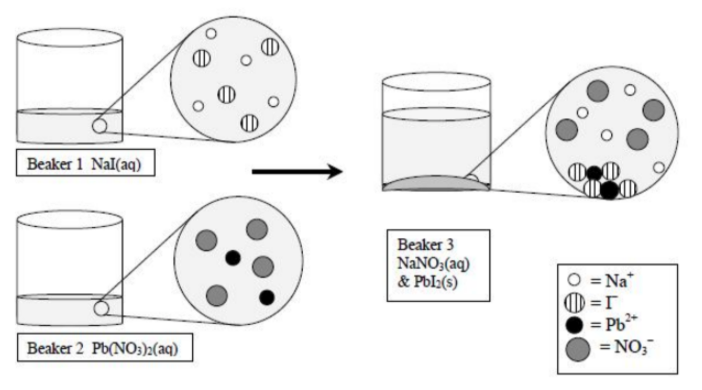
Model 1 - Mixing Two Solutions

The two solutions on the left containing the reactants are combined, resulting in the mixture on the right. The products are shown in Beaker 3. The solutions are shown at about a magnification of 109.

Question 12
12.

Question 13
13.

Draggable itemarrow_right_altCorresponding Item
arrow_right_alt
arrow_right_alt
arrow_right_alt
arrow_right_alt
arrow_right_alt
Question 14
14.

Question 15
15.

Why do you think some of the spheres in Beaker 3 depicted as touching and shown on the bottom of the beaker?

Question 16
16.

Question 17
17.

Question 18
18.

The ions identified in the question above are called spectator ions. Create a definition of spectator ions based on the model.

Question 19
19.

Write the complete balanced equation to represent the chemical reaction in Beaker 3 and indicate the states of matter.

The video in the Edpuzzle below discusses the reaction and diagram from above. Remember a similar demo from the beginning of the unit?

If you do not have an edpuzzle account, log in using your DPSWatch and answer the questions in the Edpuzzle below before moving on. You might also want to make changes to the previous set of questions.

A few things:
  • You might want to take notes as you watch.
  • The video mentions page numbers - please do not worry about these!
  • If you would like to reference the solubility rules, look at the back of your periodic table. They are also located below the Edpuzzle.

Reference the solubility rules as you answer questions 20-21

Question 20
20.

Question 21
21.

Question 22
22.

What do you understand best about predicting products of double replacement reactions and solubility rules?

Question 23
23.

What are you struggling with the most around predicting products of double replacement reactions and solubility rules?

Recall the types of chemical reactions discussed earlier in the unit. Which of the following best describes a double replacement reaction?
A + BC → AC + B
CxHy + O2 → CO2 + H2O
AB → A + B
AB + CD → AD + CB
A + B → AB
Which of the following reactions is a double replacement reaction? Note that the equations are not balanced and that there may be more than one more answer.
N2 + H2 →NH3
Al + Fe2O3 →Al2O3 + Fe
AgNO3 + CuI2 → Cu(NO3)2 + AgI
NaI + Pb(NO3)2 → NaNO3 + PbI2
The reaction below is an example of a double replacement reaction:

2NaOH + CuCO3 → Na2CO3 + Cu(OH2)

Which type of compounds react in double replacement reactions?
Metallic
Covalent compounds
Ionic compounds
Polar covalent compounds
Match the states of matter with their symbol.
liquid
(g)
gas
(s)
solid
(aq)
solution / aqueous
(l)

Part 2: Predicting Products of Double Replacement Reactions

Before we can predict the states of matter of the products in a double replacement reaction, we must first make sure that we can predict the products of a double replacement reaction. Follow the example below, then answer questions

Examine the following equation:



Step 1: In order to determine the products, start off by determining the charge of each ion in the reactants. Look at your polyatomic ions and periodic table if you are having trouble remembering them. It may help to write them out above the formulas:



Step 2: Determine which products will form in the reactions. Remember that, in a double replacement reaction, the ions "trade partners", and that oppositely charged ions always attract:



Step 3: Write your products. Keep in mind that the charges of the ions do not change from the reactants side to the products side. Also remember that ionic compounds are always neutral, so you may need to add subscripts to your formulas:



Step 4: Balance the Equation. If you are having trouble balancing, you may want to recheck your ionic equation formulas:



Your turn! Follow the steps above as you answer questions 6-
Consider the two reactants below:

NaCl + AgNO3 → ________ + ________

Which of the following are the products of this reaction? If you would like a space to write things out, click on the 'show your work' box below. Do not worry about balancing yet.
NO3Cl
NaNO3
AgCl
AgCl2
NO3Na
NaAg
Consider the two reactants below:

NaOH + Cu(SO4)2 → ________ + ________

Which of the following are the products of this reaction? If you would like a space to write things out, click on the 'show your work' box below. Do not worry about balancing yet.
NaCu
SO4(OH)
NaSO4
Cu(OH)2
CuOH
Na2SO4
Na(SO4)2
Consider the two reactants below:

iron (III) nitrate + magnesium sulfate →

Which of the following are the products of this reaction? If you would like a space to write things out, click on the 'show your work' box below. Do not worry about balancing yet.
Fe2(SO4)3
Mg(NO3)3
MgNO3
Fe2SO4
Mg(NO3)2
FeSO4
Consider the two reactants below:

nickel (II) chloride + potassium carbonate →

Which of the following are the products of this reaction? If you would like a space to write things out, click on the 'show your work' box below. Do not worry about balancing yet.
KCl2
Ni3CO
NiCO3
KCl
Ni2CO3
K2Cl2
Most of the chemicals in this reaction are _____.
solid
liquid
gas
aqueous
Match the particles present in Beaker 1, 2, and 3 with their formula.
I-
Na+
NO3-
Pb2+
PbI2
Categorize the following substances as either reactants or products for the reaction above.
NaNO3 (aq)
NaI (aq)
Pb(NO3)2 (aq)
PbI2 (s)
Reactants
Products
What evidence is found in Beaker 3 that indicates that a chemical change has occured?
A gas was formed
There was a temperature change
A solid precipitate was formed
Some ions were aqueous as reactants and remained aqueous after the reaction occured. Identify these ions.
Na+
Pb2+
NO3-
I-
Categorize the following substances as soluble or insoluble in water.
Ca(ClO4)2
K3PO4
Pb(NO3)2
CaSO4
Ba(NO3)2
CaCO3
CrPO4
Soluble
Insoluble
Determine whether the following substances form a solid or dissolve in water to form a solution.
mercury (II) chloride
copper (II) acetate
silver (I) bromide
ammonium phosphate
calcium nitrate
strontium sulfate
lithium chlorate
Forms solid
Dissolves in water