
Describe the difference between biotic and abiotic parts of an ecosystem.
Illustrate your schoolyard and identify biotic and abiotic parts of that ecosystem. Indicate the various relationships between the biotic and abiotic parts in your schoolyard (with different colored lines) and a brief description of the relationship. (see page 10 of text)
What are the basic needs of living organisms in order for survival?
What are some things that you could do without and still have all of your basic needs met?

Explain why the beaver population in Yoho National Park was declining.
What is the difference between a ‘dump’ or landfill – and a sanitary landfill?
List the 5 basic garbage ‘solutions’ we have been involved in to clean up our act.
Define what a "Carnivore" is.
Define what a "Herbivore" is.
Define what an "Ominvore" is.
Illustrate a word equation for the process of photosynthesis. (pg. 30)
What are the two reasons that photosynthesis is important?
Illustrate an example of a food chain (include arrows showing the flow of energy). Identify the type of organism you are illustrating (eg. producer, primary consumer, secondary consumer, decomposer, etc.)
Illustrate the flow of energy from producer to primary consumer, to secondary consumer, to tertiary
consumer, to scavenger, to decomposer.
Illustrate a Meadow Food Web
What would happen if the meadow mice were poisoned and became extirpated?
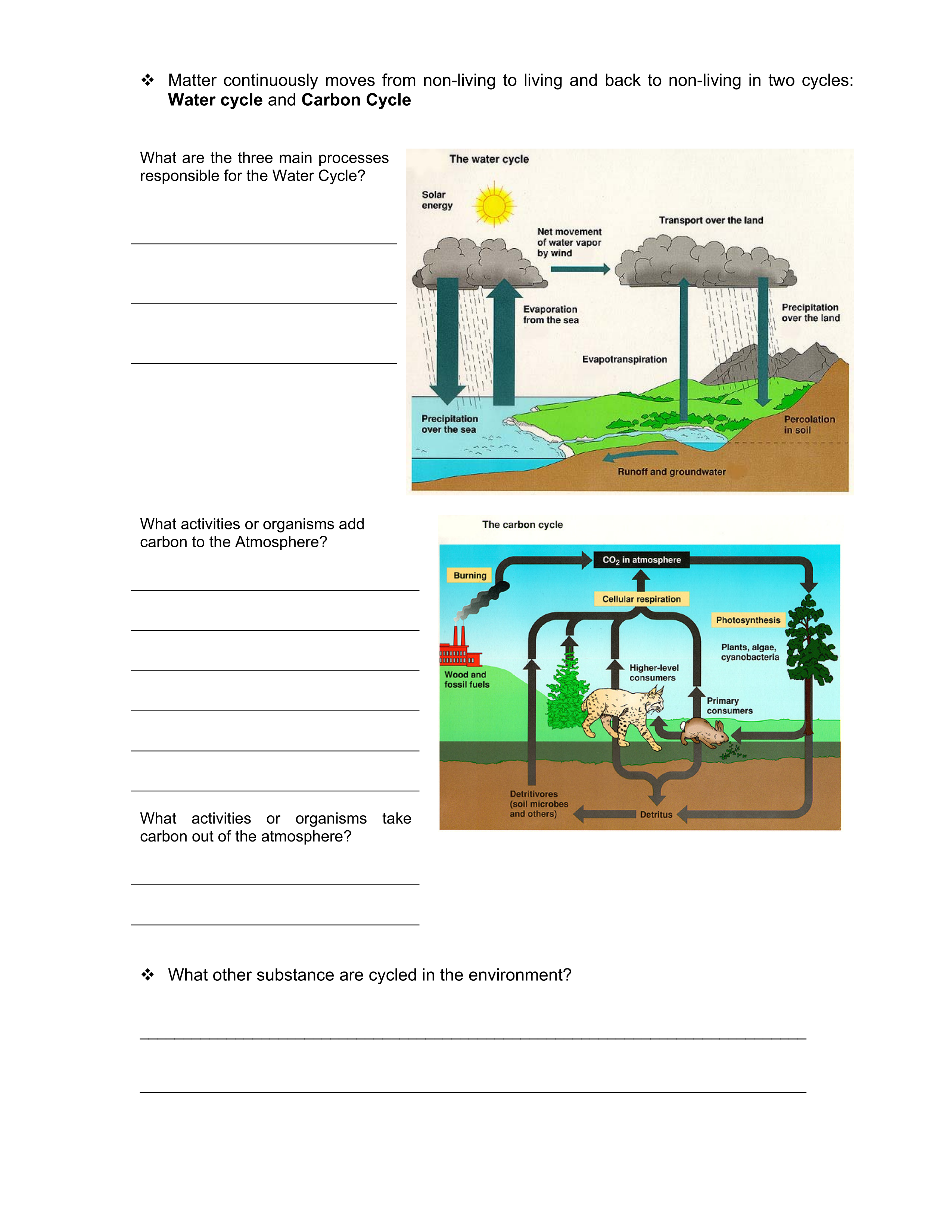
What are the three main processes responsible for the Water Cycle?
What activities or organisms add
carbon to the Atmosphere?
What activities or organisms take
carbon out of the atmosphere?
Define what "Bioinvasion" is and provide an example.
Define what "Resource Competition" is and provide an example.
Define what "Predation" is and provide an example.
Define what "Weather" is and how it affects the environment.
Describe the difference between Primary Succession and Secondary Succession.
What is a pioneer species and describe the role they play in an environment (their niche)?
What is a climax community?
What are the differences between threatened, endangered, extirpated, and extinct?
Why are Pemberton potatoes special?
What does COSEWIC stand for and what does it do?
Why are there ‘wildlife overpasses and underpasses’ in Banff national Park?
How do you determine your ecological footprint?
What are some ways you can reduce your ecological footprint?
What is meant by sustainable lifestyle?
Explain what each of the following is and give three examples to show you understand the difference.
Explain what each of the following is and give three examples to show you understand the difference.
Explain what each of the following is and give three examples to show you understand the difference.
What is symbiosis?
Describe two examples of commensalism.
Describe two examples of mutualism.
Describe two examples of parasitism
Illustrate a word equation for the process of cellular respiration.
What are the two reasons that cellular respiration is important?
Describe the difference between scavengers and decomposers.
Explain the ‘unintended consequences’ of the use of the pesticide DDT, in Borneo.
Why is DDT a banned chemical in North America?