Simple Machines Stations

Last updated about 3 years ago
18 questions
Quick reminder of the Simple Machines!
10

List 10 REAL WORLD examples of ANY simple machines from this video (or others you can think of) that we see almost every day.

Simple Machines Stations
You have been learning about simple machines in this lesson. Now you get a chance to create simple machines at 6 different stations.

MAKE SURE YOU ARE COMPLETING THE CORRECT SECTION ON THE goFORMATIVE. (Example: if you are at STATION 2 - LEVERS, make sure you are answering the questions for that section!)

At each station, there are materials to build and demonstrate one of the six simple machines.

Follow the directions to gather data and answer the questions.

Here's a quick tutorial on how to use a spring scale. These measure force in Newtons. It's important to use it correctly.


STATION 1 - INCLINED PLANE
STATION 1 - INCLINED PLANE - PURPOSE
You will figure out which type of inclined plane is most efficient (using less force) at moving objects from the ground level up to a higher position.
Bill Nye - Inclined Plane
Background Information for Inclined Planes (if needed)
10

STATION 1 - INCLINED PLANE - EXAMPLES FIND PICTURES, DRAW, or LIST 5 examples of inclined planes in the real world. They should not all be the same kind of ramp. Think of different types of examples.

STATION 1 - INCLINED PLANE - MATERIALS
  • plank of wood
  • books
  • truck with rocks in back
  • string
  • meter stick
  • spring scale
  • something to keep bottom of ramp from sliding (clay?)

IF SOMETHING IS MISSING, TELL THE TEACHER
STATION 1 - INCLINED PLANE - SET UP

1) Set up the inclined plane so the height of the ramp is 30 centimeters. You may use any of the books on the bookshelf. (I recorded the height on the data table for you).

2) Measure the length of the ramp (inclined plane) in METERS (measure in centimeters and divide by 100); record in data table.

3) Attach one end of the string to the truck and the other end to the hook on the spring scale.

4) Measure the weight of the cart in Newtons by letting the truck dangle vertically in mid-air from the spring scale; record in data table.


STATION 1 - INCLINED PLANE - PROCESS
5) Pulling parallel (along the ramp angle), pull the cart up the ramp at a constant speed with the spring scale. Record the effort force needed. (do not jerk on the rope; keep the speed as constant as possible.)

6) Now add some books to raise the ramp height to 45 centimeters.

7) Pulling parallel (along the ramp angle), pull the cart up the ramp at a constant speed with the spring scale. Record the effort force needed. (do not jerk on the rope; keep the speed as constant as possible.)

8)Finally, choose a height and build your ramp. Write the ramp's height at the top of the column on your table. Record all of your calculations on your data table above.
10

STATION 1 - INCLINED PLANE - DATA TABLE

10

Which inclined plane took the most force to pull the box up?

10

Which ramp forced you to pull in more "slack" (extra rope) to get the truck to move the same distance up the ramp?

10

Can you think of an inclined plane that works in the opposite directions to get things safely to the ground without getting damaged instead of just dropping them?

10

If you had to put a heavy box up in the back of a tall moving van but you didn't have an inclined plane, what would you most likely do? Is that more efficient (a quicker or better way)? Why or Why not? (ANSWER ALL PARTS)

SIDENOTE: Work and Simple Machines
We've looked at some examples and uses for simple machines. They have one job right? To do the work for us! But how can we figure out HOW MUCH work is being done?

This quick video explains how work is calculated. Watch carefully; you'll be doing the same thing in a minute :)
10

STATION 1 - INCLINED PLANE - CALCULATING WORK Use your data from your chart above to calculate the amount of work you performed on this lab activity.

10

Which ramp allows you to do less work?

10

Which ramp requires the most effort force?

STATION 2 - LEVER
STATION 2 - LEVER - PURPOSE
This lab is to allow you to investigate different lever designs and identify the advantages and disadvantages of each one.
TED Talks - Levers
Background information on levers (if needed)
10

STATION 2 - LEVERS - EXAMPLES FIND PICTURES, DRAW, or LIST 5 examples of levers in the real world. They should not all be the same kind of lever. Levers are used for ALL KINDS OF THINGS!!

STATION 2 - LEVERS - MATERIALS
  • Ruler (30 cm)
  • Marker
  • Clay
  • Tape
  • 2 paper cups
  • A small rock or other weight
  • Handful of pennies

IF SOMETHING IS MISSING, TELL THE TEACHER
STATION 2 - LEVER SET UP/PROCEDURES
Position the marker underneath and perpendicular to the ruler, so the marker crosses the 5 cm line. It may be helpful to tape the marker to the desk so it doesn’t roll around!


Place the rock in the “Load” cup. One by one, place pennies in the “Effort” cup until the load lifts into the air. Record the number of pennies it took in the table below.


Repeat Steps 5 through 7 with the pencil placed at 15 cm and 25 cm.


10

Fill in the number of pennies it took to lift your "Load" with each of your levers in the chart below.

10

The closer the fulcrum is to the effort force, the easier it will be to lift the load with a lever.

10

How did the position of the fulcrum affect the number of pennies needed to lift the load?

The closer the ______ is to the ______, the easier it will be to lift the load!
10

How could you modify the lever even further to make it easier to lift the load?

Think about what you just learned and take it a step further :)
STATION 3 - PULLEY
STATION 3 - PULLEY - PURPOSE
After this activity, students should be able to describe how pulleys make work easier for engineers and describe everyday examples of pulleys used by engineers.
Information on Pulleys
Background Information on Pulleys (if needed)
10

STATION 3 - PULLEYS - EXAMPLES FIND PICTURES, DRAW, or LIST 5 examples of pulleys in the real world. They should not all be the same kind of pulleys. Pulleys are used for ALL KINDS OF THINGS!!

STATION 3 - PULLEY - MATERIALS
  • Ruler
  • string/thin rope
  • pulley set ups
  • spring scales
  • weights
  • object to lift
IF SOMETHING IS MISSING, TELL THE TEACHER
STATION 3 - PULLEY SET UP/PROCEDURES
Tie one end of the string to the object to lift.
Tie a small loop in the other end of the string.
Weigh the object by hooking the loop of string to the hook on the spring scale and pulling the object straight up in the air.
Record this value (measurement on the spring scale)on the chart below.


Create a fixed pulley by running the string over the pulley wheel. (click the hyperlink to see a picture)
One student hold the pulley still and have another student pull the string down, as shown in the hyperlink.
Record the force needed (measurement on the spring scale) on the chart below.


Next, create a movable pulley by attaching the pulley to the object.
One student holds the string in place (where it says "attached" on the picture) while another student lifts the object by pulling up on the spring scale string, as shown in the link.
Observe how much force is required to lift the object (spring scale measurement) and record it on the chart below.


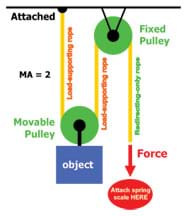
Last, create a PULLEY SYSTEM. Run the string through one pulley (the fixed pulley) and through the other (the movable pulley, which has the object attached to it), as shown below.
Have one student hold the free end of the rope (the part shown attached to the ceiling) and the fixed pulley (also shown attached to the ceiling), while another student raises the object by pulling down on the spring scale.
Record on the chart the force required to lift the object (spring scale measurement) with this two-pulley system.
10

Fill in the chart below with the data from your experiment.

10

Write two sentences explaining the relationship between the number of pulleys (or rope direction changes) and their effect on the amount of force you have to use to lift the object.

The more pulleys in the system, _________ effort was required. The fewer times the rope changed direction, ________ effort was required.