Common Assessment - Heredity : Blue Skin
star
star
star
star
star
Last updated almost 4 years ago
5 Nsɛmmisa
1
1
1
1
1
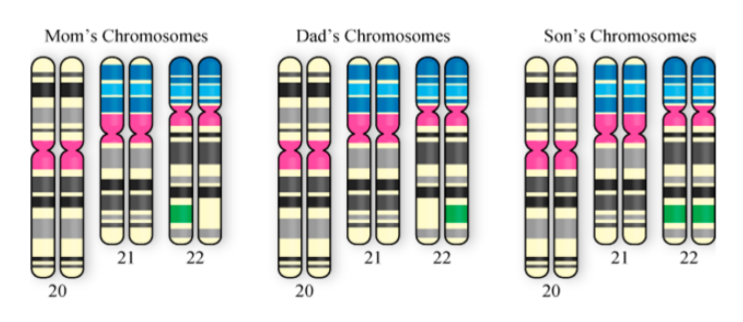
SCENARIO: John and Kalea are surprised when their son Tyler is born with blue skin. Neither parent has this condition and they do not know relatives that do either. After interviews, research, and genetic testing, doctors rule out environmental factors. They decide that blue skin is a rare condition caused by a mutation in the human population. In this condition, the hemoglobin proteins are changed. The changed hemoglobin in the blood binds too tightly to oxygen and cannot release oxygen to the cells. The lack of oxygen makes the skin appear blue.
EVIDENCE:
Compare and Contrast the chromosomes of the parents and the son.
List the similarities and differences between the parents’ and the son’s chromosomes.
Based on your Venn Diagram, circle the best claim that describes where blue-skin mutation is located.
Explain why you chose the claim using evidence from the figure and/or venn diagram.
Draw a model to show how a change in the gene (DNA) results in Tyler having blue skin while his parents do not.
Your model must include:
Genes (DNA)
Proteins
Observable Traits
Explain how your model shows how changes to a gene may result in changes to an observable trait.
Here are some sentence frames you can use:
_____ has/have caused _______. Which in turn, results/resulted in _______.
This leads me to conclude that _______.
This evidence is important because _______.
The fact that _____ shows that _______.
The evidence supports the claim by ________.