1
1
1
1
1
1
1
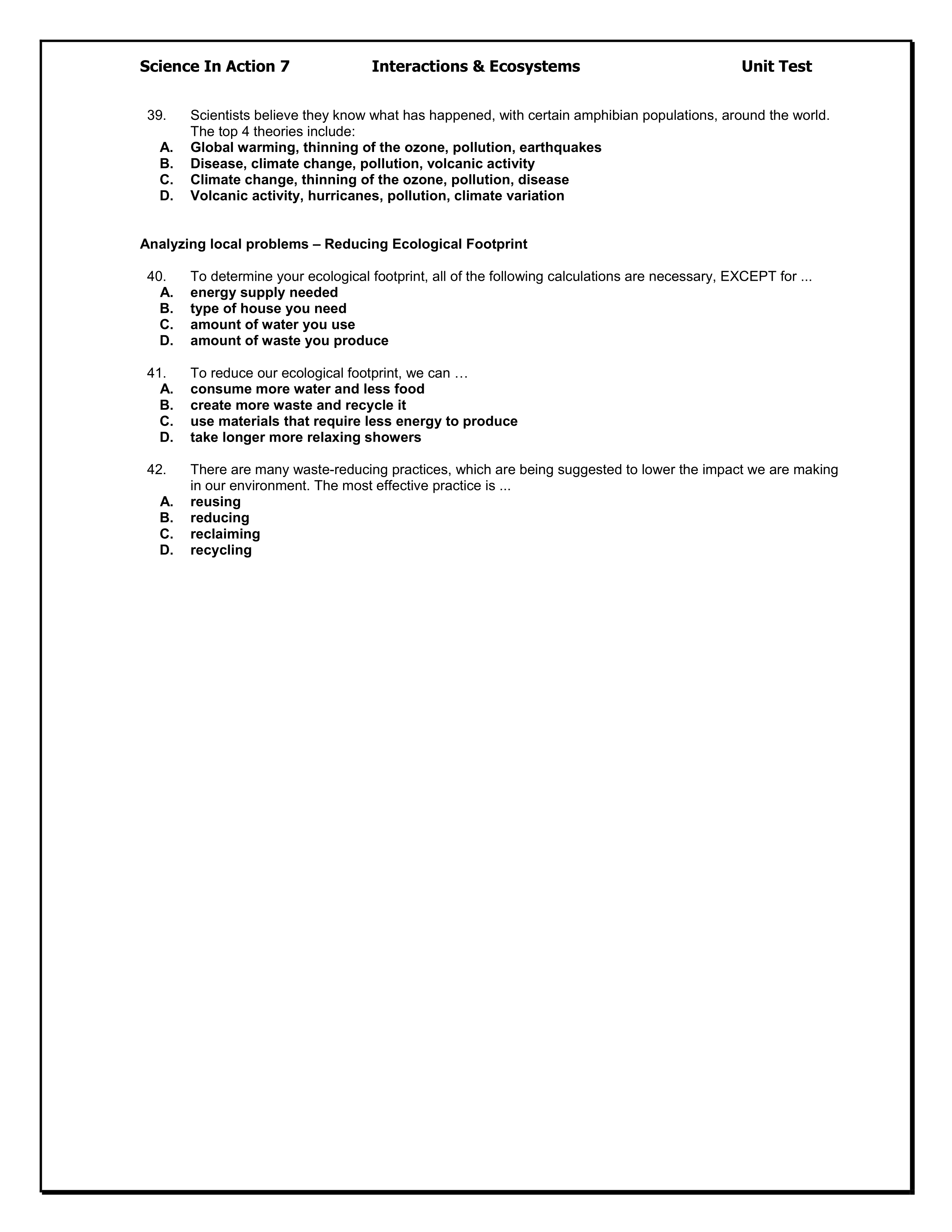
Scientists believe they know what has happened, with certain amphibian populations, around the world. The top 4 theories include:
An ecosystem thrives with biotic & abiotic parts. An example of an abiotic part of an ecosystem is ...
Which of the following should be classified as a community ?
Living things have basic needs. Throughout the first section in this unit the needs of living things were examined in depth. The four basic needs of living things are:
A particular relationship where one organism benefits (like a tree orchid – which receives access to sunlight) and the other organism (the tree) is not harmed or helped is called ...
The relationship where both organisms help each other - such as the goby fish and the snapping shrimp
is called ...
Because some of the lamprey’s victims die after it has attached itself to its host, the relationship that exists is considered to be ...
The beaver population in Yoho National Park has declined due to ...
100,000 toads are killed on highways in England each year. To prevent the extinction of this population the government has provided ...
A clay liner and a system of pipes is used in a sanitary landfill to ...
Organisms in an ecosystem can be classified as producers or consumers. The producers provide food for the consumers. An organism that consumes both producers and other consumers is called a ...
Which of the following word equations describes cellular respiration ?
Decomposers – known as the clean-up crew - are the decomposers. Scavengers also get rid of the waste in an ecosystem. Scavengers differ from decomposers because they ...
Which of the following decomposers are helpful?
Rank the following members of an ecosystem Carnivores – Herbivores - Producers in terms of their numbers. Highest to lowest.
A plant uses most of the energy it gets from the Sun to support it’s life functions. The following percentage represents the amount of energy that a plant provides to a consumer, such as a herbivore.
What happens to ‘waste’ energy in an ecosystem?
The members of different food webs are interdependent. When changes in these occur in an ecosystem food web, which of the following would affect the members of that food web?
Food chains and food webs are models in science, which visually show us the different relationships within an ecosystem. The primary difference between the food chain and the food web is ...
In a meadow food web, what would happen to the owl, if a pesticide killed all of the grasshoppers? (which btw owls do eat)
All living things need water to live. The water cycle has four main processes. The two processes that return
water to the earth are ...
The process in which water, goes through a change of state, from a gas to a liquid, is called ...
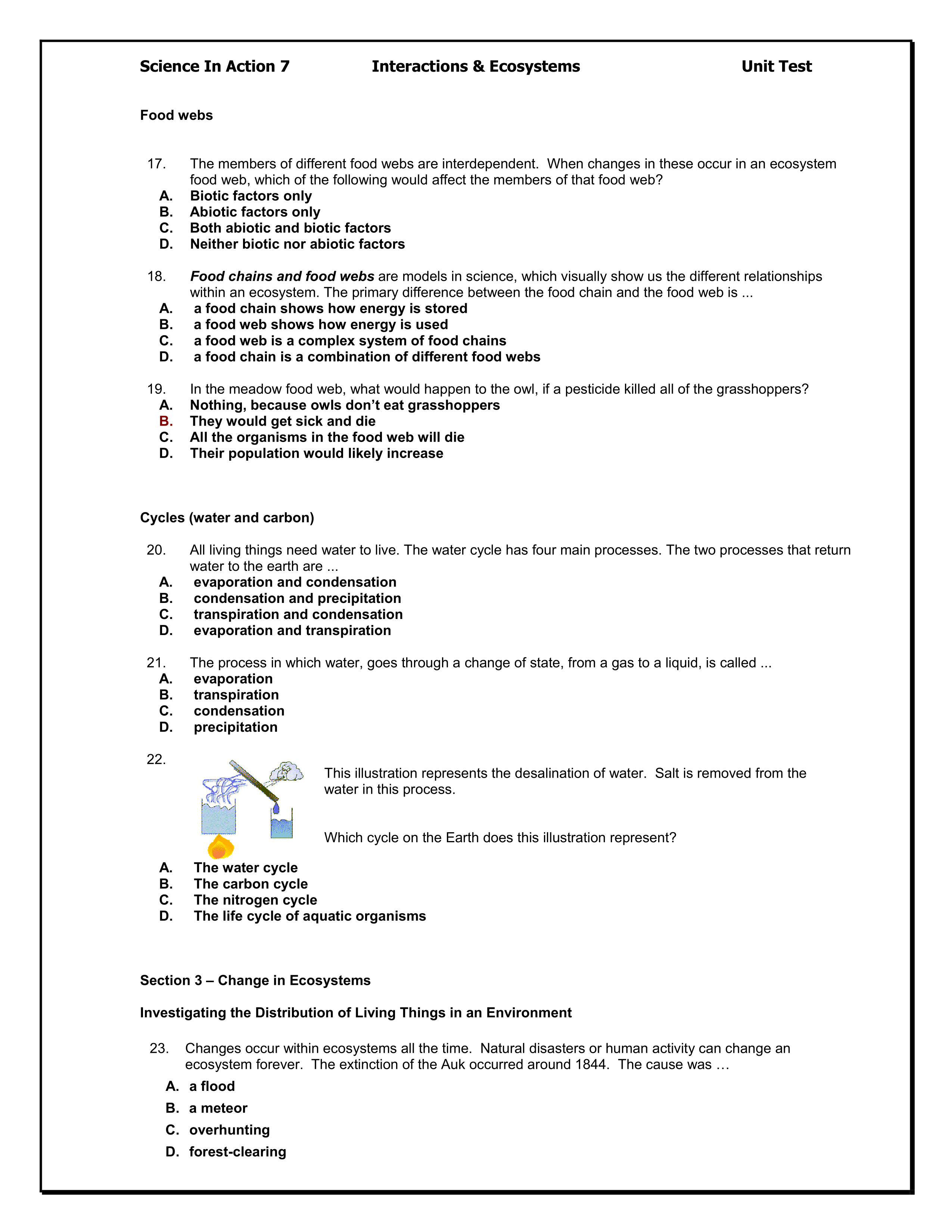
The illustration represents the desalination of water. Salt is removed from the water in this process.
Which cycle on the Earth does the illustration represent?
Changes occur within ecosystems all the time. Natural disasters or human activity can change an ecosystem forever. The extinction of the Auk occurred around 1844. The cause was ...
When students studied their schoolyard to identify what human impact had on the numbers of organisms
they recorded their data in a table. Two places where they likely studied were the ...
A long-term change to an ecosystem will likely occur as a result of this type of human impact ...
The introduction of a new species to an area will likely negatively impact the native species in that area. Scientists call this introduction of new species ...
Purple loosestrife has taken over many wetland and marshy areas. Because this was first introduced from Europe, it is not considered to be ...
The overabundance of European starlings causes problems in farmer’s fields and hazards at airports. This introduced species competes with other birds, such as bluebirds, woodpeckers and flycatchers for ...
The first living species to arrive in an area are usually alga and fungus. Together their mutual relationship is visible in their form they can be observed - lichen. Lichen grows on bare rock and is considered to be the ...
When populations of many different species grow and replace one another within a particular area, a stable
community of a diverse number of species that is not easily replaced by other communities will result. This
is called a ...
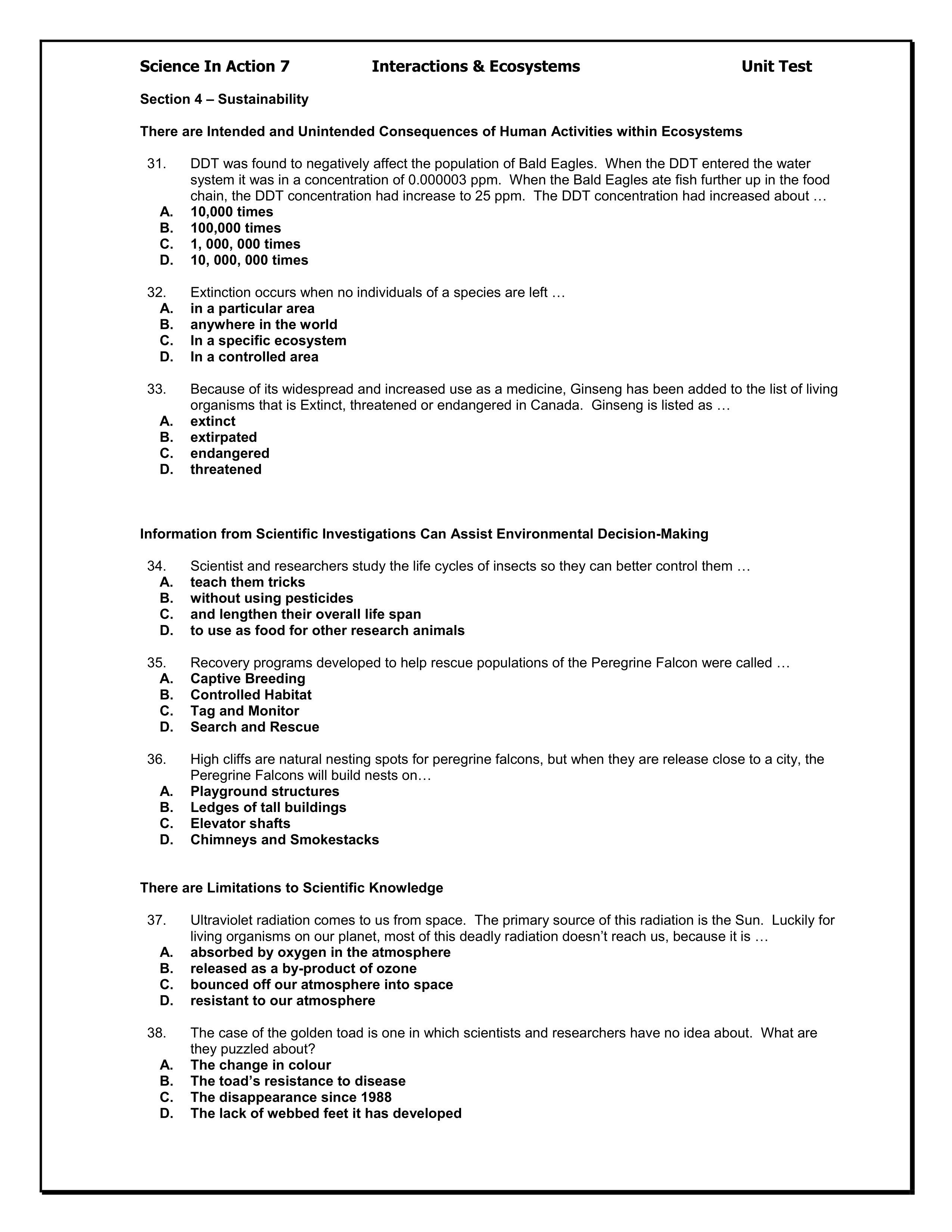
DDT was found to negatively affect the population of Bald Eagles. When the DDT entered the water system it was in a concentration of 0.000003 ppm. When the Bald Eagles ate fish further up in the food chain, the DDT concentration had increase to 25 ppm. The DDT concentration had increased about ...
Extinction occurs when no individuals of a species are left ...
Because of its widespread and increased use as a medicine, Ginseng has been added to the list of living organisms that is Extinct, threatened or endangered in Canada. Ginseng is listed as ...
Scientist and researchers study the life cycles of insects so they can better control them ...
Recovery programs developed to help rescue populations of the Peregrine Falcon were called ...
High cliffs are natural nesting spots for peregrine falcons, but when they are release close to a city, the Peregrine Falcons will build nests on...
Ultraviolet radiation comes to us from space. The primary source of this radiation is the Sun. Luckily for living organisms on our planet, most of this deadly radiation doesn’t reach us, because it is ...
The case of the golden toad is one in which scientists and researchers have no idea about. What are they puzzled about?
To determine your ecological footprint, all of the following calculations are necessary, EXCEPT for ...
To reduce our ecological footprint, we can ...
There are many waste-reducing practices, which are being suggested to lower the impact we are making in our environment. The most effective practice is ...