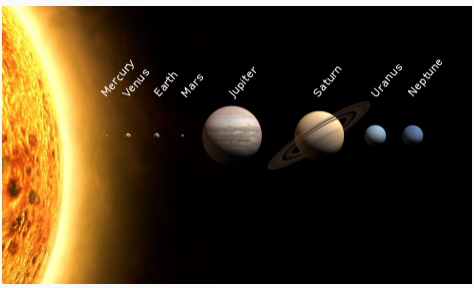
Scale of Solar System

Last updated about 5 years ago
8 questions
Note from the author:
Scale of the solar system
1

Success Criteria:

  1. Each person will complete their own Formative.
  2. When neccessary, all members have access and can see the work on a shared screen.
  3. Each discussion question should take about 3-5 minutes. Check to make sure others are ready to move on.
  4. All voices are heard during the discussion.
  5. Time to think is provided.
  6. When a talk tip is provided, it is used as people build on each other’s ideas.
  7. All recorded responses reflect a collective discussion.

1

Discuss and add what you already know about space to the brain image.

1

Predict:

Make a predictive sketch of the relative sizes and distance for each planet or star in the solar system including: Sun, Mercury, Venus, Earth, Mars, Jupiter, Saturn, Uranus, Neptune, and minor planet Pluto. Don't look anything up, just show me what you know, or predict how masive they are compared to one another and approximate distance apart (no need to be exact).

Absorb

Watch the video below. You can watch it together by sharing your screen or individually. Work with your group to answer questions 2-3 . Watch is as many times as you need.
1

Do you think there is complex life outside our solar system (sun + planets that orbit it)? Explain why or why not.

1

How did the video make you feel about the size and scale (distances) of objects in the Universe?

Absorb

Watch the video below. You can watch it together by sharing your screen or individually. Talk with your group about what was interesting or surprising in this video. Watch is as many times as you need. Then answer question 6.
1

Reflect:

After watching the video of the group of folks who built a model solar system in the desert, what was surprising or interesting to you?

This is a group lab, work with your team in your webex break out room to: analyze data about the solar system, and then create a scale model of our solar system using objects at your home.

Please make sure the objects you choose best represent the size of the planets in our solar system, and use the distance data to measure the distance each object is from the Sun.

Watch the video below for an example of how other people built a scale model of our solar system in the desert.
Look at the data tables and the image of the solar system taken from wikipedia. Describe 2 reasons why the picture from wikipedia is an inaccurate model of the solar system.
What objects in your home could appropriately represent each of the outer planets (look at their diameter)?


Next, think about how you will measure distance from sun for each planet. What unit of measure could you use instead of A
1

Plan a model of the solar system that portrays the size and distance of each planet and the sun in our solar system. Make sure to reference the data tables in your model.
Remember that a model tries to explain something that is too big or too small to see. A model might include:
  • objects
  • labels
  • arrows or lines
  • pictures
  • distance
Brainstorm first in your group. Discuss in your group what materials you could use to represent each planet, and our sun as well as how you can measure distance from sun with materials you have at your home.
Show Your Work

Build a small model of the the solar system with materials you have in your home. Use the information you developed with your group or individually in question 4. Your model can be built inside or outside, please make sure you clean up after you are finished.
1) Build a model
2) Take a picture or a video
3) Turn in your video or picture to the Canvas assignment called "Solar Scale System Model".
1

Reflect

At the beginning of class you picked a quality of being a scientist that you wanted to focus on today. How did you do with this? What evidence do you have for this?
Example, "I did an OK job of being patient. I found myself frustrated with the technology drawing tool. You can see this in my model because I didn't get very far with it."