1
1
1
Explain your answer for number 2.
Explain your answer for number 2.
1
1
Explain your answer to #4.
Explain your answer to #4.
1
Explain your answer for number 2.
Explain your answer to #4.
Why do you think the activated complex is called the transition state?
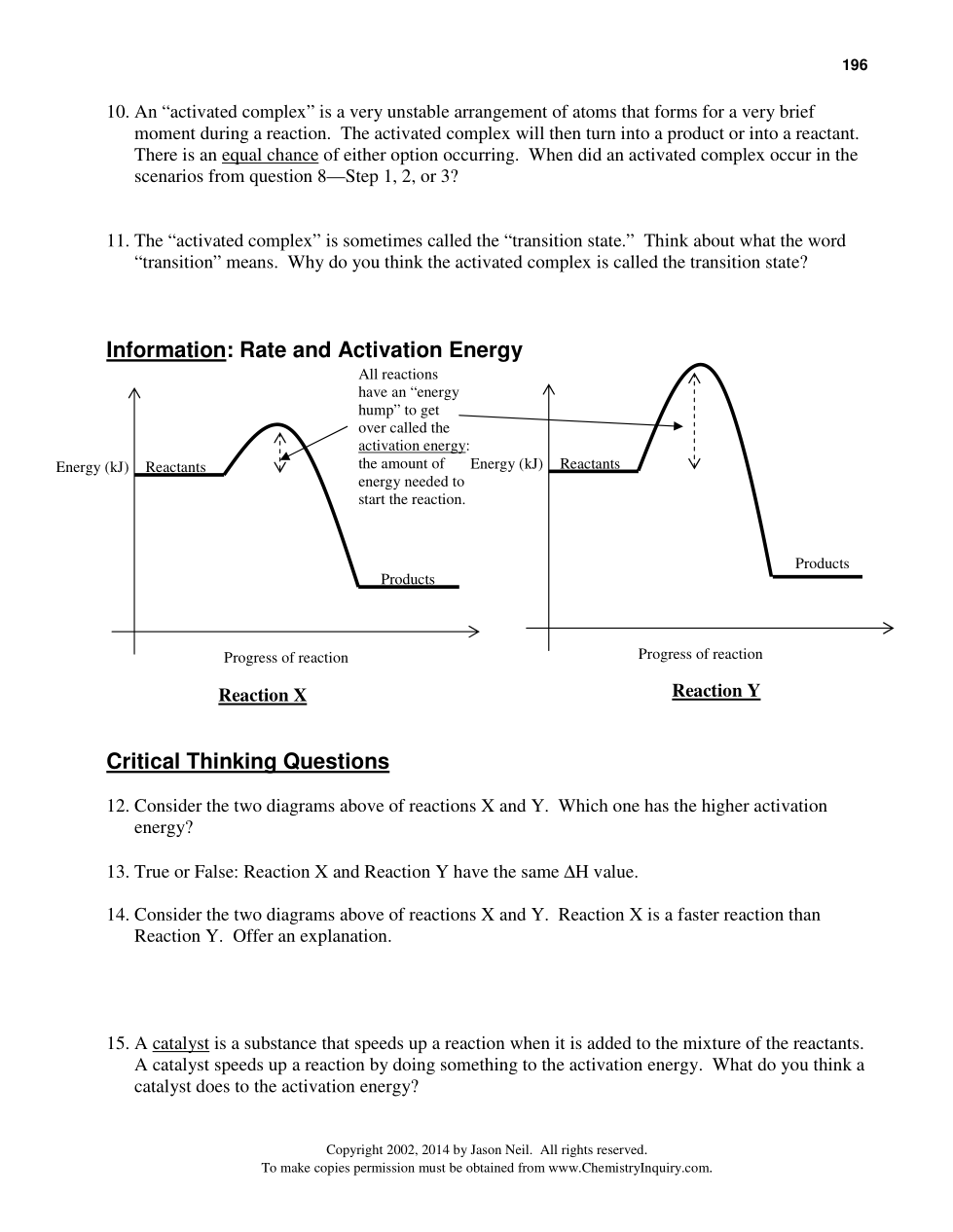
Why is Reaction X a faster reaction then Reaction Y?
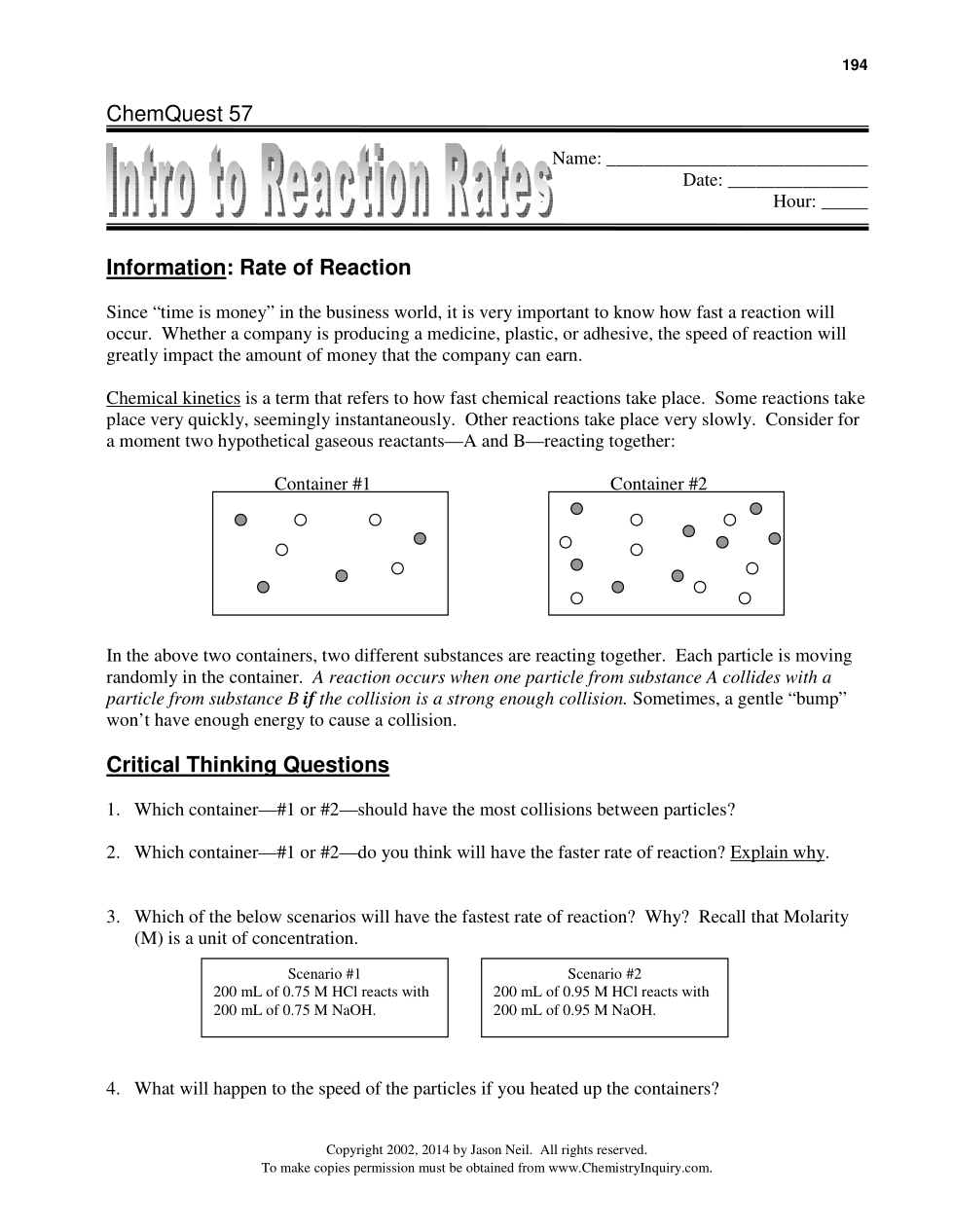
Which container should have the most collisions between particles?
Which container should have the faster rate of reaction?
Since molarity is a unit of concentration, how much of a substance is present (the bigger the number, the more of it), which scenario will have the fastest rate of reaction?
What will happen to the speed of the particles if you heated up the containers? Recall that thermal energy is the kinetic (motion) energy of the molecules and atoms.
If the particles are heated up, what will happen to the energy of the particles' collisions?
Will the collisions have more or less energy?
Again, consider heating up a container of particles. Will there be more collisions or fewer collisions after heating them up.
Given your answer to questions 7-10 what happens to the rate of the reaction if you increase the temperature of the reactants?
Write two reasons why.
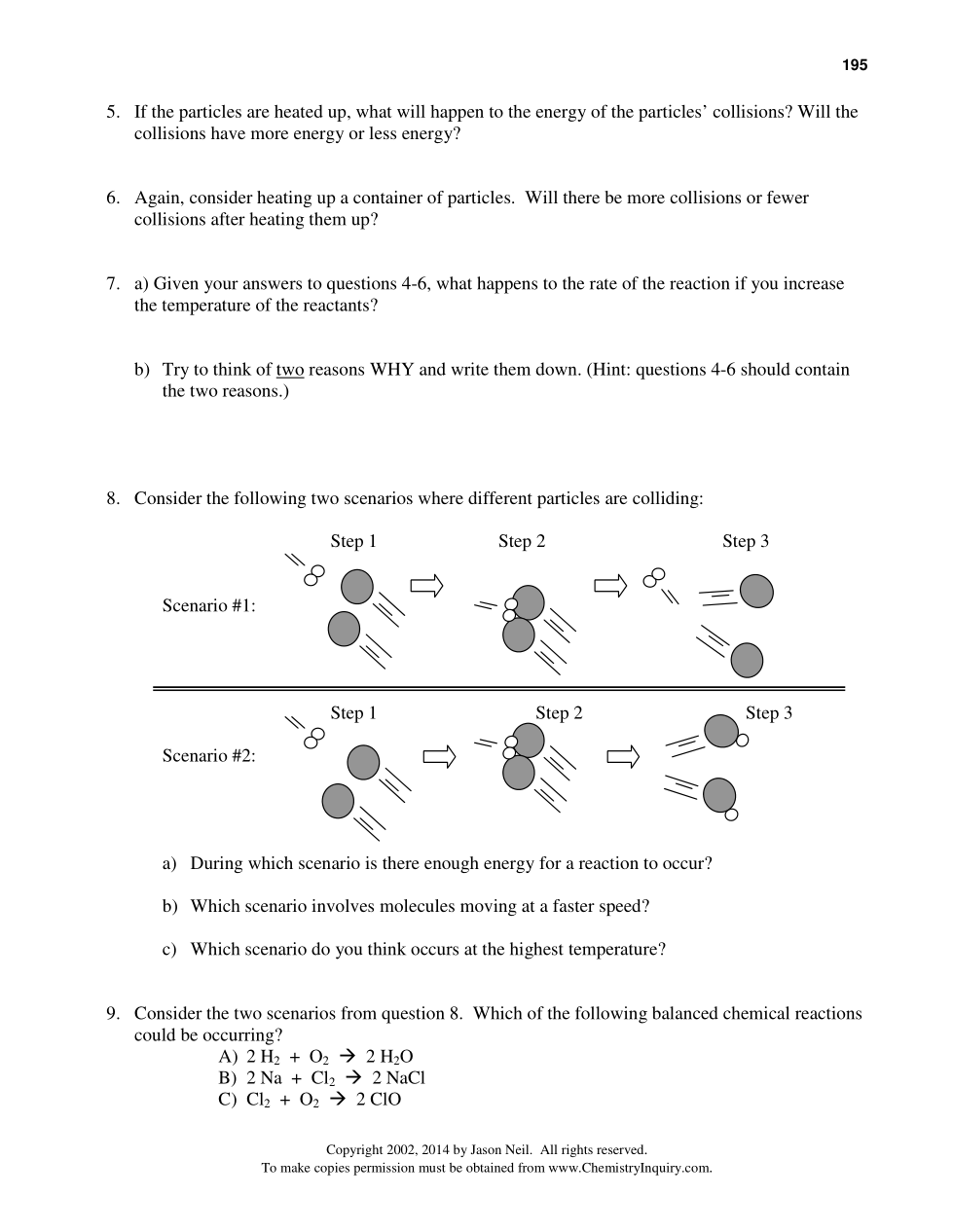
During which scenario is there enough energy for a reaction to occur?
Which scenario involves molecules moving at a faster speed?
Which scenario do you think occures at the highest temperature?
Using the diagrams of the previous scenarios, which of the listed reactions could be occuring?
When did an activated complex occur im the scenario from question 8?
Consider the two diagrams above of reactions X and Y. Which one has the higher activation energy
If delta H is the change in energy is this statement true or false: Reaction X and Reaction Y have the same delta H value.
What do you think a catalyst does to the activation energy?
Redraw the energy diagram to show what happens after a catalyst is added.
Which version of the sugar has the greatest surface area?
Which version of the sugar would dissolve fastest in water?
The greater the surface area of the substance, the ____ the reaction rate.
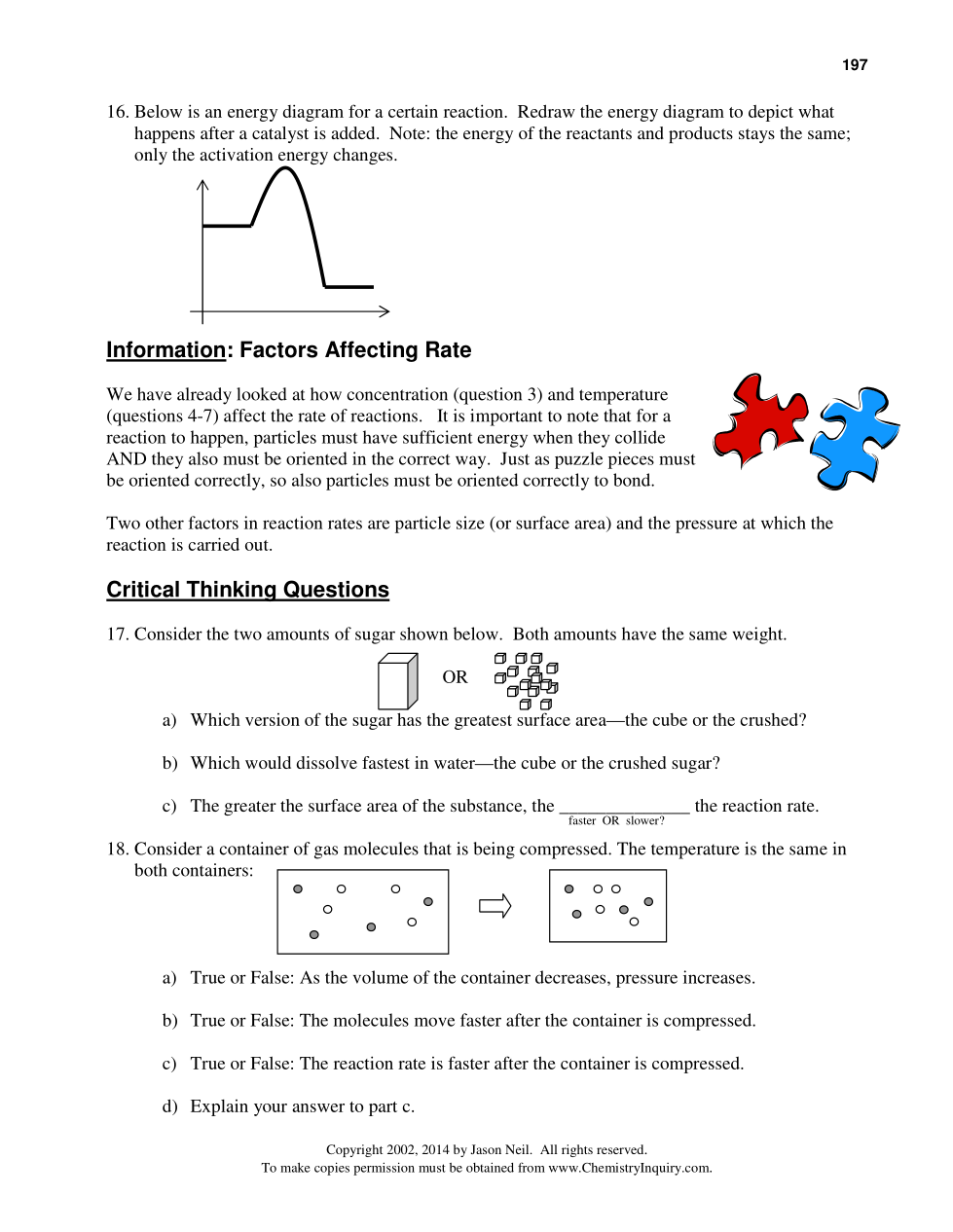
As the volume of the container decreases, pressure increases.
The molecules move faster after the container is compressed.
The reaction rate is faster after the container is compressed.
Explain your answer to 28.