Log in
Sign up for FREE
arrow_back
Library
HPC WB4.1 Inverse Relations and Functions
By Nichole Raiewski
star
star
star
star
star
Share
share
Last updated over 5 years ago
9 questions
Add this activity
10
F.BF.4.a
F.IF.1
10
F.IF.1
10
F.BF.4.a
F.BF.4.c
F.IF.1
1
zoom_in
10
Question 1
1.
What is the inverse of
f
? Is the inverse a function?
A
B
C
D
F.BF.4.a
F.IF.1
2
zoom_in
10
Question 2
2.
What is the inverse of
f
? Is the inverse a function?
A
B
C
D
F.BF.4.a
F.IF.1
3
zoom_in
10
F.BF.4.a
F.IF.1
4
zoom_in
10
Question 4
4.
A
B
C
D
F.BF.4.a
5
zoom_in
10
Question 5
5.
A
B
C
D
F.BF.4.a
6
zoom_in
10
F.BF.4.a
Question 8
8.
Reasoning:
A function consists of the pairs (2, 3), (
x
, 4), and (5, 6). What values, if any, may
x
not assume?
For the relation to be a function,
x
may not assume 2 or 5.
x
may assume any real number and the relation will still represent a function.
For the relation to be a function,
x
may not assume 3, 4, or 5.
For the relation to be a function,
x
may not assume 2, 3, 4, 5, or 6.
Question 9
9.
Reflection:
Math Success
visibility
View drawing
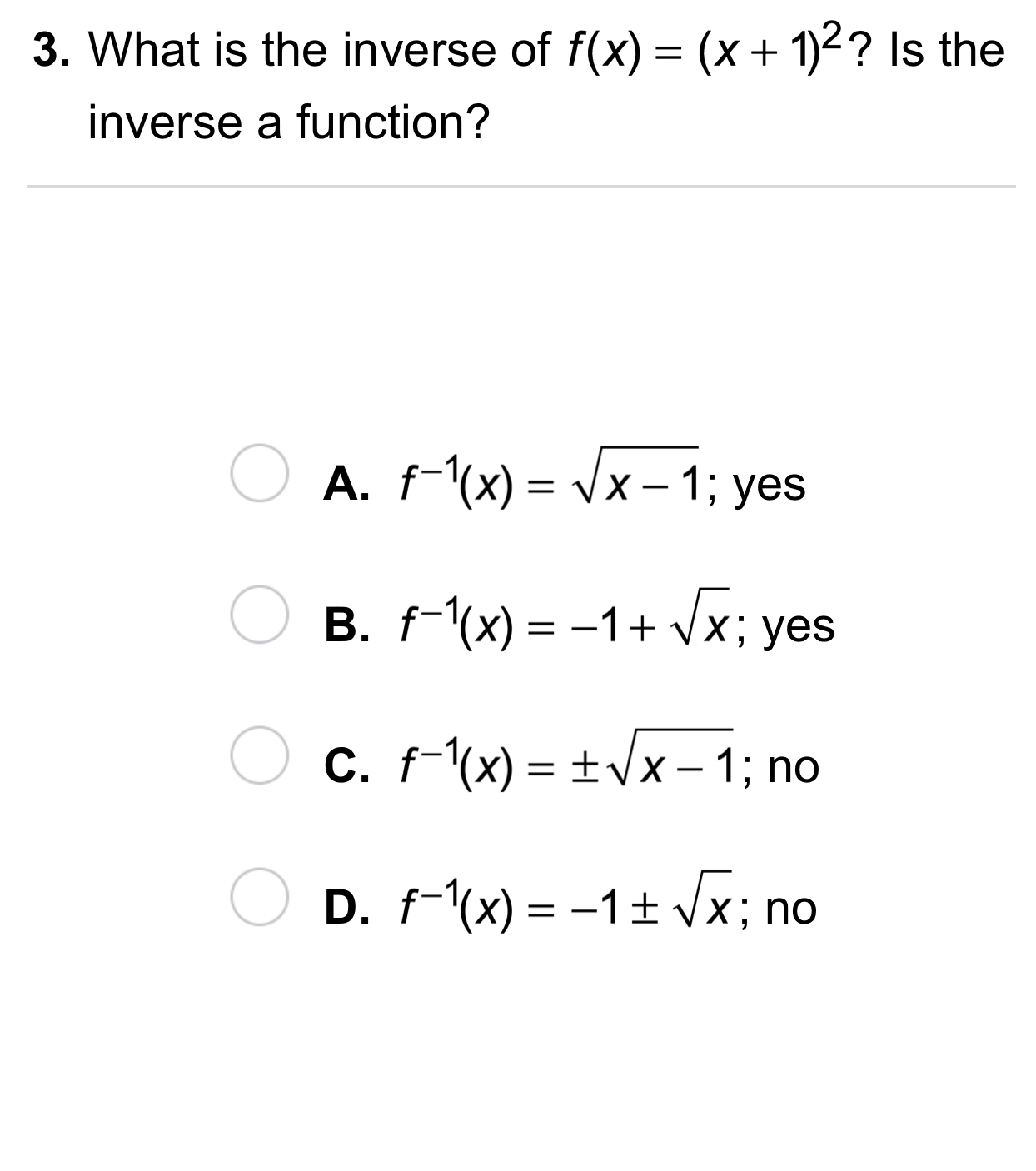
Question 3
3.
What is the inverse of
f
? Is the inverse a function?
A
B
C
D
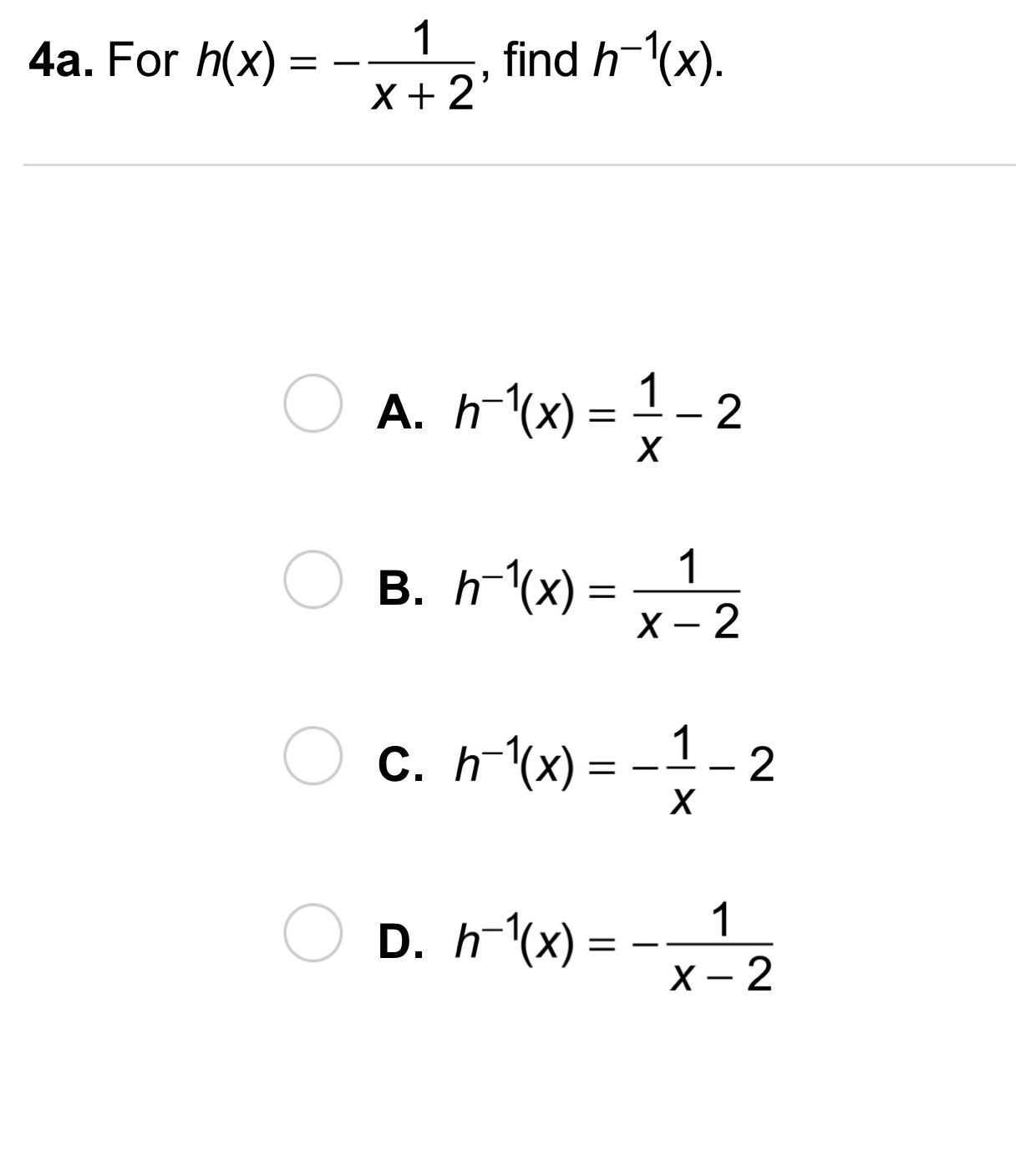
Question 6
6.
For
h
, find the value for
x
for which the equality
(
h
◦
h
-1
)(
x
) =
x
does not hold.
A
B
C
D
