Describe what happens to the plates at a divergent plate boundary and draw the movement with ARROWS in the box.
1 point
1
Question 4
4.
Describe what happens to the plates at a convergent plate boundary and draw the movement with ARROWS in the box.
1 point
1
Question 5
5.
Match the three types of CONVERGENT plate boundaries with their land formations
Draggable item
arrow_right_alt
Corresponding Item
Continental - Continental
arrow_right_alt
Mountains
Oceanic - Continental
arrow_right_alt
Mountains, volcanoes
Oceanic - Oceanic
arrow_right_alt
Trench, island arcs, volcanoes
1 point
1
Question 6
6.
Describe what happens to the plates at a transform plate boundary and draw the movement with ARROWS in the box.
1 point
1
Question 7
7.
A zone of active volcanoes that encircles the Pacific Ocean
1 point
1
Question 8
8.
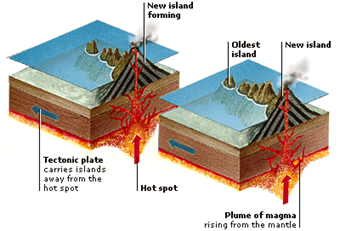
Why do hotspots occur?
1 point
1
Question 9
9.
At the boundaries between tectonic plates, sudden movements that are created when the plates slide past each other are called
1 point
1
Question 10
10.
What happens to magma at divergent boundaries?
1 point
1
Question 11
11.
What is the subduction zone?
Plates move in THREE basic ways. Let’s take a look at each.
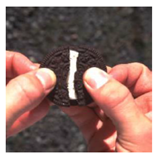
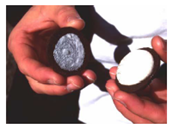
Choose a cookie. Don’t eat it… yet!
· First, carefully remove the upper cookie (you must twist it!)
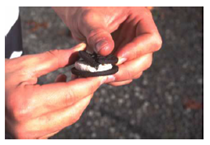
· Slide the upper cookie over the creamy filling. This motion simulates the movement of a rigid lithospheric plate over the softer asthenosphere.
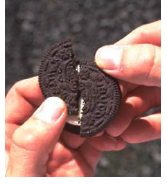
· Next, break the upper cookie in half. As you do so, listen to the sound it makes.
1 point
1
Question 12
12.
What sound do you hear (describe it)?
1 point
1
Question 13
13.
What does that breaking represent?
1 point
1
Question 14
14.
Let’s look at divergent plate boundaries. Divergent means
1 point
1
Question 15
15.
Now push down on the two broken cookie halves and slide them apart. What happens to the creamy filling?
1 point
1
Question 16
16.
What does this represent?
1 point
1
Question 17
17.
Now let’s look at convergent plate boundaries.Convergent means to
1 point
1
Question 18
18.
Take the two cookie halves and slowly push them toward each other. What happens to the filling as the plates slide together?
1 point
1
Question 19
19.
What happens to the cookies as they push against each other?
1 point
1
Question 20
20.
What does this represent?
1 point
1
Question 21
21.
Now let’s look at a transform plate boundary. Try sliding the two cookie pieces laterally past one another, over the creamy filling. What do you notice about the cookie edges?
1 point
1
Question 22
22.
You can feel and hear that the “plates” do not slide smoothly past one another, but rather stick and then let go. This phenomenon in the real world is described as
1 point
1
Question 23
23.
Some of Earth’s landforms are created by hotspots where a plate rides over a fixed “plume” of hot mantle, creating a line of volcanoes. Imagine if a piece of hot, glowing coal were imbedded in the creamy filling – a chain of volcanoes would be burned into the overriding cookie. Name a location on Earth where this occurs.