Calculate the relative atomic mass using hte following mass spectrum data for Rubidium.
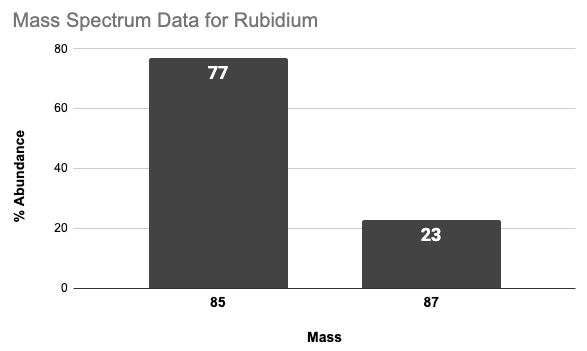
Calculate the relative atomic mass using hte following mass spectrum data for Rubidium.
IB Chemistry SL
Topic 1.1 Matter & Change
Topic 2.1 Atomic Structure
Which process happens as a substance changes from the liquid state to the gaseous state?
Which state of matter has a fixed volume and takes the shape of the container?
Which of the following is compound?
Which of the following is a homogenous mixture?
Which statement about the numbers of protons, electrons and neutrons in a neutral atom is always correct?
What is the difference between two neutral atoms represented by the symbols 5927Co and 5928Ni?
How many electrons are there in one 2412Mg2+ ion?
Consider the composition of the species, W, X, Y and Z below. What species is an anion?
What is the correct number of each particle in a fluoride ion, 19F-1?
A certain sample of element Z contains 60% of 69Z and 40% of 71Z. What is the relative atomic mass of element Z in this sample?
List the symbol for each of the following: Liquid, Solid, and Gas
State the parts of a chemical equation in the correct format.
State the name and number of each element represented in the compound: NaCl
State the name and number of each element represented in the compound: K3PO4
State the name and number of each element represented in the compound: Ca(OH)2
State the relative mass and charge for the subatomic particle of an atom: proton
State the relative mass and charge for the subatomic particle of an atom: electron
State the relative mass and charge of the subatomic particle of an atom: neutron
Define the term Mass Number (A).
Define the term Atomic Number (Z).
Define the term ion.
Define the term isotope.
The element vanadium has two isotopes, 5023V and 5123V, and a relative atomic mass of 50.94. State the number of protons, electrons and neutrons in 5023V.
The element vanadium has two isotopes, 5023V and 5123V, and a relative atomic mass of 50.94. State and explain which is the more abundant isotope.
Chlorine exsists as two isotopes, 35Cl and 37Cl. The relative atomic mass of chlorine is 35.45. Calculate the percentage abundance of each isotope.
Calculate the relative atomic mass using hte following mass spectrum data for Rubidium.