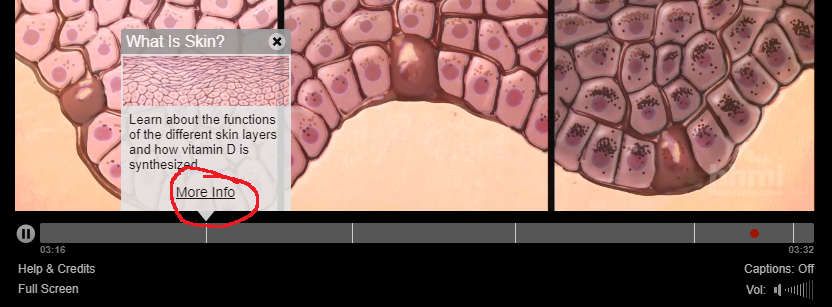
Stop number 1: Hover over the first verticle line: "What is Skin?" and click 'more info'
Make sure you click around the interactive to explore it to answer the questions below:
Before you begin, think about your skin. It covers your entire body! What questions do you
have about skin and skin color?
Stop number 1: Hover over the first verticle line: "What is Skin?" and click 'more info'
Make sure you click around the interactive to explore it to answer the questions below:
Match the 'skin layer' with the description of its function:
| Draggable item | arrow_right_alt | Corresponding Item |
|---|---|---|
Dermis | arrow_right_alt | The layer that protects the body from most physical objects (except certain gases) and produces vitamin D. |
Hypodermis | arrow_right_alt | The layer that helps the body control its temperature using the vessels, glands, and nerve endings within it |
Epidermis | arrow_right_alt | The layer that insulates the body with fat cells that can also be used for energy when needed |
Why is vitamin D important to our health? Select all that apply:
What is the connection between skin, sunlight, and Vitamin D?
Case study: you are a pediatrician and one of your young patients is at risk for rickets. Outline a treatment you would recommend to the child and their parents, and justify why:
Go back up to the interactive at the top of the page and click on the second verticle line and click "more info"
Stop Number 2: What are skin cells?
Re-order the items below into the correct life cycle of a "Keratinocyte:"
Keratinocytes form from stem cells at the bottom of the epidermis
Keratinocytes move upward while increasing keratin production
Keratinocytes keep the body waterproof until they fall off
Keratinocytes stop dividing
Keratinocytes die
Where do keratinocytes get their name?
Select all the true statements about Melanocytes
Approximately when did our ancestors become mostly hairless?
Looking at the timeline of evolution, what else do you notice changing as hair gets less dense in populations?
What was the primary advantage of having less hair for early homo species? How do you think that helped early homo species survive to reproduce more effectively?
Go back up to the interactive at the top of the page and click on the third verticle line and click "more info"
Stop Number 3: What is Melanin?

Write in the word that goes with each blank:
What are the two primary types of melanin and how do they differ?
Explain how the amount of eumelanin and number of melanosomes differ between a
person with lighter color skin and a person with darker color skin.
Which type of melanin is produced by the version of the MC1R gene (i.e., the MC1R allele) that is most prevalent among people of African ancestry??
Overall, human DNA on the African Continent is the most diverse of any continent, but the MC1R gene is less diverse in populations in equatorial Africa. Why might that be?
Why does the body need to protect itself from UV light?
Explain how the body uses melanocytes to protect itself:
Note: saying how something happens involves describing all the steps
"Mutations" are "Errors in the DNA sequence" - this happens when...
The answer to the multiple choice above is (C) - prove to me that you understand this process by describing how UV radiation causes mutations in DNA:

Fill in the blank:
What are the positive and negative effects of UVB exposure?
Play with the map of the world by sliding the double-arrowed circle.
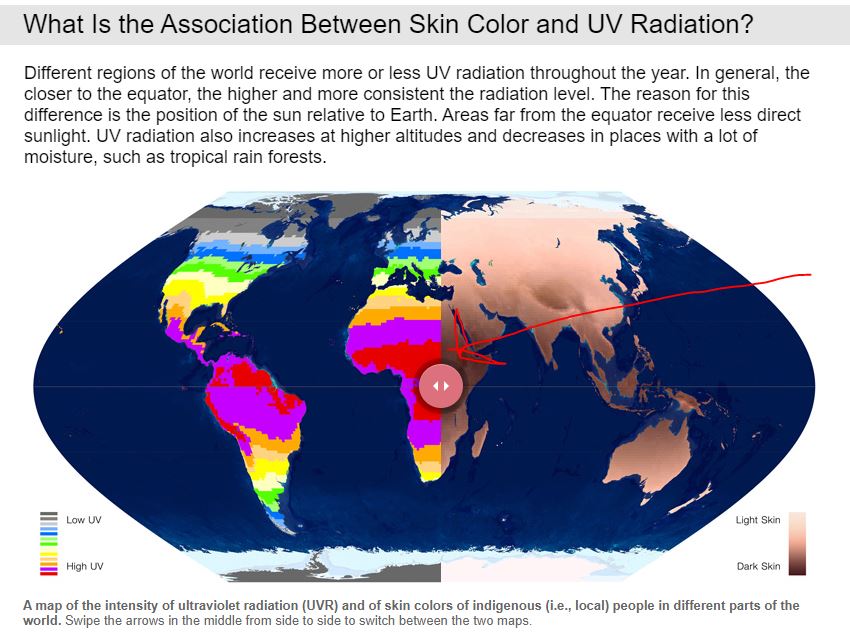
What do you notice? What do you wonder?
Which of these is an environmental advantage to having darker skin color?
Which of these is an environmental advantage to having lighter skin color?
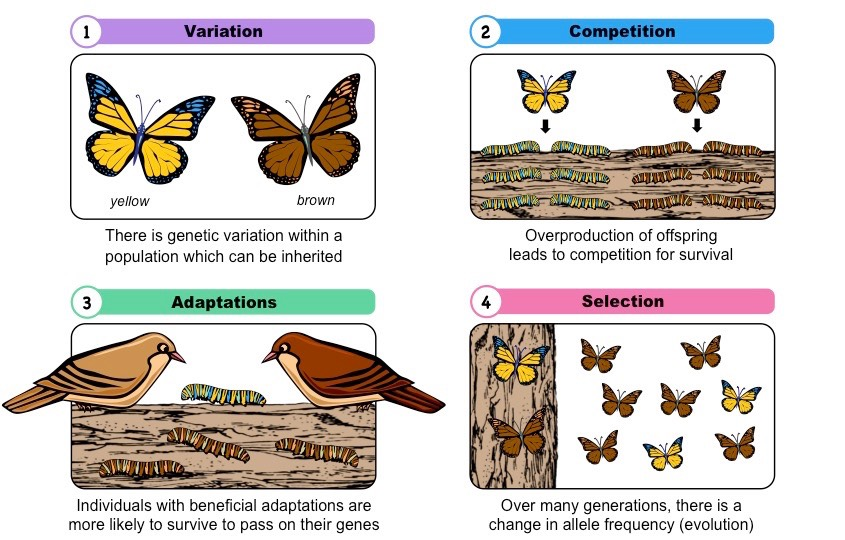
Explain how the relationship between skin color and UV radiation provides evidence that
this trait evolved by natural selection:
Watch the last video and answer the question: How does sunlight cause tanning?
Your friend, who tans easily, argues that it’s great to get a tan because darker skin
pigmentation offers lots more protection from damaging UV radiation, so he’s keeping
himself safe. Write a response to convince him otherwise:
Fill in the blank: