Log in
Sign up for FREE
arrow_back
Library

Matter Celebration

star
star
star
star
star
Last updated over 5 years ago
26 questions
1
1
1
1
1
1
1
1
1
1
1
2
2
2
1
1
5
6
1
1
1
1
1
1
1
1
Question 1
1.

Question 2
2.

Question 3
3.

Question 4
4.

Question 5
5.

Question 6
6.

Question 7
7.

Question 8
8.

Question 9
9.

Question 10
10.

Question 11
11.

Question 12
12.

List two examples of a liquid.

Question 13
13.

List two examples of a gas.

Question 14
14.

List two examples of a solid.

Question 15
15.

Identify one example of matter.

Question 16
16.

Identify one example that is NOT matter.

Question 17
17.

Question 18
18.

Question 19
19.

Question 20
20.

Question 21
21.

Question 22
22.

Question 23
23.

Question 24
24.

Question 25
25.

Question 26
26.

Which of the following is a chemical change?
a. water evaporating
b. Carbon and Oxygen forming Carbon dioxide
c. a person blushing
d. ice cream melting
What happens during a physical change?
a. new substances are formed
b. the identity of the substance is changed
c. a chemical reaction occurs
d. a substance may look different
Which of these is a physical change?
a. paper burning
b. iron rusting
c. new substances forming
d. cutting an orange
Which one can cause a change in the state of matter of a substance?
a. light
b. heat
c. sound
d. wind
Which is an example of a chemical change?
a. a scientist melts ice to a liquid
b. a scientist shapes melted glass into a cylinder
c. a scientist grinds an iron rod to make iron filings
d. a scientist mixes sodium and choride to make salt
A solid has ___________________________
a. definite volume and definite shape
b. no definite volume and no definite shape
c. a definite volume but no definite shape
d. no definite volume but definite shape
Which is an example of a gas?
a. wood
b. oil
c. ice
d. water vapor
Which of the following is a clue that a chemical change is occurring?
a. its state
b. its smell
c. heat
d. how it freezes
Which of the following is a physical change?
a. bleach changes the color of fabric
b. crushing a can
c. a car rusts
d. silver tarnishes
A substance with a definite volume that takes the shape of its container is a:
a. property
b. gas
c. liquid
d. solid
Use the following chart to answer the question below.
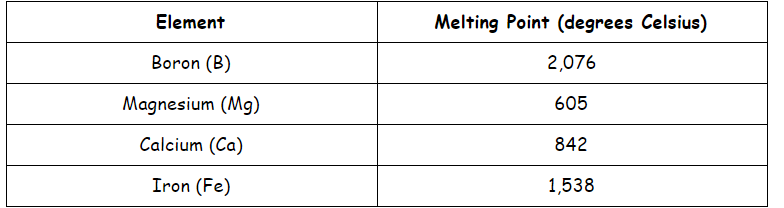

A group of scientists are studying how elements change from solids to liquids. They create small bricks of boron, magnesium, calcium, and iron, Each brick is 1 cm cubed. They place the bricks in an oven and gradually heat them to 1,000 degrees Celsius. At that temperature, which pair of bricks will still be in a solid state?
a. Boron & Iron
b. Calcium & Iron
c. Magnesium & Boron
d. Magnesium & Calcium
Drag the word to the correct definition.
atom
nucleus
electron
proton
neutron
The subatomic particle that has no charge
The subatomic particle that has a negative charge
The smallest particle of an element
The center of an atom that contains protons and neutrons
The subatomic particle that has positive charge
Drag the word to the correct definition.
boiling point
freezing point
volume
mass
melting point
grams
the measure of how much matter is in an object
the amount of space that something takes up
the temperature where a substance becomes a gas
the temperature where a substance changes from a solid to a liquid
mass is measured in __________
the temperature where a substance changes from liquid to a solid
True or False. Teeth crushing food is a physical change.
True
False
True or False. Bending a nail with a hammer is a chemical change.
True
False
True or False. Water changes to steam is a chemical change.
True
False
True or False. Scientists mixing Sodium and Chloride to make salt is a chemical change.
True
False
True or False. Stomach acids dissolving pizza is a chemical change.
True
False
True or False. A match stick turns to ash is a physical change.
True
False
True or False. Snow melting is a physical change.
True
False
True or False. An iron pipe rusting is a chemical change.
True
False