Flame Test and Bright Line Spec Lab

Last updated about 5 years ago
6 questions
Bohr proposed that an electron is found only in specific circular paths, or orbits, around the nucleus.  As a result, each orbit has a fixed energy called an energy level.  These energy levels (orbits) are like  the rungs of a ladder (See Figure A). 
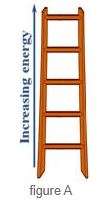

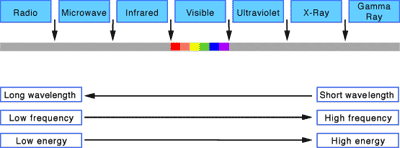
The electrons cannot be found in between these energy levels, just like a person cannot stand in between the rungs.  Electrons must gain energy (become excited) to move up energy levels.  Electrons can become excited by heat, light, electricity etc.  These high energy electrons are unstable and eventually fall back down to their lower energy levels (ground states) releasing the energy that they had gained when they were initially excited.  This energy is released in the form of light and it is what Bohr observed.  White light will produce a continuous spectrum when viewed using a prism or spectroscope.  Different colors of light have different energies.  (see Figure B)

When electrons of an atom are excited they will release different colors of light as they fall back to ground state (this is called emission line spectra).  The colors of light correspond to the amount of energy released (See Figure C). 
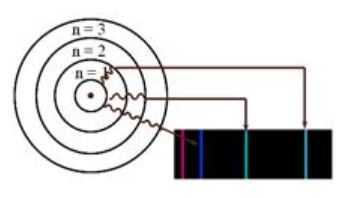
Using a spectroscope you can view the emission line spectra.  Different elements produce different spectra that are unique enough to be considered a “fingerprint” of the element.

Purpose: Using a flame test and a spectroscope, determine the emission line spectrum of various known ions. Then determine the identity of 2 unknown ions using a flame test and the emission line spectra from the known ions.
1

Place the colors in the continous spectrum in order from the shortest wavelength to the longest wavelength.

  1. Yellow
  2. Blue
  3. Orange
  4. Violet
  5. Green
  6. Red
Part 1: Emission Spectroscopy

To access the emission spectra for various elements click HERE.
Observe the spectra lines that are produced for each element. In data table 1 draw lines under each letter representing the colors that you observed. (V= violet, B= blue, G= green, Y= yellow, O= orange, & R= red ...Indigo was left out because it is difficult to distinguish in this activity).
1

Data Table 1: Bright Line Spectra of Selected Elements

To access the emission spectra for unknown elements click HERE. Choose 2 and fill out the data table below.
1

Data Table 2: Bright Line Spectra of Unknown Elements

Part 2: Flame Test

Hybrid Students will perform the flame test using a bunsen burner and metal ion samples
Procedure:
  1. Using a clean wood splint, place the splint into the solution in the test tube
  2. Leave the splint in the solution for 10 seconds
  3. Hold the splint in the hottest part of the flame (being careful not to allow the wood to burn)
  4. List the ion and record the flame color (be specific) for each metallic ion in the data table.
  5. Repeat for each metal ion or unknown metal ion sample.
FULLY Remote Students will access pictures of the Flame Test Results HERE
1

Data Table 3: Flame Test

1

Identify all unknown samples from parts 1 and 2 of the lab.

1

Develop a scientific argument (claim, evidence, reasoning) that answers the research question. Write your argument in the space provided below.

Guiding Question: What is the identity of ONE of the unknown samples from the lab? (You can choose an unknown from either part of the lab (Spectra or Flame test), Be sure to state which unknown you will be arguing in your claim).