Soils 101
star
star
star
star
star
Last updated almost 6 years ago
10 Nsɛmmisa
3
2
4
3
3
2
2
3
5
6
Define "soil."
The composition of soil is dependent on _____.
Match the average percentage (by volume) with the correct soil ingredient.
| Draggable item | arrow_right_alt | Corresponding Item |
|---|---|---|
25% | arrow_right_alt | Air |
25% | arrow_right_alt | Humus (organic matter) |
5% | arrow_right_alt | Minerals |
45% | arrow_right_alt | Water |
Explain how the minerals that primarily compose soil are produced.
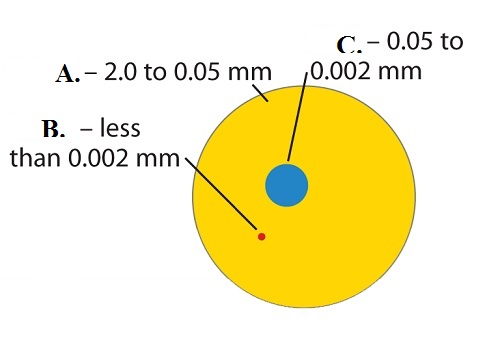
Match the mineral particles with the correct particle size.
| Draggable item | arrow_right_alt | Corresponding Item |
|---|---|---|
Clay | arrow_right_alt | A. |
Silt | arrow_right_alt | B. |
Sand | arrow_right_alt | C. |
Of the three, which particle is the most reactive mineral ingredient in the soil?
What two elements occupy the pore spaces and are essential to the life of soil organisms?
Identify what humus or organic matter is comprised of.
Match the characteristic with the correct soil-forming factor.
Soil temperature and water availability.
Localized changes in moisture and temperature.
Unconsolidated organic and mineral material.
Exposure to rain and growing plants.
Recycling of nutrients by various organisms.
Climate
Landscape Position
Living Organisms
Parent Material
Time
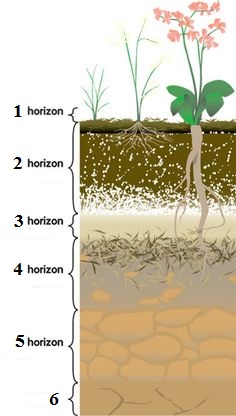
Sequence the soil horizons in the correct order from the uppermost layer (1) to the lowest layer (6).
E horizon
O horizon
A horizon
C horizon
R horizon
B horizon