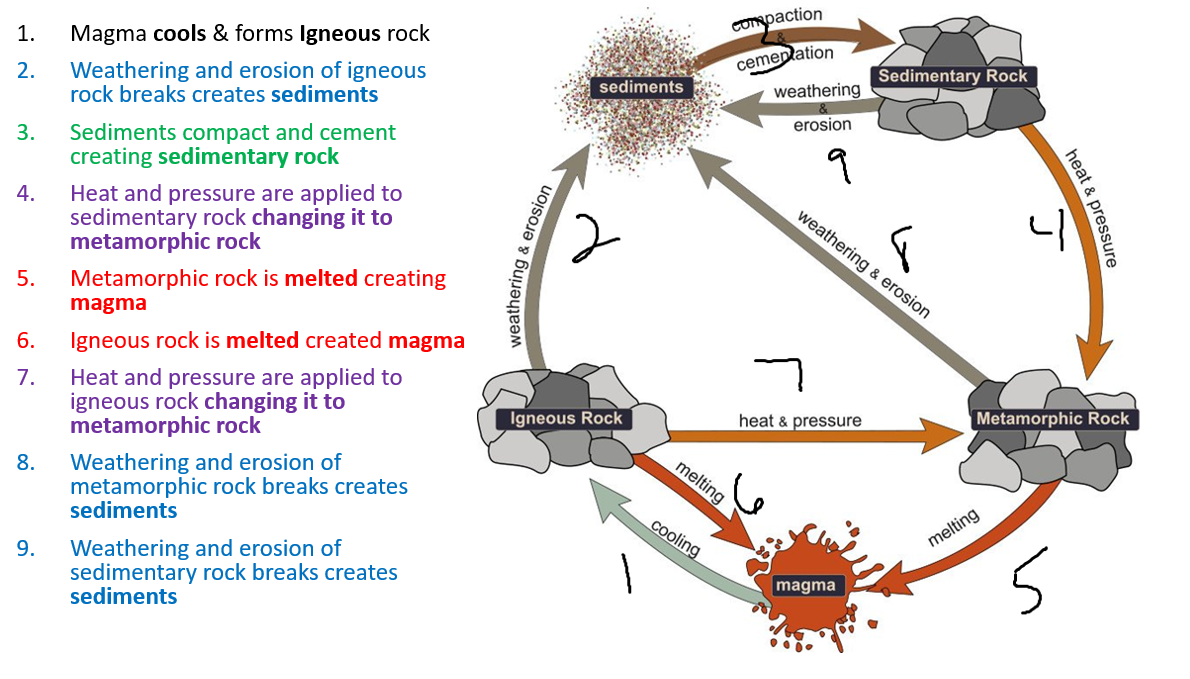
Experiment:
Create a model of the three different types of rocks (sedimentary, metamorphic, & igneous) using starburst candy. Note: candy is for experimental purposes only and may not be eaten.
Materials Needed:
· Starburst candies (2 different colors)
· Scissors
· Plastic baggie
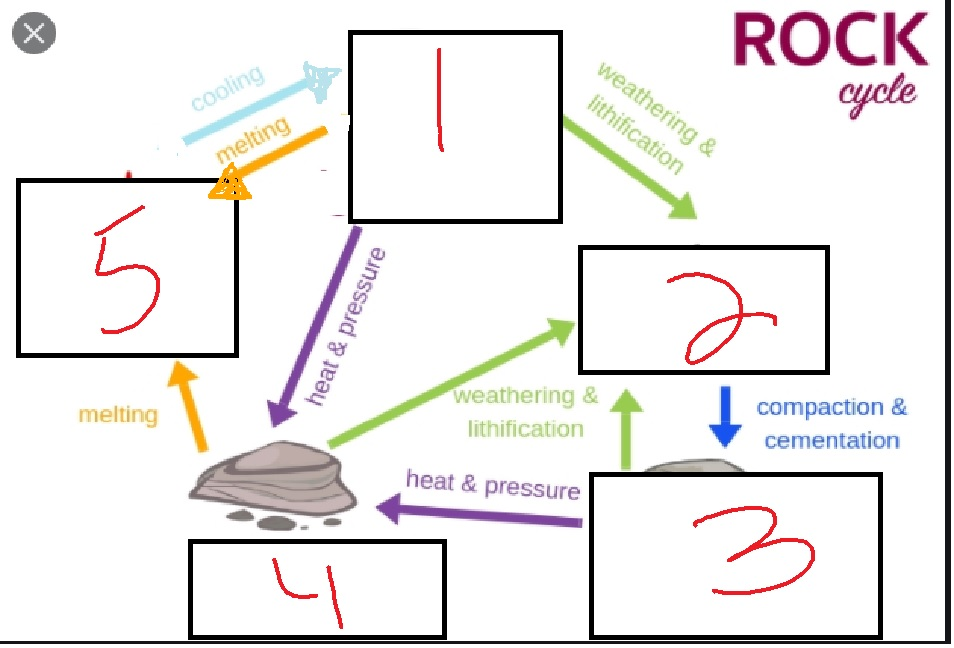
Draw your rock cycle pictures in the boxes and draw and label arrows to each step of the rock cycle as you do them.
Directions (Part 1) :
1. Obtain 2 pieces of starburst candy from your teacher. Each starburst candy must be a different color. The starburst represent rock!
2. Remove the wrapper and cut each starburst candy into 3 strips using scissors.
3. Cut your strips into smaller squares by cutting each strip into thirds. Cutting represents weathering of the rock.
What do the starburst and "cutting" represent
What do the cut up pieces represent?
Directions (Part 2) compacting and cementation:
1. Divide your sediment into like colors. You should have two different groups.
2. Put down all of the sediment of one color
3. Put all of the other color on top and gently press down (so that you can still see the square shape but all of the pieces are squished together). This represents compacting and cementing.
What type of rock have you formed and what process formed it?
DIAGRAM:
1. Draw what you have created in the correct box on the rock cycle diagram at the top of the page.
2. Draw an arrow from where you started (from part 1) to where you ended up (after part 2). Label the ARROW process you performed to get there.
Directions (Part 3) Heat and Pressure:
You will need to apply heat and pressure to make the next type of rock. Have you ever seen a person creating fire by rubbing two sticks together? They are using a concept called friction to create heat. We can apply this same principle to get our heat.
Place your starburst rock into a plastic baggie. Create friction by rubbing the rock between your hands and applying pressure at the same time. You will need to keep this up for at least one minute to generate the heat and pressure needed to create your next type of rock. Be careful not to break the plastic bag.
What was formed?
What did the mashing,squeezing, and rubbing of the starburst represent
Directions (Part 4) Melthing:
9. To create our last type of rock, we will need some serious heat.
10. Place your "rock" on the plate
11. Heat in the microwave for 20 seconds
12. Let it cool until you can peel it off the plate.
What have you formed?
What did the microwave/hot plate represent?
DIAGRAM
1. Draw a picture of what you created in the correct box in the rock cycle diagram
2. Draw an arrow from where you started (from part 3) to where you ended up (after part 4). Label the arrow with process you performed to get there.
3. Lastly, go back and add the other possible pathways a rock could travel. For instance, what would need to happen in order to get the igneous rock you created back to sediment? You may refer to a rock cycle diagram to help label all of the possible pathways a rock could travel during the rock cycle.
Match the word and definition
| Draggable item | arrow_right_alt | Corresponding Item |
|---|---|---|
Igneous Rock | arrow_right_alt | Rocks that have changed due to heat and pressure |
sediment | arrow_right_alt | Formed by magma cooling |
Sedimentary rock | arrow_right_alt | melted rock |
MetaMORPHic Rock | arrow_right_alt | Formed when sediment is squeezed togther and hardens (compact and cement) |
Magma | arrow_right_alt | small pieces of rock, shell, mineral made from weathing and erosion |
9 represents what part of the rock cycle
10 represents what part of the rock cycle
11 represents what part of the rock cycle
12 represents what part of the rock cycle
13 represents what part of the rock cycle