Unit 4 FRQ Exam

Last updated 7 months ago
10 questions
1

As soils form, distinct layers known as horizons develop over time. One of these is the A horizon.

Identify one specific biotic component of the A horizon.

1

As soils form, distinct layers known as horizons develop over time. One of these is the A horizon.

Identify one specific abiotic component of the A horizon.

1

Explain how divergent plate boundaries can lead to new crust.

1

Describe what happens to the tectonic plates along a transform boundary at the moment when an earthquake occurs.

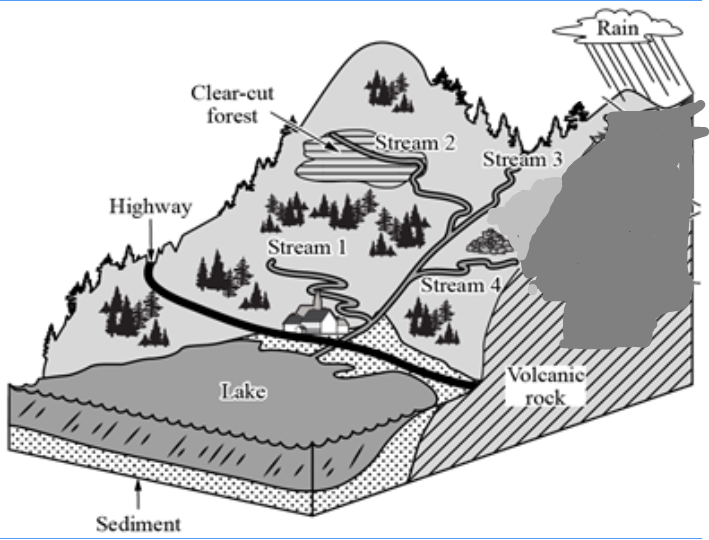
The diagram shows the watershed around an underground mine. Stream 3 runs from the top of the mountain ridge to the lake. The entire watershed is underlain by bedrock that contains some metal. A town on the lakeshore is concerned because of an increase in metal contaminants in the lake.

1

Based on the diagram, explain why stream 1 would have less suspended sediment than stream 2.

1

Some of the miners assert that the area in which the ore is being mined must have been located at a transform plate boundary.

Make a claim using evidence that supports or opposes the miners’ assertion.

1

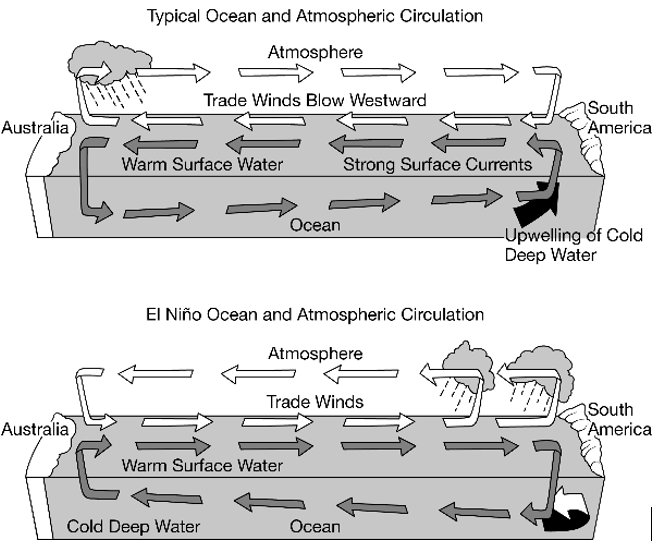
The model below shows a cross-sectional view of El Niño conditions.
Describe a change in ocean circulation that results from an El Niño event that is represented in the model.

Students want to determine the impact of soil erosion from the development of new housing. They plan to measure the density of a species of algae growing along the bottom of a river that flows through their town. The town is built in a heavily forested area, but a large area of trees along the river was recently clear-cut to allow for the construction of a new housing development, which has caused exposed soil to wash into the river. The river flows north to south through the town and is still forested both up- and downstream of the town. The students collect water samples from the river downstream from the northern forest, downstream from the southern forest, and downstream of the housing development. In the water samples, students are measuring the turbidity (the measure of relative clarity of a liquid) of the three sites. The students found that the turbidity of the water samples near the northern forest was the lowest (clearest) and the samples downstream of the housing development had the highest turbidity. The students found that the samples near the housing complex had the lowest density of species of algae growing along the bottom of the river.
1

Identify the control for the experiment.

1

Identify the independent variable for the experiment.

1

Identify the dependent variable for the experiment.