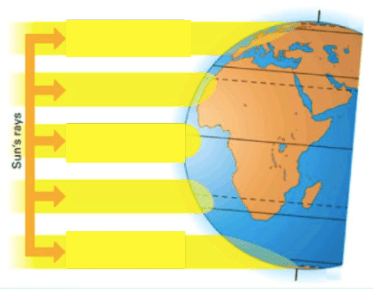
What is the main source of heat energy for our planet?
For questions #2-5, use the image below. Each question connects to the numbered dot on the image.
1
1
1
1
Question 5
5.
Explain how the amount of sunlight that an area recieves impacts the area's overall temperature?
Question 6
6.
What is wind? And what causes it?
(be sure to answer BOTH parts of this question)
Question 7
7.
Why is ocean water warmer near the equator?
Question 8
8.
Question 9
9.
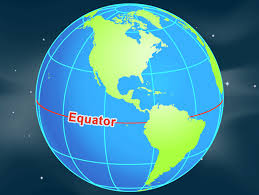
Looking at the image of the planet below, where on Earth do cold water currents form?
(be specific with your answer)
Question 10
10.
Building on your answer from question 9, explain why that area creates colder water currents.
Question 11
11.
Explain the major difference between ocean currents that originate near the equator and ocean currents that originate near the poles.
Question 12
12.
Question 13
13.
In areas by the equator, there is more rain and severe storms. Using what you know about the suns energy and the water cycle, explain why this happens.
Question 14
14.
Based off all we know about weather, climate and ocean currents; where would be your ideal place to go on a vaction? Why would you pick this place? Explain your answer using the scientific words and concepts we have learned.
Question 2
2.
Question 3
3.
Question 4
4.
What is an ocean current?
A continuous movement of ocean water
The movement of waves on the shore
Water that stays in one area of the ocean
The back and forth motion of ocean water between the continents
You are on vacation in Mexico near a warm ocean current. What type of climate would you expect this region to experience?
Cold and humid (moist)
Cold and dry
Warm
Warm and humid (moist)
Based on the amount of sunlight being received, is this a hotter or colder part of the planet?
Colder
Hotter
Based on the amount of sunlight being received, is this a hotter or colder part of the planet?
Colder
Hotter
The sunlight is more direct at the middle of the planet. Does that increase or decrease the temperature in that area?