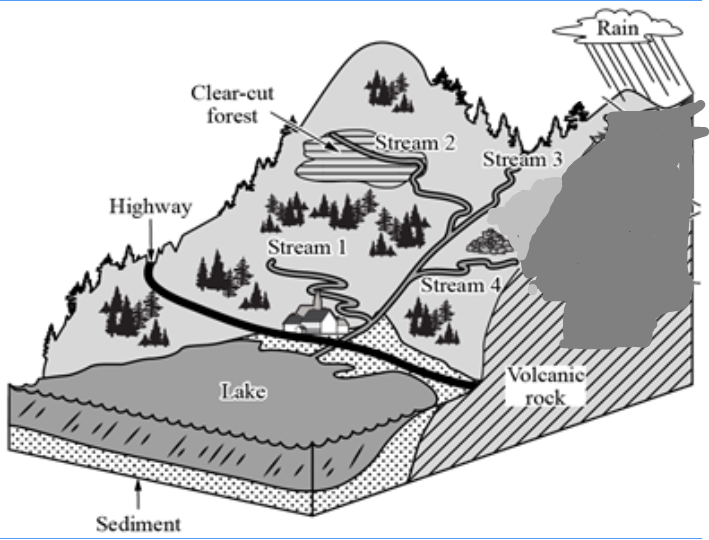
Students want to determine the impact of soil erosion from the development of new housing. They plan to measure the density of a species of algae growing along the bottom of a river that flows through their town. The town is built in a heavily forested area, but a large area of trees along the river was recently clear-cut to allow for the construction of a new housing development, which has caused exposed soil to wash into the river. The river flows north to south through the town and is still forested both up- and downstream of the town. The students collect water samples from the river downstream from the northern forest, downstream from the southern forest, and downstream of the housing development. In the water samples, students are measuring the turbidity (the measure of relative clarity of a liquid) of the three sites. The students found that the turbidity of the water samples near the northern forest was the lowest (clearest) and the samples downstream of the housing development had the highest turbidity. The students found that the samples near the housing complex had the lowest density of species of algae growing along the bottom of the river.