What is the relative atomic mass of an element with the mass spectrum in Figure 17?
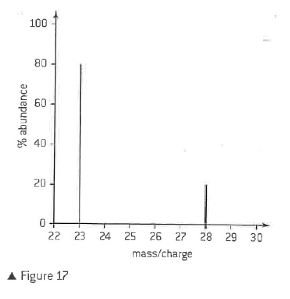
What is the relative atomic mass of an element with the mass spectrum in Figure 17?
Topic 1.1 Matter & Change & Topic 2.1 The nuclear atom
Which process happens as a substance changes from a gaseous state to a solid state?
Which state of matter does not have a fixed shape or volume?
Which of the following is an element?
Which of the following are usually found in the nucleus of an atom?
Which of the following statements is true about electrons?
Which statement about the neutral isotopes of chlorine is correct?
Which is correct for the chromium isotope 5324Cr?
Which of the following is an isotope of 2412Mg?
What is the correct number of each particle in a potassium ion, 40K+1
Consider the composition of the species R, S, T, and U below. Which species is a cation?
In which set do all the species contain more electrons than neutrons?
Bromine exists as the isotopes, 79Br and 81Br. What is the percentage of 79Br in a sample with a relative atomic mass of 79.9?
A sample of element X contains 69% of X-63.0 and 31% of X-65.0. What is the relative atomic mass of X in this sample?
What is the relative atomic mass of an element with the mass spectrum in Figure 17?
List the state of matter for (s).
Using the equation, A+B --> C + D, label part A+B.
State the relative mass and charge of a neutron.
Define Mass number (A)
Define Atomic number (Z)
Deduce the symbol for an atom of phosphorus with 18 electrons and 15 neutrons. (Write the symbol)
Define the term isotope.
State the number of protons, neutrons, and electrons in 4722Ti+2
The element titanium has two isotopes, 4722Ti and 5022Ti, and a relative atomic mass of 47.87. State and explain which is the more abundant isotope.
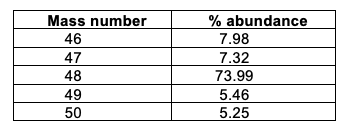
Titanium exists as several isotopes. The mass spectrum of a sample of titanium gave the following data. Calculate the relative atomic mass of titanium to two decimal places.
Boron exists as two isotopes, 10B and 11B. The relative atomic mass of boron is 10.81. Calculate the percentage abundance of each isotopes.
Calculate the relative atomic mass based on the mass spec data provided below.
