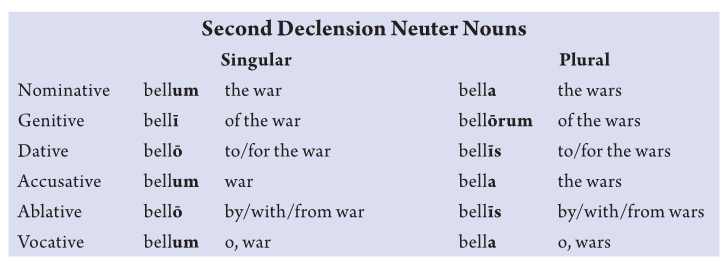
Neuter nominative plural forms always end in –ī.
Neuter nominative plural forms always end in –ī.
An agricola is a farmer.
A poēta is a sailor.
A pronoun is a word that takes the place of a noun.
Sanjay came to school one day feeling very out-of-sorts, and, when he was greeted with the words “Quid agis?” by his teacher, he replied,
Sonja sees her two best friends coming into the Latin classroom and says to them,
What part of speech describes an adjective?
Latin nouns have all of the following EXCEPT
What term indicates the function of a noun?
The term which indicates a singular or plural noun is
The nominative case is used for the predicate nominative and the
The girl loves water.
The Latin word neuter means “neither.” In grammar, it refers to a word
The characteristic vowel of the first declension is
Which of the following has a predicate nominative?
Both nouns and verbs have
What ending indicates the present infinitive?
Which case is used to show possession?
Neuter nominative plural forms always end in –ī.
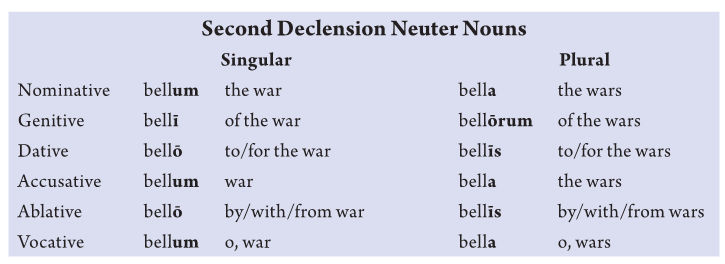
What neuter forms always end in the letter a?
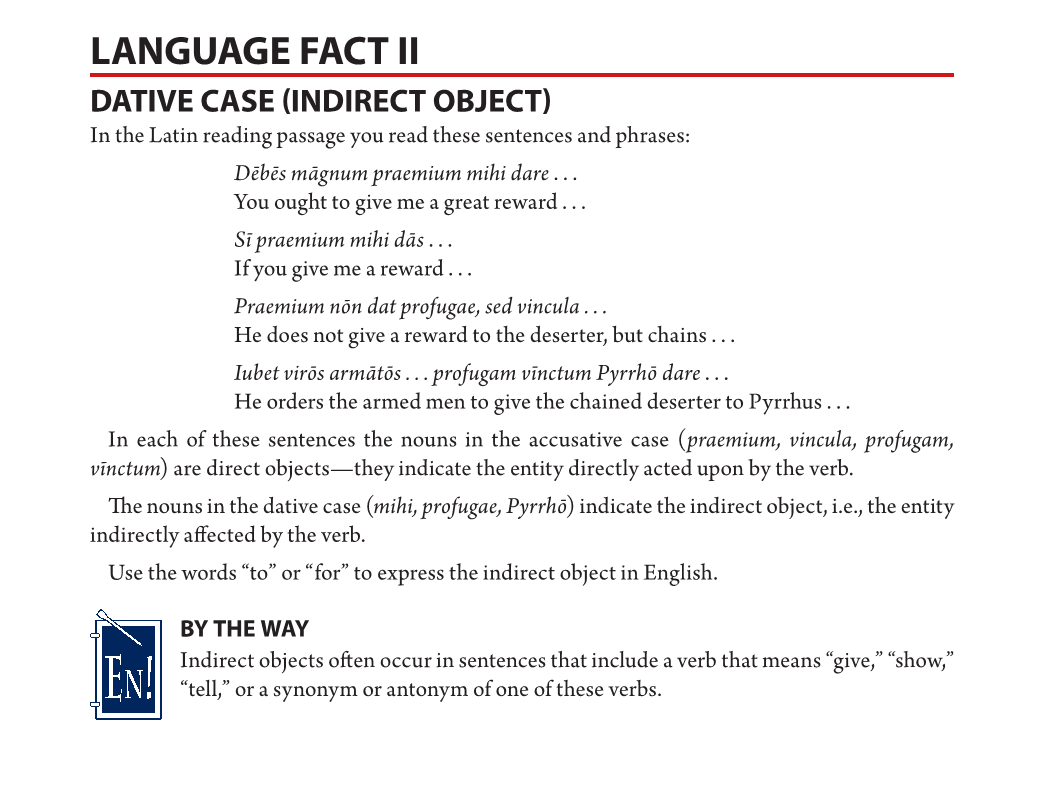
Which case is used for the indirect object?
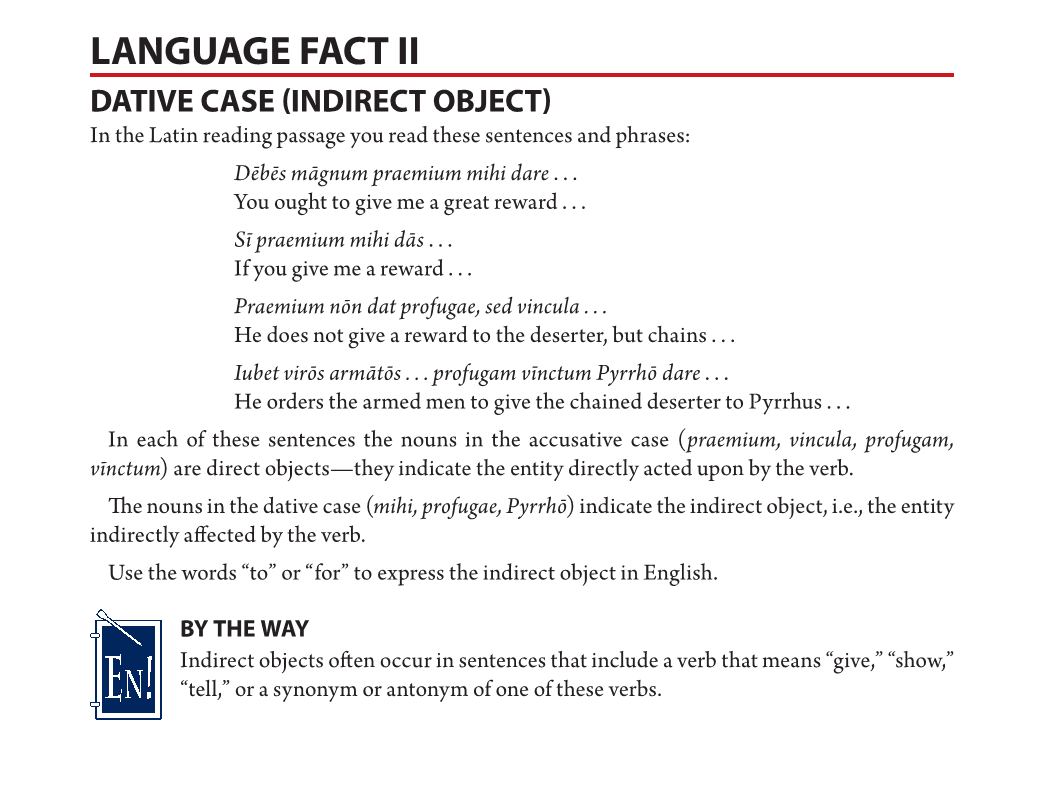
Which of the following sentences, when translated into Latin, would use the dative case?
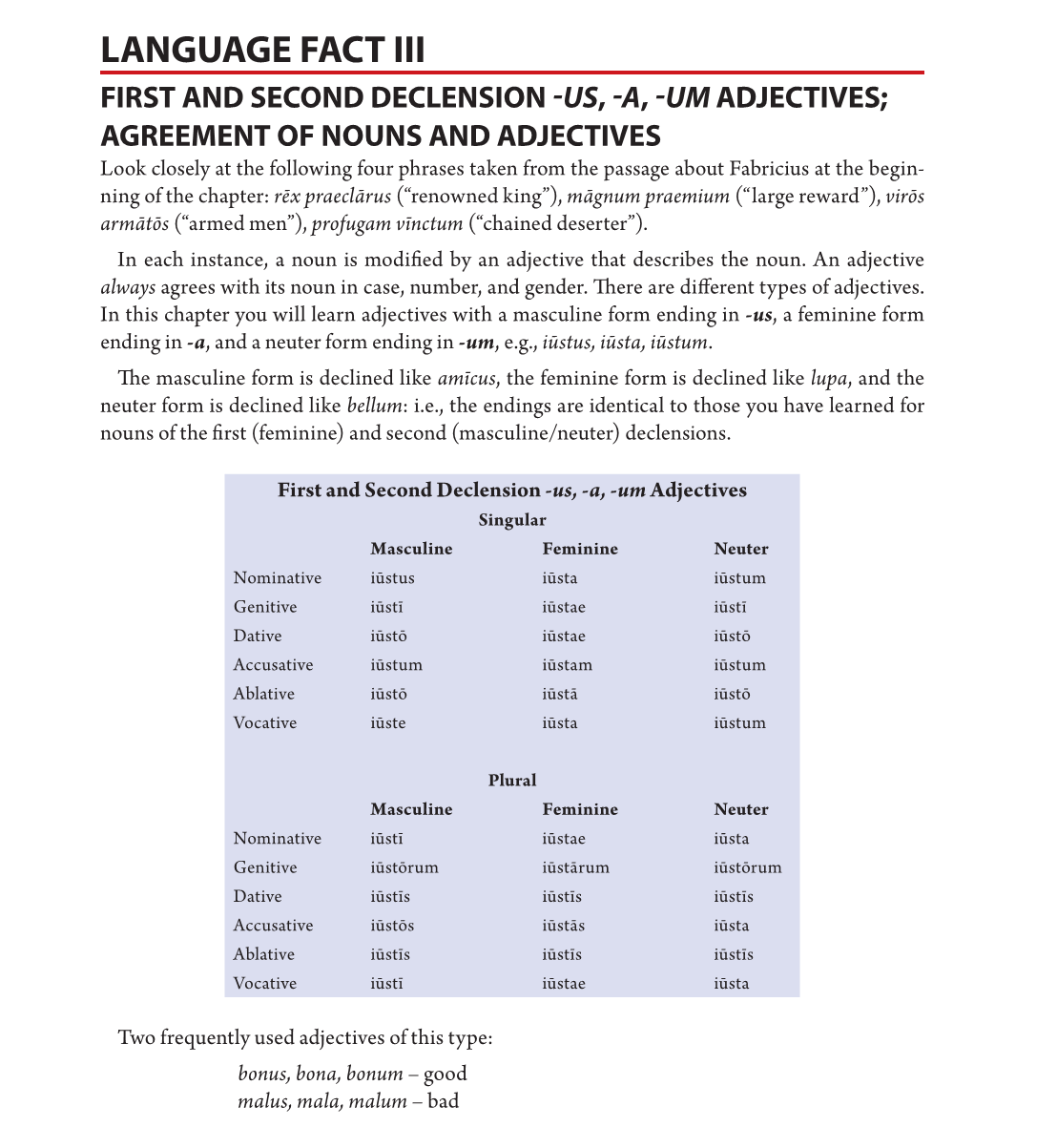
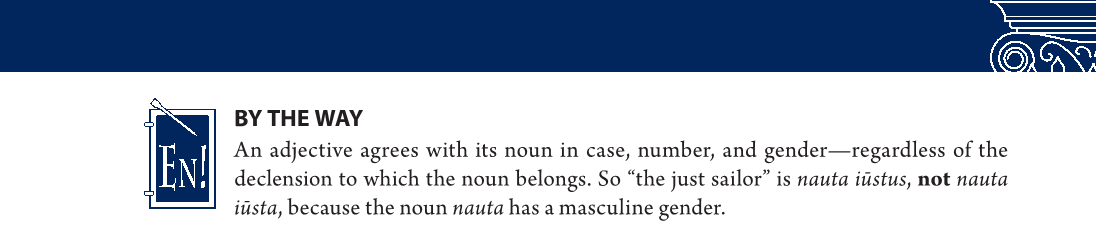
Adjectives must agree with their nouns in all of the following EXCEPT
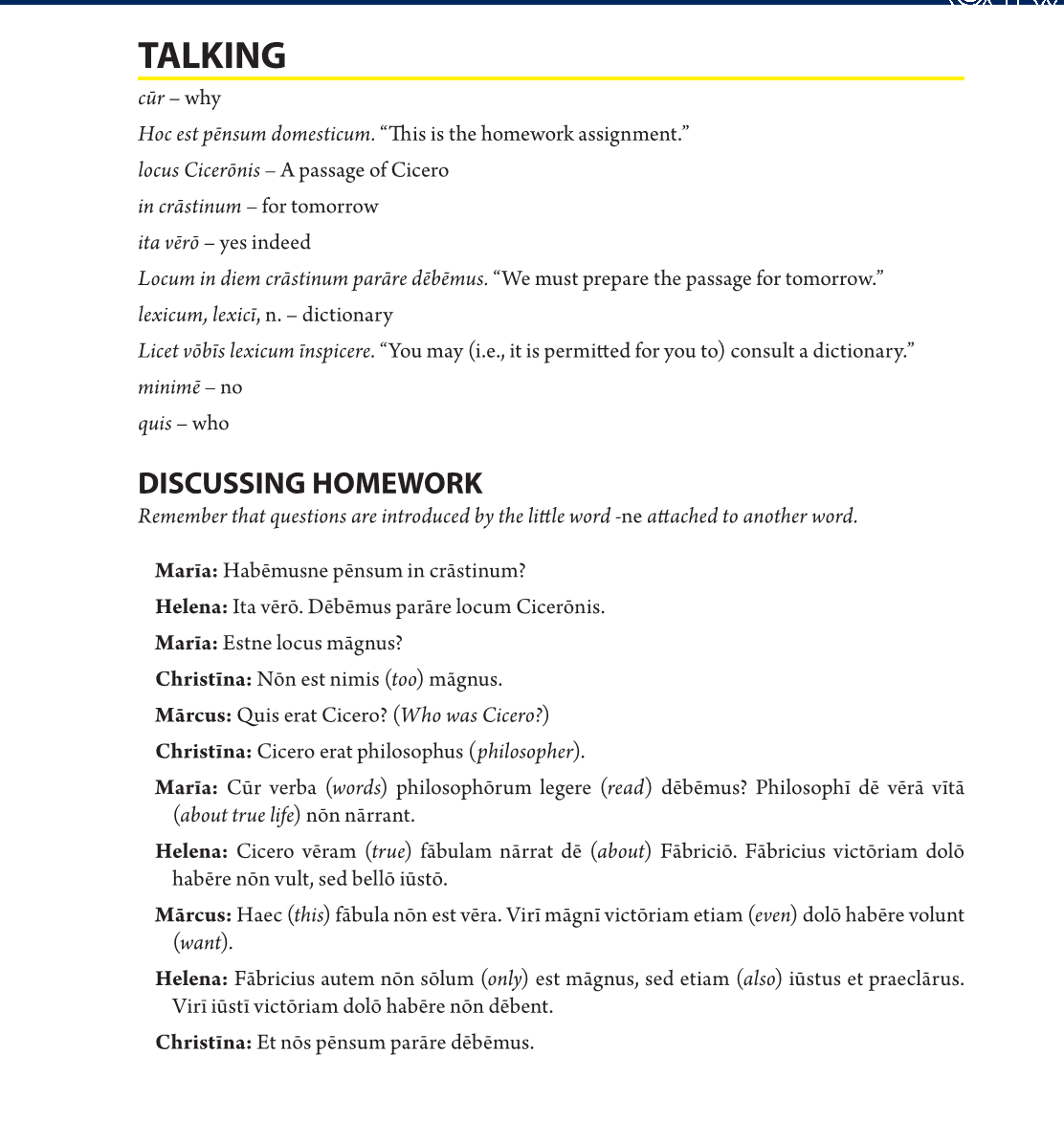
What is one way Romans indicated questions in Latin?
Nouns
| Draggable item | arrow_right_alt | Corresponding Item |
|---|---|---|
liber, librī, m. | arrow_right_alt | help |
praemium, praemiī, n. | arrow_right_alt | war |
exemplum, exemplī, n. | arrow_right_alt | camp |
epistula, epistulae, f. | arrow_right_alt | plan, advice |
familia, familiae, f. | arrow_right_alt | trickery, deception |
vīta, vītae, f. | arrow_right_alt | letter |
venēnum, venēnī, n. | arrow_right_alt | example |
castra, castrōrum, n. pl. | arrow_right_alt | family, household |
auxilium, auxiliī, n. | arrow_right_alt | joy |
tenebrae, tenebrārum, f. pl. | arrow_right_alt | tear |
littera, litterae, f | arrow_right_alt | book |
dolus, dolī, m. | arrow_right_alt | letter of the alphabet; pl. literature, letter |
gaudium, gaudiī, n. | arrow_right_alt | memory |
cōnsilium, cōnsiliī, n. | arrow_right_alt | reward |
memoria, memoriae, f. | arrow_right_alt | shadows, darkness |
vinculum, vinculī, n. | arrow_right_alt | poison |
bellum, bellī, n. | arrow_right_alt | chain, fetter |
lacrima, lacrimae, f. | arrow_right_alt | life |
Adjectives
| Draggable item | arrow_right_alt | Corresponding Item |
|---|---|---|
miser, misera, miserum | arrow_right_alt | armed |
longus, longa, longum | arrow_right_alt | good |
māgnus, māgna, māgnum | arrow_right_alt | legitimate, open, just |
multus, multa, multum | arrow_right_alt | long |
pulcher, pulchra, pulchrum | arrow_right_alt | large, great, important |
Rōmānus, Rōmāna, Rōmānum | arrow_right_alt | bad |
iūstus, iūsta, iūstum | arrow_right_alt | wretched, sad, miserable |
armātus, armāta, armātum | arrow_right_alt | much, many |
malus, mala, malum | arrow_right_alt | famous, distinguished |
praeclārus, praeclāra, praeclārum | arrow_right_alt | beautiful, nice |
bonus, bona, bonum | arrow_right_alt | Roman |
Verbs
| Draggable item | arrow_right_alt | Corresponding Item |
|---|---|---|
sum, esse, fuī, —— | arrow_right_alt | to think |
cōgitō, cōgitāre, cōgitāvī, cōgitātum | arrow_right_alt | to give |
possum, posse, potuī, —— | arrow_right_alt | to teach |
parō | arrow_right_alt | to feel pain, to be hurt |
iūdicō, iūdicāre, iūdicāvī, iūdicātum | arrow_right_alt | to strengthen |
servō, servāre, servāvī, servātum | arrow_right_alt | to lie down, to be inert |
doceō, docēre, docuī, doctum | arrow_right_alt | to enter |
iaceō, iacēre, iacuī, —— | arrow_right_alt | to order somebody to do something |
soleō, solēre, solitus sum + infi nitive | arrow_right_alt | to judge |
iubeō, iubēre, iussī, iussum + accusative + infinitive | arrow_right_alt | to remain |
dō, dăre, dedī, dătum | arrow_right_alt | to design |
maneō, manēre, mānsī, mānsum | arrow_right_alt | to be able, can |
doleō, dolēre, doluī, —— | arrow_right_alt | to save, to preserve |
intrō, intrāre, intrāvī, —— | arrow_right_alt | to be accustomed |
firmō, firmāre, firmāvī, firmātum | arrow_right_alt | to be |
Adverbs, Prepositions and Conjunctions
| Draggable item | arrow_right_alt | Corresponding Item |
|---|---|---|
propter + accusative | arrow_right_alt | far |
sed | arrow_right_alt | often |
ad + accusative | arrow_right_alt | always |
in + accusative | arrow_right_alt | by, from, away from |
ā (ab) + ablative | arrow_right_alt | into, towards, to |
nam | arrow_right_alt | about, concerning, down from |
autem | arrow_right_alt | from, out of |
tamen | arrow_right_alt | into, to, agains |
semper | arrow_right_alt | because of, on account of |
saepe | arrow_right_alt | however |
ē (ex) + ablative | arrow_right_alt | while |
dum | arrow_right_alt | for, in fact |
longē | arrow_right_alt | – not only . . . , but also . . . |
nōn sōlum . . . , sed etiam . . . | arrow_right_alt | but |
dē + ablative | arrow_right_alt | however |
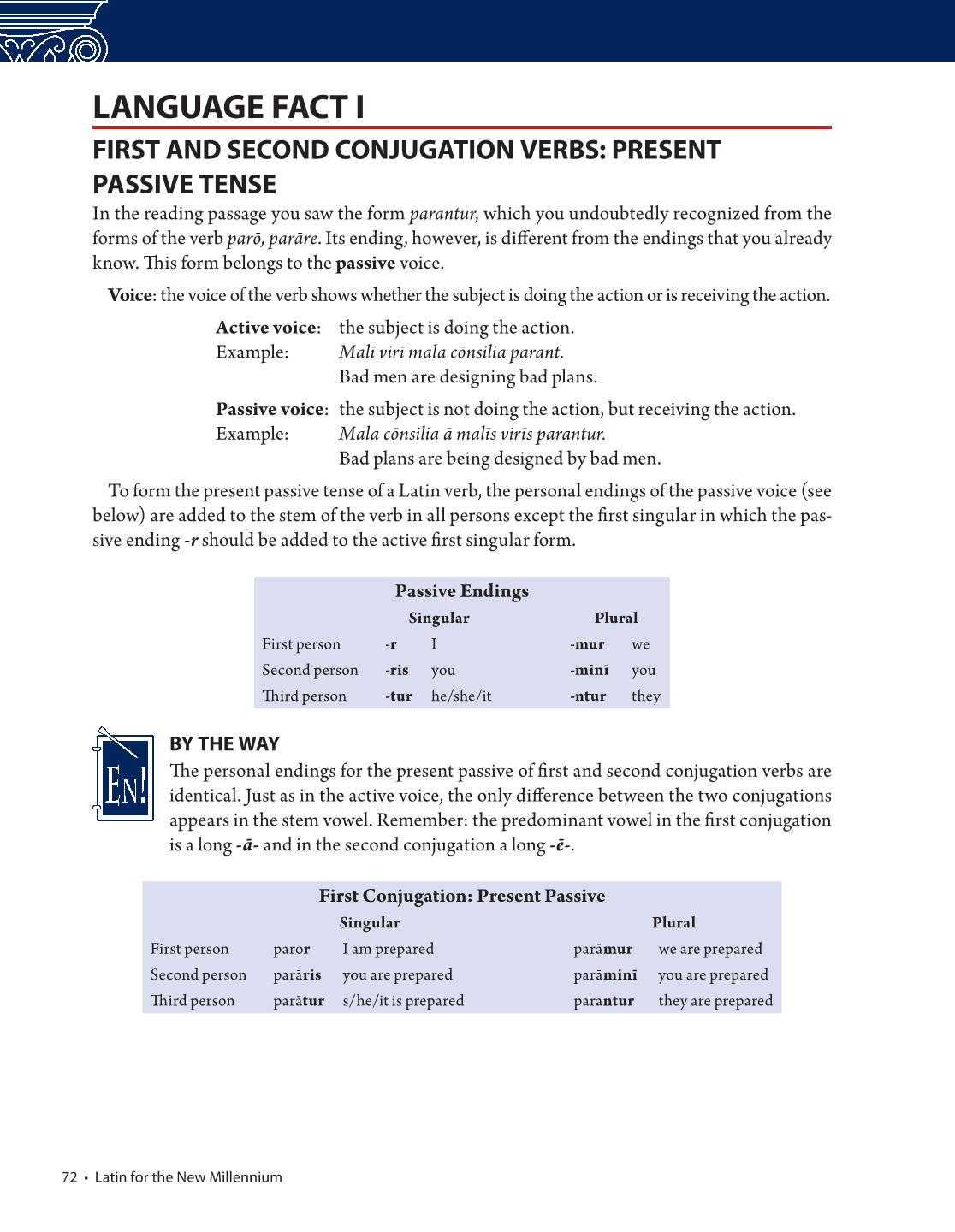
Passive voice is when the subject is receiving the action.
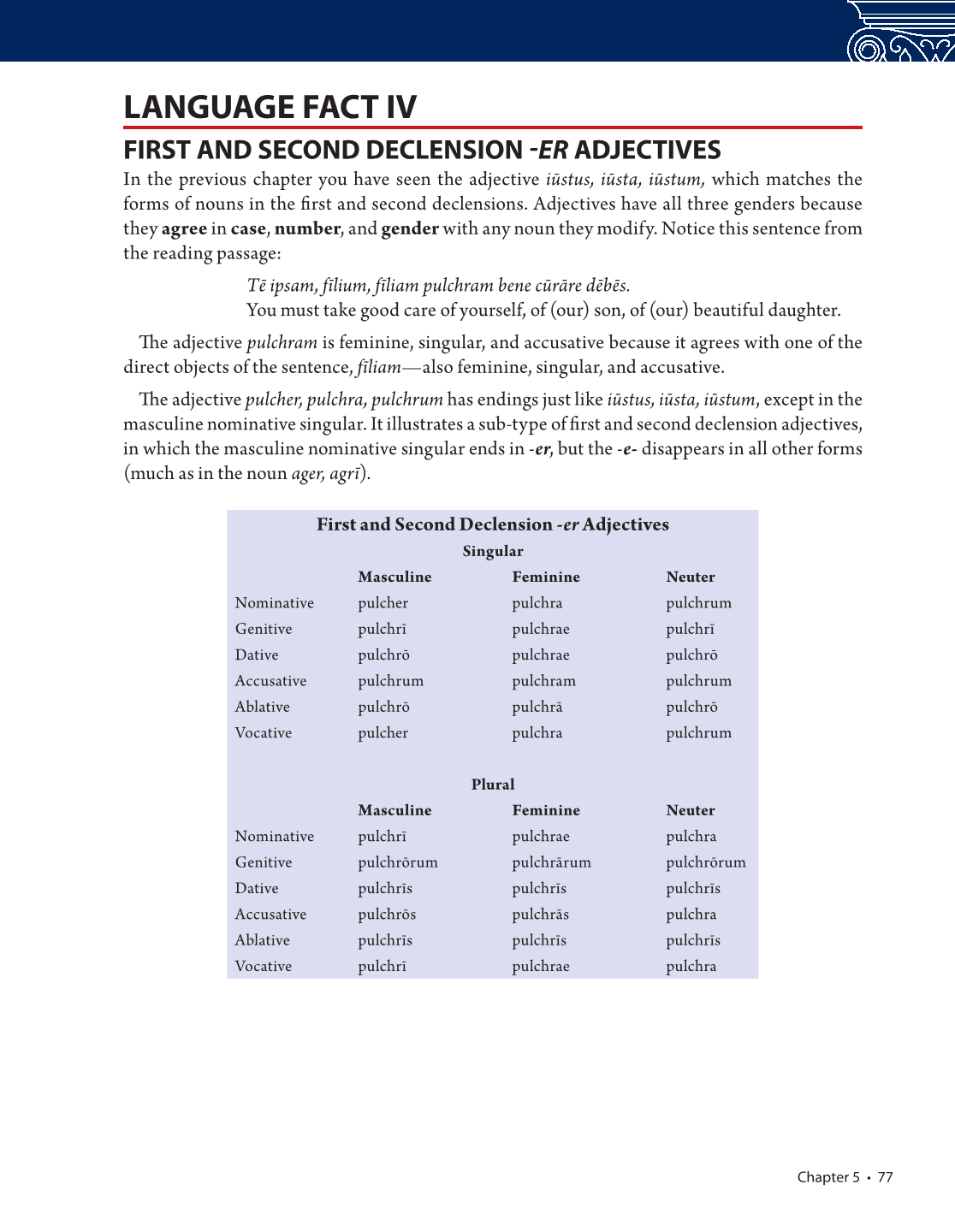
Adjectives have all three genders.
Which of the following is in the passive voice?
In a Latin sentence containing a passive verb,
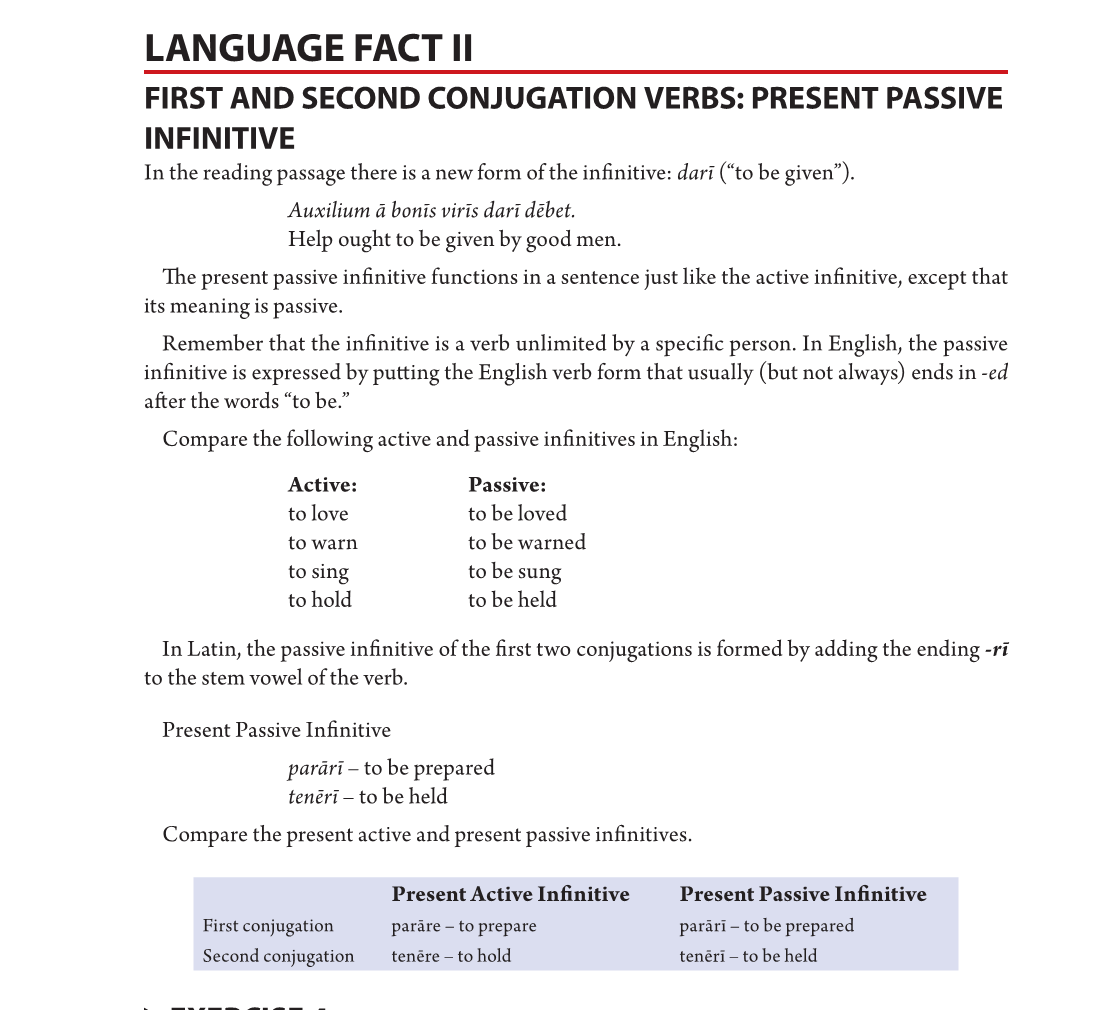
A present passive infinitive always ends with the letter
When an active verb in a sentence is changed to the passive form, the direct object becomes
Intransitive verbs do not have direct objects.