LNM1 Ch 10 Exercise 3
star
star
star
star
star
Last updated almost 4 years ago
10 Nsɛmmisa

1
1
1
1
1
1
1
1
1
1
Fill in the blanks by changing the verb from the first sentence to complete the meaning of the second sentence.
Translate the changed sentence.
The Reading Vocabulary may be consulted.
Example: Graecī cōnsilia capiunt. Cōnsilia ā Graecīs __________.
Cōnsilia ā Graecīs capiuntur.
Plans are made by the Greeks.
Ulixes dīcit: “Māgnum equum ligneum aedificāre cupiō.” Graecī dīcunt: “Nōs (we) māgnum equum ligneum aedificāre
Translate: Graecī dīcunt: “Nōs (we) māgnum equum ligneum aedificāre __________."
Trōiānī contrā hostēs ācrēs cōnsilia capiunt. Trōiānī contrā hostēs ācrēs cōnsilia
Translate: Trōiānī contrā hostēs ācrēs cōnsilia __________ dēbent.
Cōnsilia contrā Graecōs capiō. Cōnsilia ā mē (by me) contrā Graecōs
Translate: Cōnsilia ā mē (by me) contrā Graecōs __________.
Paucī Trōiānī fugiunt. Dīcō paucōs Trōiānōs
Translate: Dīcō paucōs Trōiānōs __________.
Ex urbe Trōiānōrum fugimus. Ego ex urbe Trōiānōrum
Translate: Ego ex urbe Trōiānōrum __________.
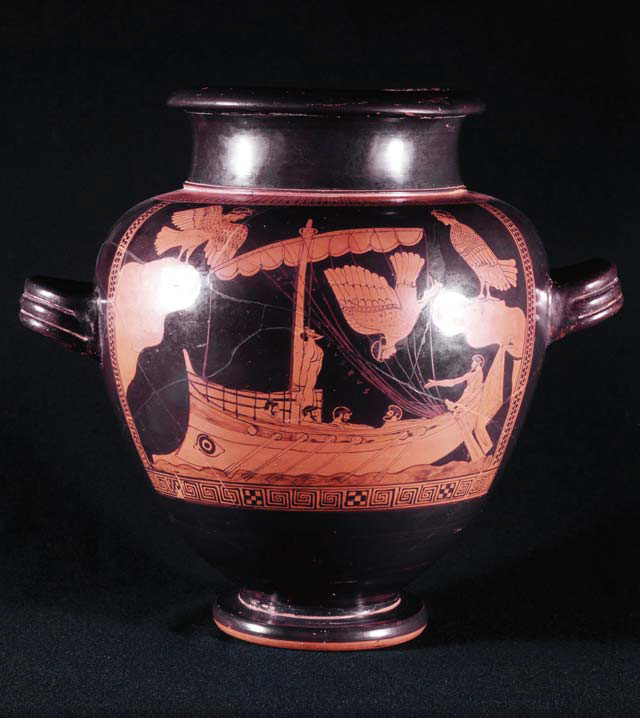
After the ruse of the Trojan Horse allowed the Greeks inside the city, they burned Troy. On his way home to Ithaca, Ulysses had himself tied to the mast of his ship in order to be able to hear the songs of the dangerously enchanting Sirens.
Odysseus encounters more challenges that test his spirit and cunning upon returning to Ithaca. The Phaeacians transport him home and leave him asleep on the shore. He awakens, worried that he has been tricked, until Athena in disguise welcomes him home. She warns him about the suitors, disguises him as a beggar, and puts her plan in motion. Odysseus and his son Telemachus reunite at the hut of the swineherd Eumaeus and plan the destruction of the suitors. The disguised Odysseus goes to the palace and the first of several recognition scenes takes place. His dog sees him, wags his tail, and dies. At the palace he witnesses for himself the abuse of hospitality, the insolence of the suitors, and the predicament of his family. He is in turn mocked, insulted, and attacked by his “guests.” Penelope comes to greet the stranger and orders Eurycleia, his old nurse, to wash his feet. She recognizes the boar scar but is urged to hold her tongue. Then suddenly his wife decides to hold a contest. Whoever is able to string Odysseus’ bow and shoot an arrow through twelve axe-heads will claim her as a wife. Odysseus asks if he can participate but his request is rudely rejected by the suitors. Penelope, however, gives him permission, and Telemachus sends her to her room and puts himself in charge of the bow and the contest. Odysseus in disguise completes the task. With the help of Athena, the swineherd, and the goatherd, the bloodbath begins. The suitors and the disloyal servants are killed, but the herald and bard are spared. Odysseus does not gloat over his victory, but cautions the overjoyed Eurycleia that it was impious to gloat over slain men. When Penelope hears the news that her husband has returned and killed the suitors, she is not convinced. As a test she orders the marriage bed to be moved so he can sleep there. Odysseus protests and reveals the secret of the marriage bed that cannot be moved. It was made from the trunk of an olive tree and the whole house was built around it. Penelope is assured that he is indeed Odysseus; they are reunited and talk far into the night about all his travels. The next day he lets his father Laertes know he is alive. Meanwhile the fathers of the suitors want revenge and are ready for war. Athena stops them, and Zeus seconds the motion with a thunderbolt. Peace is restored.