Log in
Sign up for FREE
arrow_back
Library
LNM1 Ch 5: Exercises 1 & 3 - Passive Voice
By Michael Garcia
star
star
star
star
star
Share
share
Last updated over 3 years ago
29 questions
Add this activity
1
1
1
1
1
1
1
1
1
1
1
1
1
1
1
1
1
1
2
1
1
1
1
1
1
1
play_arrow
Question 1 | 00:24
00:00/00:00
closed_caption_disabled
slow_motion_video
fullscreen
Question 1
00:24
keyboard_arrow_down
1
Question 1
1.
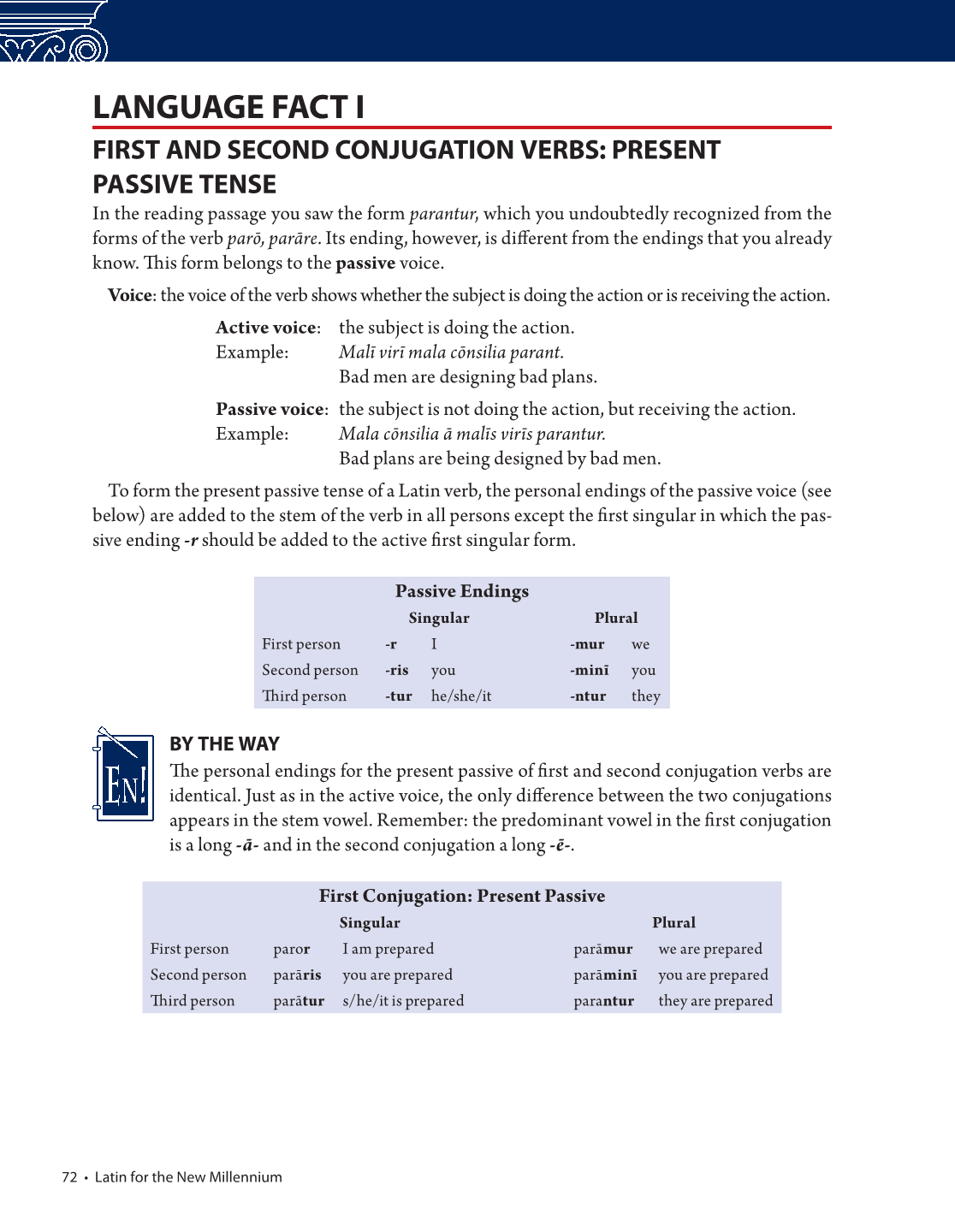
What is the main difference between the active voice and the passive voice?
play_arrow
Question 2 | 01:57
Question 3 | 04:28
00:00/00:00
closed_caption_disabled
slow_motion_video
fullscreen
Question 2
01:57
keyboard_arrow_down
1
Question 2
2.
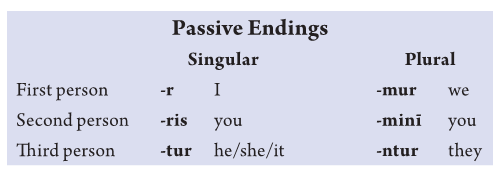
How do you form the present passive?
Question 3
04:28
keyboard_arrow_down
1
zoom_in
zoom_in
EXERCISE 1
Identify the person and number of each verb and change into the passive voice, keeping the same person and number.
Example
:
tenēs
second person singular
tenēris
Question 4
4.
vident
1st Person Singular
2nd Person Singular
3rd Person Singular
1st Person Plural
2nd Person Plural
3rd Person Plural
Question 5
5.
Passive form of
vident
:
Question 6
6.
vocat
1st Person Singular
2nd Person Singular
3rd Person Singular
1st Person Plural
2nd Person Plural
3rd Person Plural
Question 7
7.
Passive form of
vocat
:
Question 8
8.
iubēmus
1st Person Singular
2nd Person Singular
3rd Person Singular
1st Person Plural
2nd Person Plural
3rd Person Plural
Question 9
9.
Passive form of
iubēmus:
Question 10
10.
cūrātis
1st Person Singular
2nd Person Singular
3rd Person Singular
1st Person Plural
2nd Person Plural
3rd Person Plural
Question 11
11.
Passive form of
cūrātis:
Question 12
12.
amō
1st Person Singular
2nd Person Singular
3rd Person Singular
1st Person Plural
2nd Person Plural
3rd Person Plural
Question 13
13.
Passive form of
amō:
Question 14
14.
dēbent
1st Person Singular
2nd Person Singular
3rd Person Singular
1st Person Plural
2nd Person Plural
3rd Person Plural
Question 15
15.
Passive form of
dēbent:
Question 16
16.
das
1st Person Singular
2nd Person Singular
3rd Person Singular
1st Person Plural
2nd Person Plural
3rd Person Plural
Question 17
17.
Passive form of
das:
Question 18
18.
exspectat
1st Person Singular
2nd Person Singular
3rd Person Singular
1st Person Plural
2nd Person Plural
3rd Person Plural
Question 19
19.
Passive form of
exspectat:
EXERCISE 3
Complete each sentence with the correct form of the word in parentheses
Translate the completed sentence.
Example
:
Venēnum ā malīs virīs __________. (parō)
Venēnum ā malīs virīs
parātur
.
Poison is being prepared by bad men.
Question 20
20.
Epistula Terentiae ā Cicerōne (ablative) _______ . (teneō)
Question 21
21.
Translate:
Epistula Terentiae ā Cicerōne (ablative) _________. (teneō)
Question 22
22.
Cicero est _______ et Terentia est _______ . (miser)
Question 23
23.
Translate:
Cicero est __________ et Terentia est __________. (miser)
Question 24
24.
Bona cōnsilia ā bonīs virīs _______ . (parō)
Question 25
25.
Translate:
Bona cōnsilia ā bonīs virīs __________. (parō)
Question 26
26.
Epistulae longae ā Cicerōne (ablative) _______ . (exspectō)
Question 27
27.
Translate:
Epistulae longae ā Cicerōne (ablative) __________. (exspectō)
Question 28
28.
Terentia in animō Cicerōnis (genitive) _______ . (videō)
Question 29
29.
Translate:
Terentia in animō Cicerōnis (genitive) __________. (videō)
Question 3
3.
In a sentence with a passive verb, what case is used for the noun indicating the person or thing doing the action of the verb?