LNM1 Ch 6 Ex 5: Transitive and Intransitive Verbs
star
star
star
star
star
Last updated almost 4 years ago
19 Nsɛmmisa
22
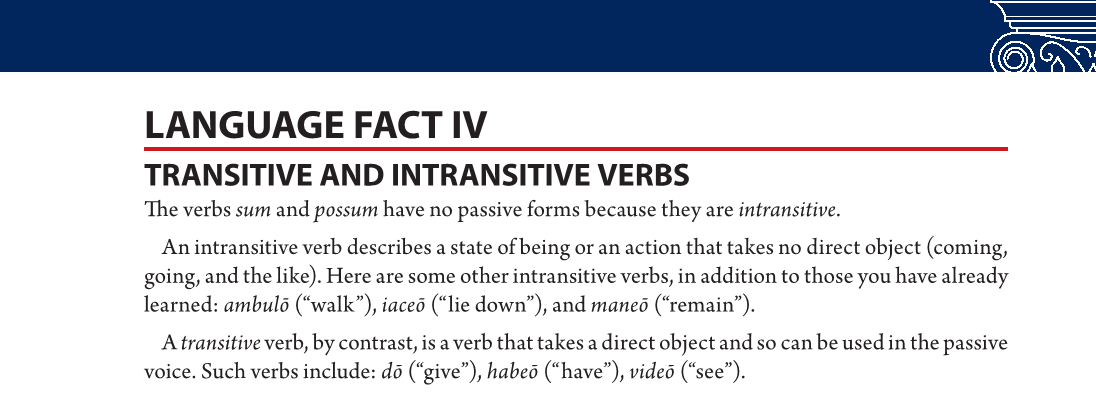
The following list of verbs is from the Vocabulary to Learn, Chapters 1–6.
Indicate whether they are transitive or intransitive by dragging them to the correct category.
Try to do it from memory. However, if you need help, here is a file with all the vocabulary from chapters 1-6:
dō, dare
habeō, habēre
parō, parāre
ambulō, ambulāre
firmō, firmāre
videō, vidēre
teneō, tenēre
exspectō, exspectāre
iaceō, iacēre
possum, posse
servō, servāre
habitō, habitāre
intrō, intrāre
doceō, docēre
dēbeō, dēbēre
sum, esse
vocō, vocāre
maneō, manēre
timeō, timēre
amō, amāre
nārrō, nārrāre
Transitive
Intransitive
1. Epistulam puellae teneō.
Identify the verb/s.
Is the verb transitive or intransitive?
Translate: Epistulam puellae teneō.
2. In familiā sunt memoriae pulchrae.
Identify the verb/s.
Is the verb transitive or intransitive?
Translate: In familiā sunt memoriae pulchrae.
3. Virī māgnī saepe in vinculīs iacent.
Identify the verb/s:
Is the verb transitive or intransitive?
Translate: Virī māgnī saepe in vinculīs iacent.
4. Auxilium ā bonīs virīs datur.
Identify the verb/s.
Is the verb transitive or intransitive?
Translate: Auxilium ā bonīs virīs datur.
5. Fīliam et fīlium valdē amō.
Identify the verb/s.
Is the verb transitive or intransitive?
Translate: Fīliam et fīlium valdē amō.
6. Amīcus in memoriā semper manet.
Identify the verb/s.
Is the verb transitive or intransitive?
Translate: Amīcus in memoriā semper manet.