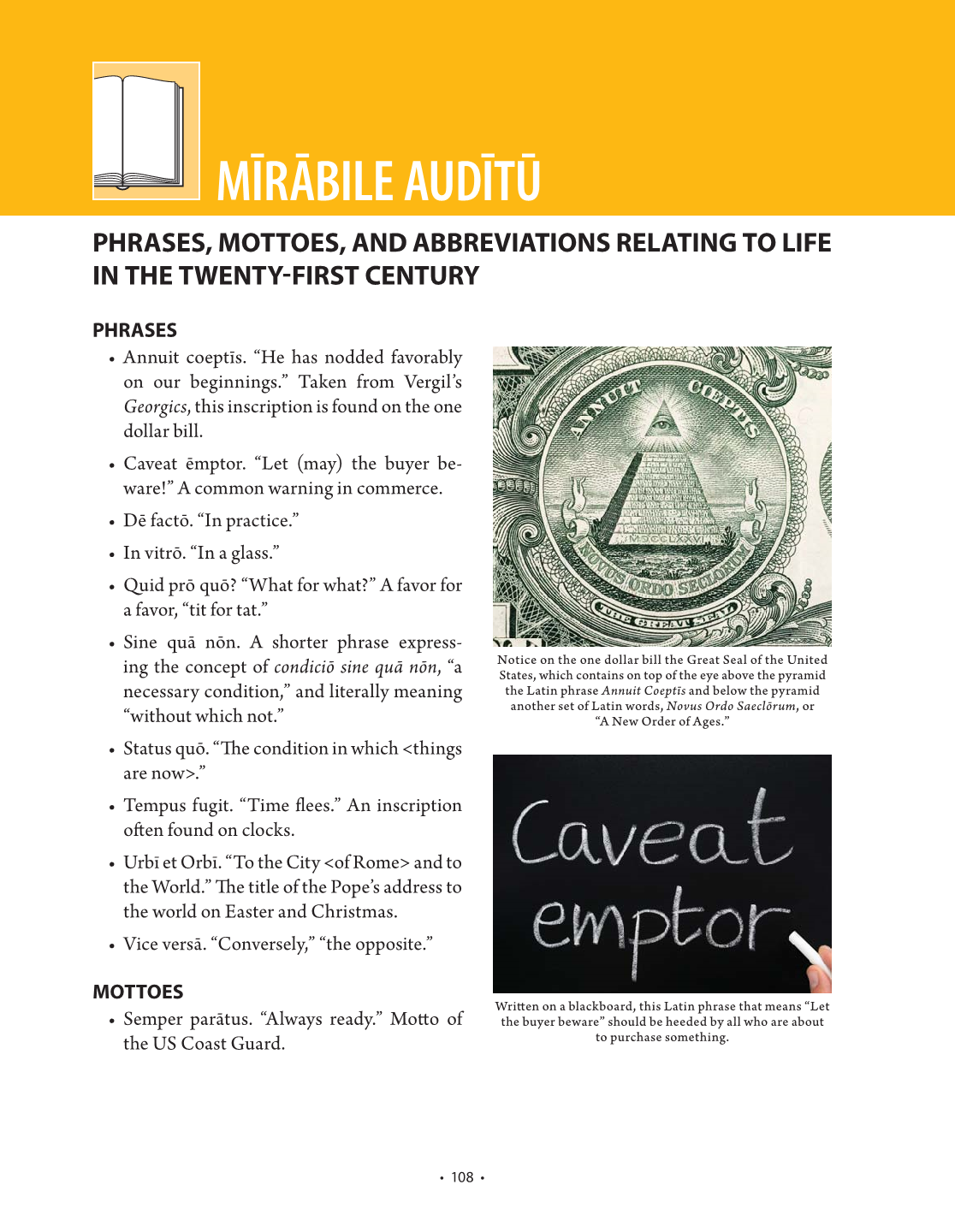
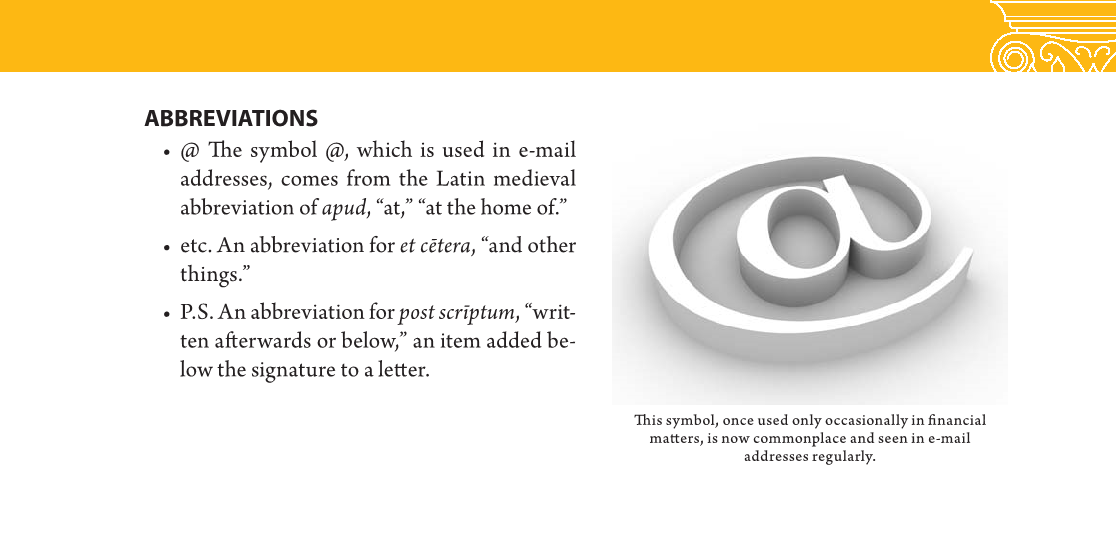
Match the Latin phrase, motto, or abbreviation to its English translation.
| Draggable item | arrow_right_alt | Corresponding Item |
|---|---|---|
Vice versā | arrow_right_alt | “He has nodded favorably on our beginnings.” |
Urbī et Orbī: The title of the Pope’s address to the world on Easter and Christmas. | arrow_right_alt | “Let (may) the buyer beware!” |
P.S. An abbreviation for post scrīptum | arrow_right_alt | “In practice.” |
@ | arrow_right_alt | “In a glass.” |
Tempus fugit | arrow_right_alt | “What for what?” A favor for a favor, “tit for tat.” |
In vitrō | arrow_right_alt | “a necessary condition,” and literally meaning “without which not.” |
etc. An abbreviation for et cētera | arrow_right_alt | “The condition in which <things are now>.” |
Sine quā nōn: A shorter phrase expressing the concept of condiciō sine quā nōn | arrow_right_alt | “Time flees.” An inscription often found on clocks. |
Quid prō quō? | arrow_right_alt | “To the City <of Rome> and to the World.” |
Caveat ēmptor: A common warning in commerce. | arrow_right_alt | “Conversely,” “the opposite.” |
Dē factō | arrow_right_alt | “Always ready.” |
Semper parātus: Motto of the US Coast Guard. | arrow_right_alt | The Latin medieval abbreviation of apud, “at,” “at the home of.” |
Annuit coeptīs: Taken from Vergil’s Georgics, this inscription is found on the one dollar bill. | arrow_right_alt | “and other things.” |
Status quō | arrow_right_alt | “written afterwards or below,” an item added below the signature to a letter. |
Which of the phrases might be taught in a consumer economics class?
Which abbreviation is oft en found at the end of a list of items?
Which phrase means an absolute necessity?
Which phrase might be cited when establishing precedent?
Folks who oppose or fear change, want to preserve what instead?
Which phrase is related to retaliation?
In discussing opposites, one might employ which phrase?
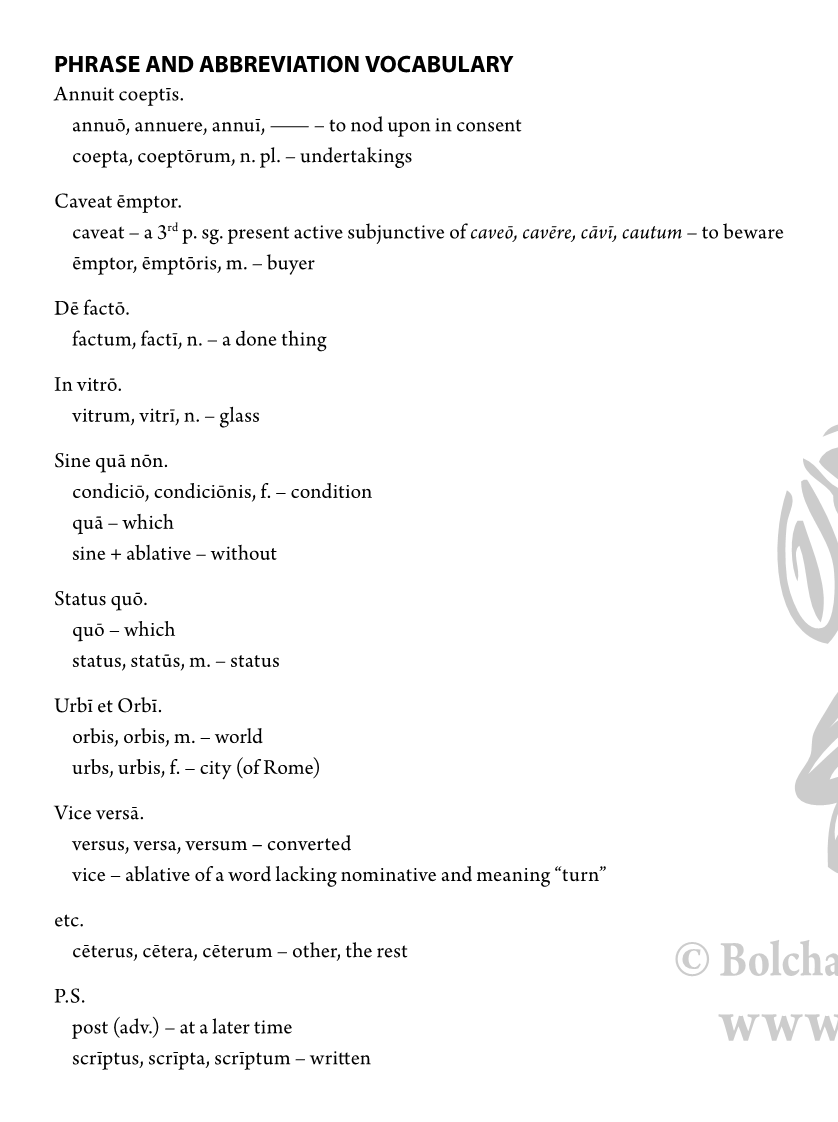
Now match these individual Latin terms to their English meaning.
| Draggable item | arrow_right_alt | Corresponding Item |
|---|---|---|
orbis, orbis, m. | arrow_right_alt | to nod upon in consent |
cēterus, cētera, cēterum | arrow_right_alt | undertakings |
status, statūs, m. | arrow_right_alt | to beware |
caveat – a 3rd p. sg. present active subjunctive of caveō, cavēre, cāvī, cautum | arrow_right_alt | buyer |
vice | arrow_right_alt | a done thing |
sine + ablative | arrow_right_alt | glass |
annuō, annuere, annuī, —— | arrow_right_alt | condition |
factum, factī, n. | arrow_right_alt | which |
coepta, coeptōrum, n. pl. | arrow_right_alt | without |
quā / quō | arrow_right_alt | status |
post (adv.) | arrow_right_alt | world |
condiciō, condiciōnis, f. | arrow_right_alt | city (of Rome) |
ēmptor, ēmptōris, m. | arrow_right_alt | converted |
vitrum, vitrī, n. | arrow_right_alt | ablative of a word lacking nominative and meaning “turn” |
scrīptus, scrīpta, scrīptum | arrow_right_alt | other, the rest |
versus, versa, versum | arrow_right_alt | at a later time |
urbs, urbis, f. | arrow_right_alt | written |