Discovering a Sea Otter
star
star
star
star
star
Last updated almost 6 years ago
15 Nsɛmmisa
1
1
1
1
1
2
3
1
1
1
1
1
1
2
3
Read the text. Then answer the questions.
DISCOVERING A SEA OTTER
In September 2014, a person taking an evening walk on a California beach heard the cry of a newborn sea otter. The citizen notified authorities. Scientists studied the situation and decided the otter pup could not be retrieved that night. The following morning, the pup was still in the same location. Since she had apparently been orphaned, the scientists rescued her. She was thought to be only one week old.
Sea otters must eat at least 25 percent of their body weight every day. The newborn female had been separated from her mother for at least 16 hours. She needed prompt feeding in order to survive. The pup was delivered to the Monterey Bay Aquarium in California. The aquarium is a leader in rescuing and conserving sea otters. The aquarium helped stabilize the pup. The pup spent a month receiving care in California.
The baby, called Pup 681, was then sent to Shedd Aquarium in Chicago. Shedd Aquarium is dedicated to marine mammal care and conservation. Pup 681 was five weeks old, less than two feet long, and weighed a little less than six pounds. She received constant attention from animal care and veterinarian teams. Tim Binder, vice president of Animal Collections at the aquarium, discussed the situation in a press release. “Pup 681’s situation was urgent,” he said. “We were perfectly positioned to ensure that this little pup had a home.”
Sea otters are members of the weasel family. They are the smallest marine mammals that live in the ocean. Pup 681 is a southern sea otter, also known as a California sea otter. Southern sea otters live along the coast of California. They can grow up to four feet long, and adult females can weigh 35 to 60 pounds. In the wild, they may live 15 to 20 years. Currently, the population in the wild is fewer than 3,000.
An adult female will usually give birth to one pup each year. Sea otters give birth in the water. Typically, a mother floats on her back, holding her baby to her chest to nurse it. Pups usually stay with their mothers for about eight months. During this time, they learn life skills. Young otters learn to swim and hunt by watching their mothers. Sea otters ordinarily spend most of their time in the water. However, they may sometimes come ashore to sleep.
A young sea otter must learn many skills, such as foraging for food and grooming, in order to survive. Otters spend up to four hours a day grooming because they need a clean, healthy coat of fur to stay warm. Because Pup 681 was orphaned, human experts stepped in to teach her important life skills. “Our animal care team
is teaching the pup how to be an otter,” Binder said. They began by feeding her formula from a bottle. She moved on to eating solid foods, such as shrimp and clams. They helped her learn other important skills such as grooming.
While people help Pup 681, they will also learn from her. They can study her biology and behavior. Binder also hopes learning about sea otters will “encourage people to preserve and protect them in the wild.”
As you answer the questions below, make sure to refer back to the text above.
Why did the scientists remove the baby sea otter from the wild?
This question has two parts. First, answer part A. Then, answer part B.
Part A ~What allowed Pup 681 to survive?
Choose the detail from the text that best supports the answer to part A.
Read the sentence from the text.
Pups usually stay with their mothers for about eight months.
What is the meaning of the word pups according to the text?
Read the sentences from the text.
Sea otters are members of the weasel family. They are the smallest marine mammals that live in the ocean. What does the word marine most likely mean?
How does Tim Binder feel about the aquarium? How does the author reveal these feelings?
Use evidence from the text to support your answer. Use complete sentences.
Mark the boxes to match each cause with its effect.
Choose the sentence that contains a spelling error.
Which sentence is written correctly?
Choose the sentence that is not written correctly.
Which sentence is written correctly?
A student is writing an article for class. Read the article below.
(1) Ants are great construction workers. (2) many types of ants dig tunnels and build tunnels and build underground nests withmany rooms. (3) The rooms have curved ceilings to trap heat and sloping floors so water drains out. (4) Ants keep their nests safe and comfortable by repairing walls and filling holes.
Which sentence needs to be edited?
Read the paragraph below.
(1) Katarina loves reading, especially fantasy books likeThe dragon's Secret. (2) She enjoys reading about the different characters and imagining their adventures in new jersey. (3) Her teachers want her to share her stories, but Katarina is shy. (4) Katarina thought, "Should I be a writer, or maybe I'll be an illustrator instead."
Which 2 sentences are not written correctly?
Andre is writing a story about a boy who gets a new puppy. Read the first paragraph of his story.
Rewrite and revise the paragraph. Think about how you can add more description and details. How can you make the sentences longer and less choppy?
I got a new puppy. Her name is Gracie. She is white and black. My dad promised me that I would get to choose which puppy I got. I love her already.
Think about our essential question: Why is it important to research and protect endangered animals.
How can research expeditions like the one in the story Quest for the Tree Kangaroo help to protect the tree kangaroo? What data did the team collect? Include specific facts and details. What did the research team hope to learn from their data and how could this be used to protect the tree kangaroos?
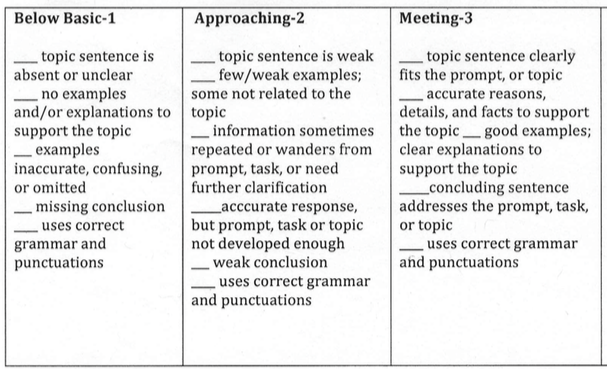
Remember to begin with a topic sentence. Add supporting details and examples from Quest for the Tree Kangaroo. Make sure to include a conclusion. Use the rubric above to review your response.