What is the domain in the table below?
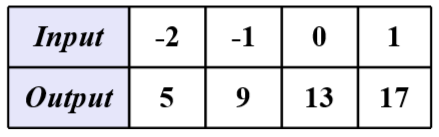
What is the domain in the table below?
Which set of ordered pairs represents a function?
Which graph below does not represent a function?
Which of the following represents a function?
What is the domain in the table below?
If f(x) = -0.5x - 5 , which statement is always true?
Which table below does not represent a function?
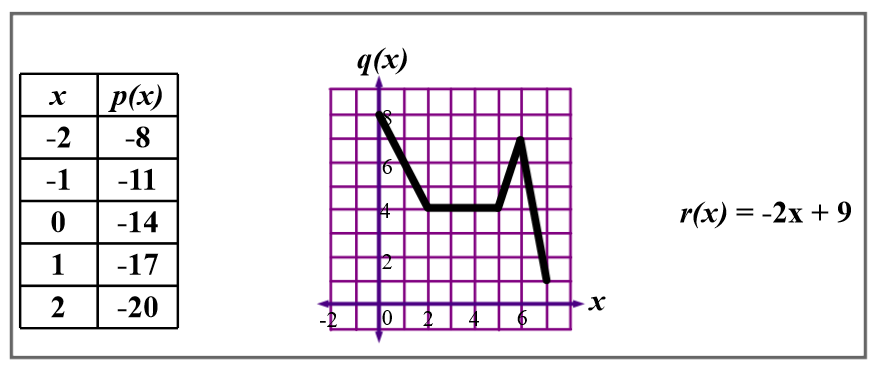
Based on the information given below, which of the following is NOT true?
Let g be a function such that g(x) = -4x + 1 is defined on the domain below.
What is the range of the function?
If f(x) = 2x2 - 4x and g(x) = 8x - 16 , for which values of x is f(x) = g(x) ?
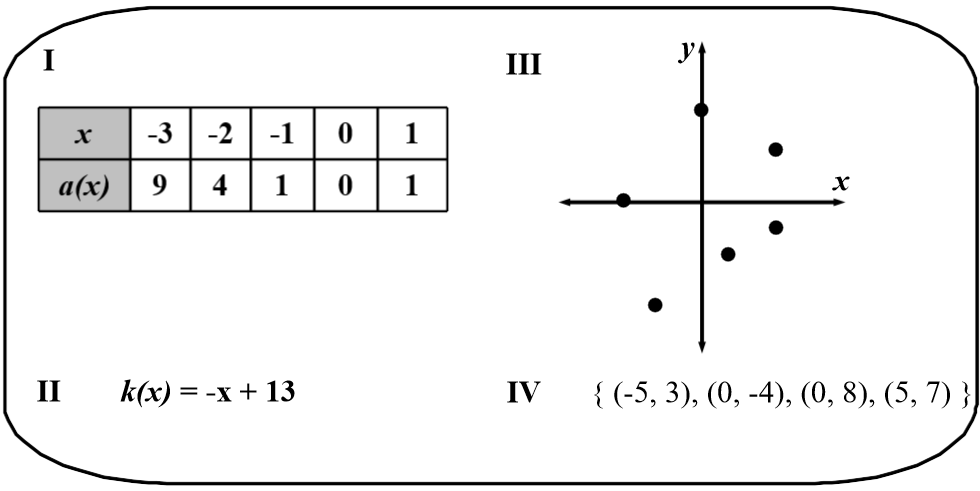
Which representations are NOT functions?
Which represents the range of the function below?
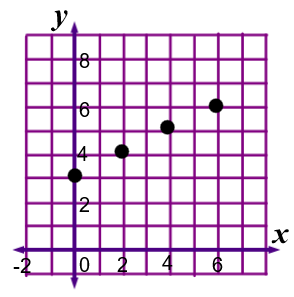
What is the range in the graph below? Is this graph a function? Explain your answer.
Complete your own table with a relation that is a function.
Explain why your relation is a function.
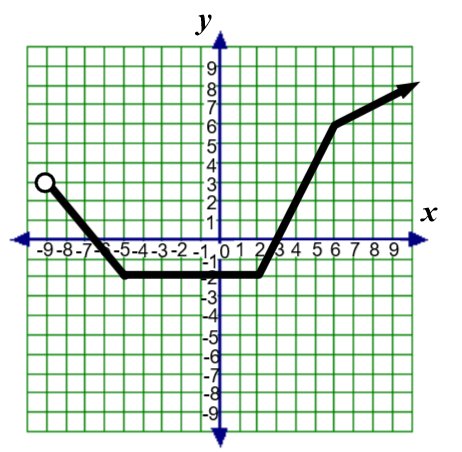
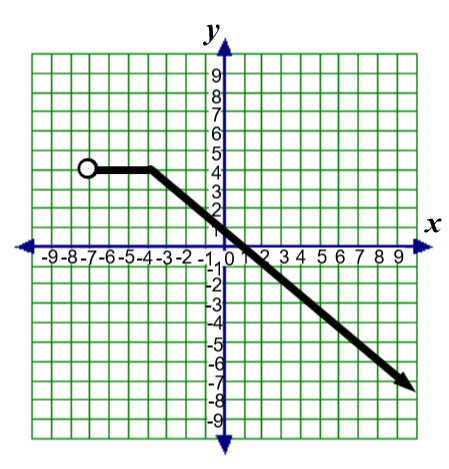
Identify the domain of the accompanying graph. You can write it in either inequality (set notation) or interval notation.
Identify the range of the accompanying graph. You can write it in either inequality (set notation) or interval notation.
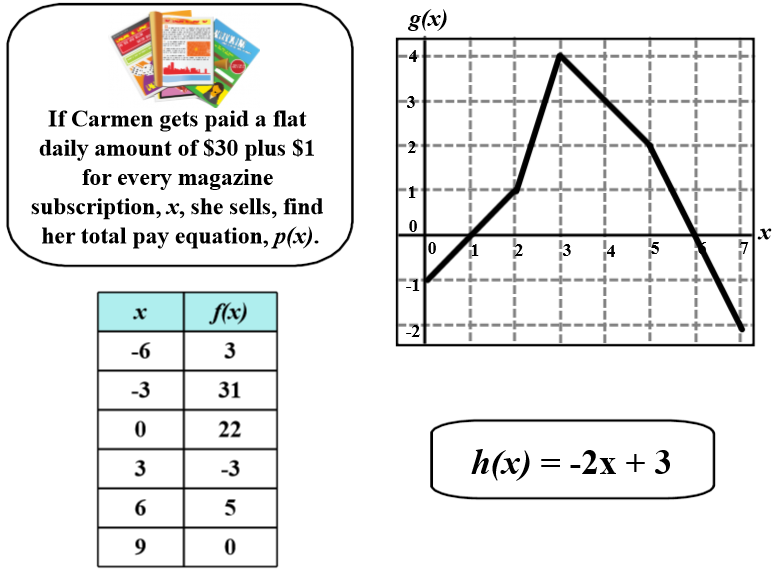
Given the information below, evaluate each function.
Evaluate: f (6) + g (4) =
Given the information below, evaluate each function.
Evaluate: h (5) + p (5) =
Given the information below, evaluate each function.
If f (x) = 0 , then x =