Chapter 1 Review
star
star
star
star
star
Last updated about 2 years ago
26 Nsɛmmisa
1
1
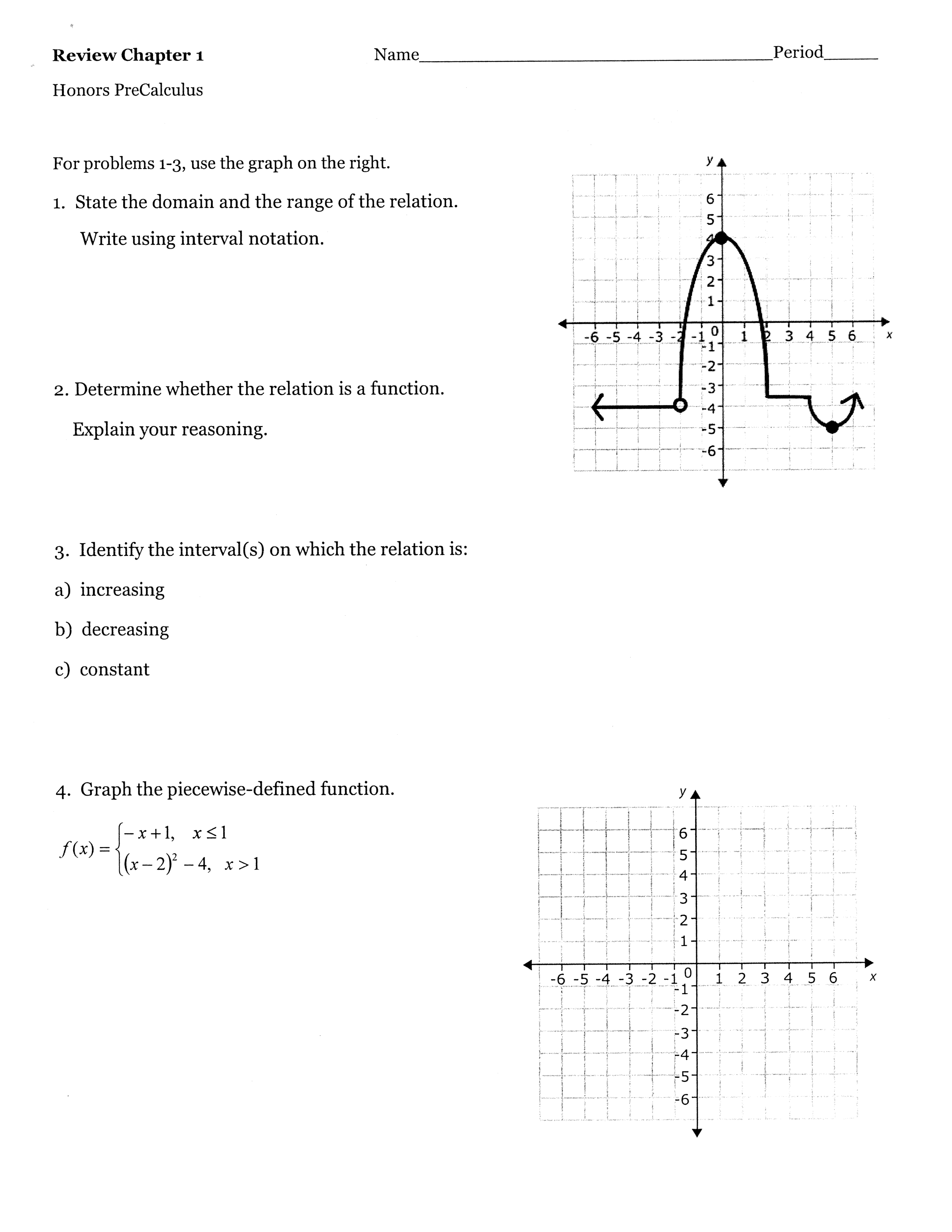
Is the relation a function? Explain your reasoning.
State any interval(s) on which the relation is increasing. If there is not one, then just state none. Use inf for infinite.
Find the inverse of f(x). Use / to get a fraction in typing your response.
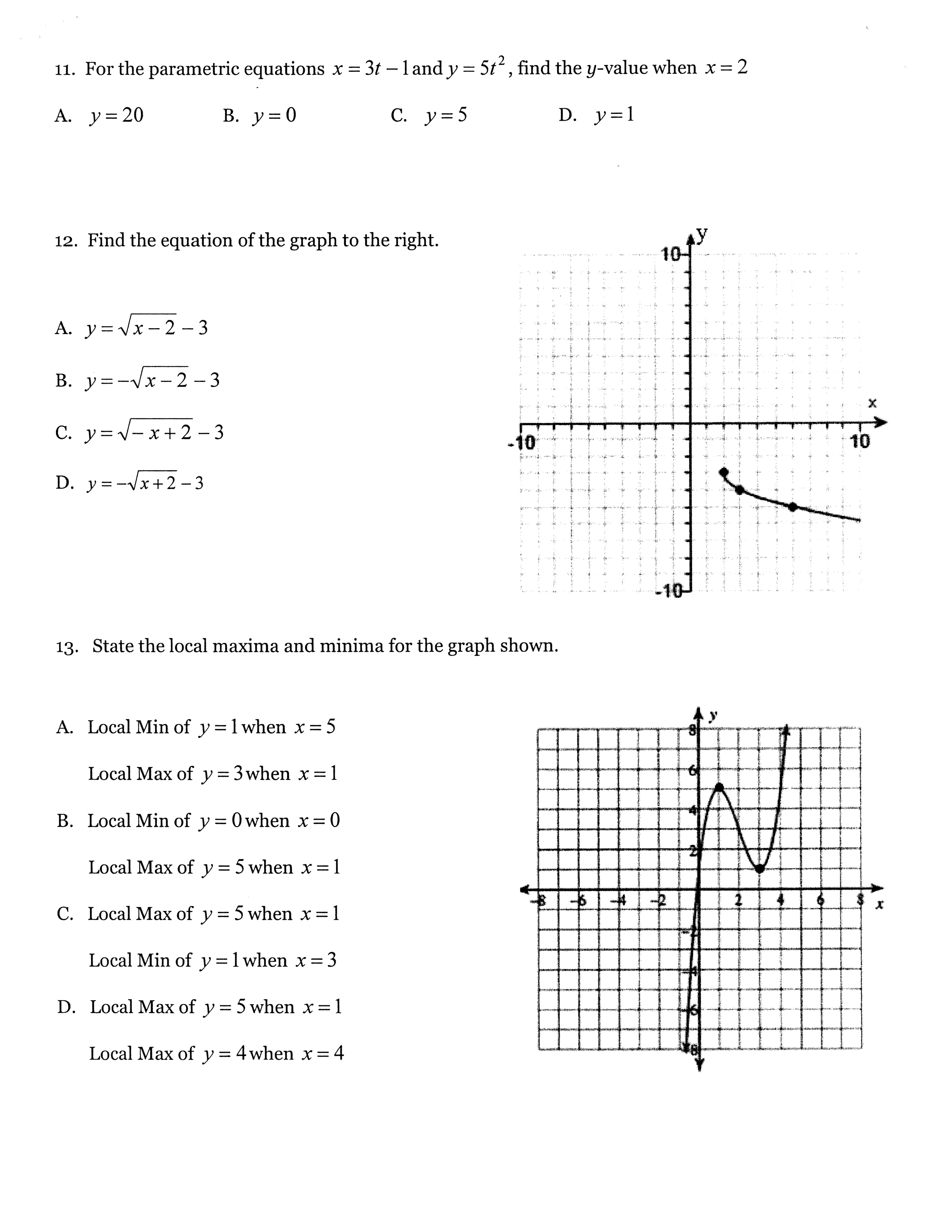
Determine the correct equation of the graph in problem 12.
State the local extrema for the graph in problem 13.
Determine the domain and range of the relation. Use inf for infinite.
State any interval(s) on which the relation is decreasing. If there is not one, then just state none. Use inf for infinite.
State any interval(s) on which the relation is constant. If there is not one, then just state none. Use inf for infinite.
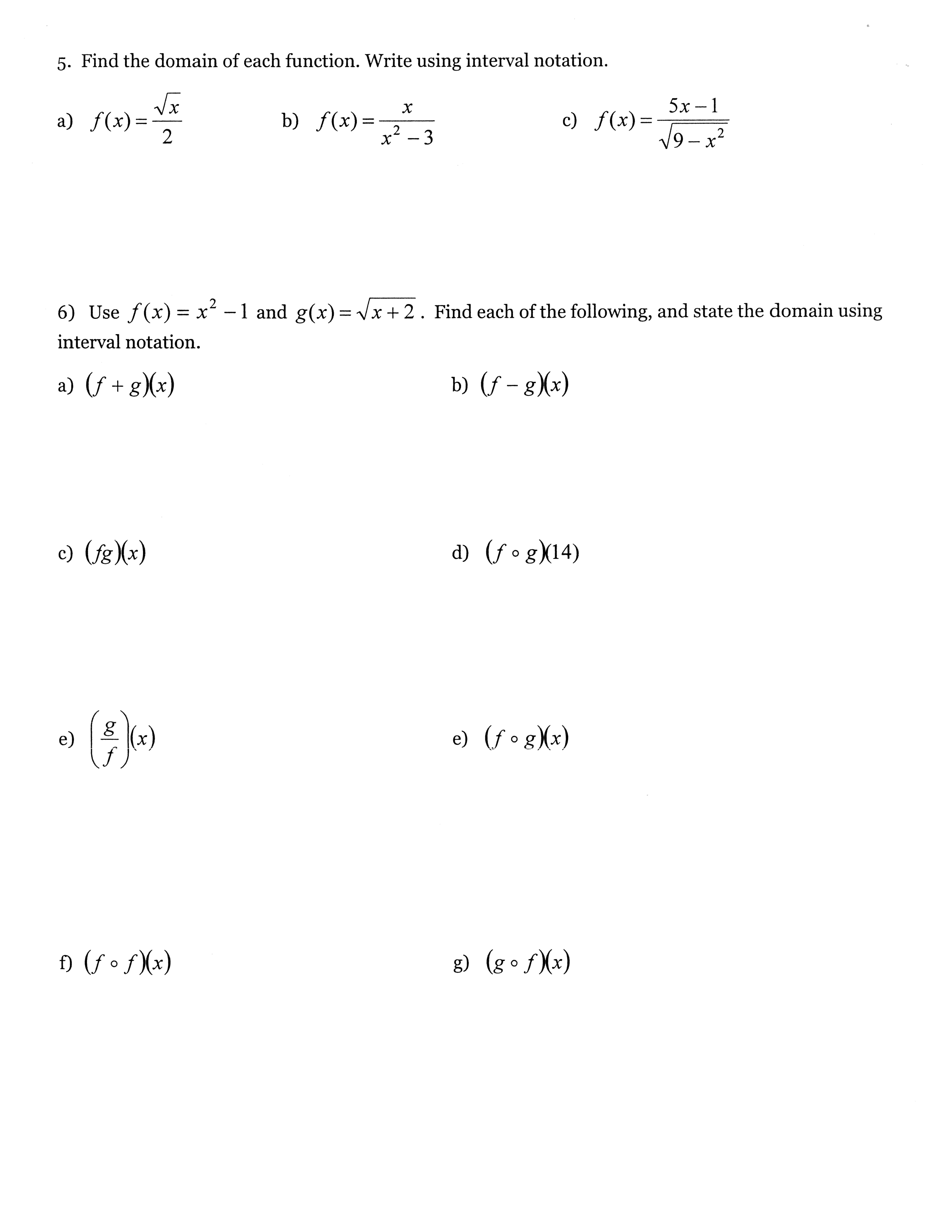
Graph the piecewise function.
a) Find the domain of the function in interval notation.
b) Choose the correct domain of the function in interval notation. Use inf for infinite.
c) Find the domain of the function in interval notation.
Determine f + g.
State the domain of f + g. Use inf for infinite.
Determine fg.
State the domain of fg.
Determine g/f. Use / to get a fraction in typing your response.
State the domain of g/f. Use inf for infinite.
Determine g(f(x)).
State the domain of g(f(x)). Use inf for infinite.
a) Determine whether the inverse of f(x) is a function. Explain your reasoning.
b) Determine whether the inverse of f(x) is a function. Explain your reasoning.
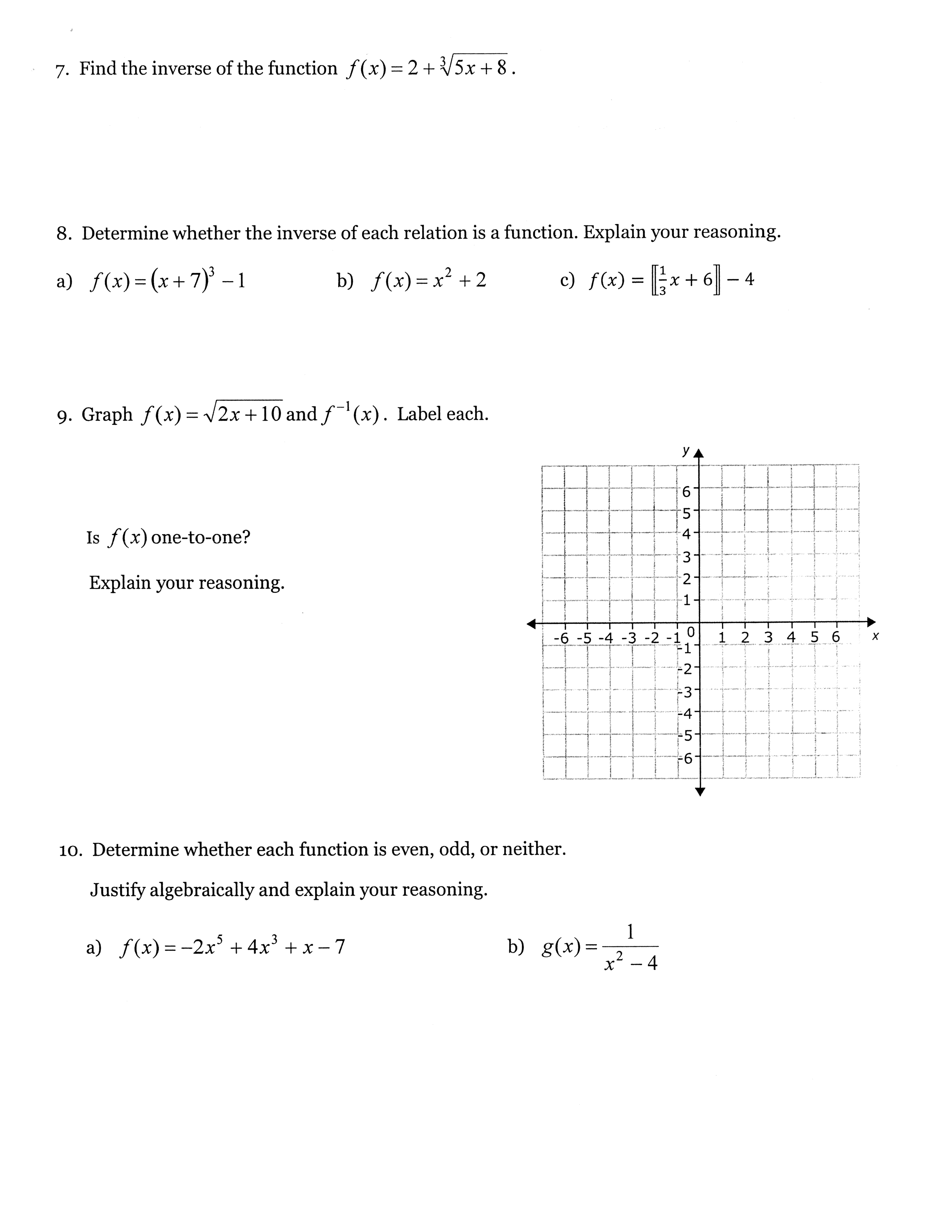
Use Desmos to graph both f(x) and inverse of f(x).
Is f(x) one-to-one? Explain your reasoning.
a) Determine whether f(x) is even, odd, or neither. Justify your reasoning algebraically.
b) Determine whether g(x) is even, odd, or neither. Justify your reasoning algebraically.