HPC Unit 1 Test Version B REVISED
star
star
star
star
star
Last updated about 2 years ago
15 Nsɛmmisa
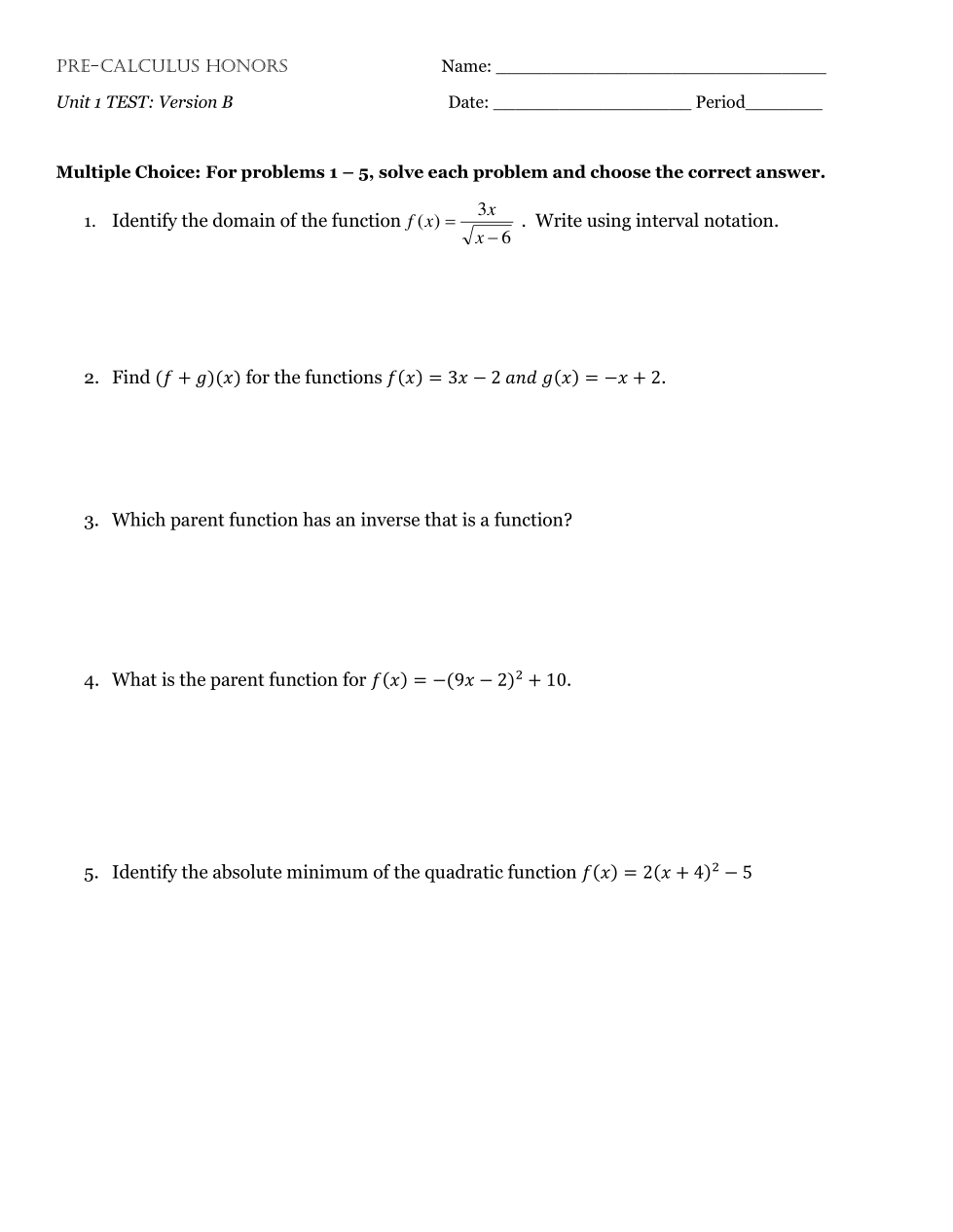
Identify the domain of f(x) in interval notation. Use inf for infinity.
Find f + g.
Which parent function has an inverse that is a function?
What is the parent function of f(x)?
Identify the absolute minimum of f(x).
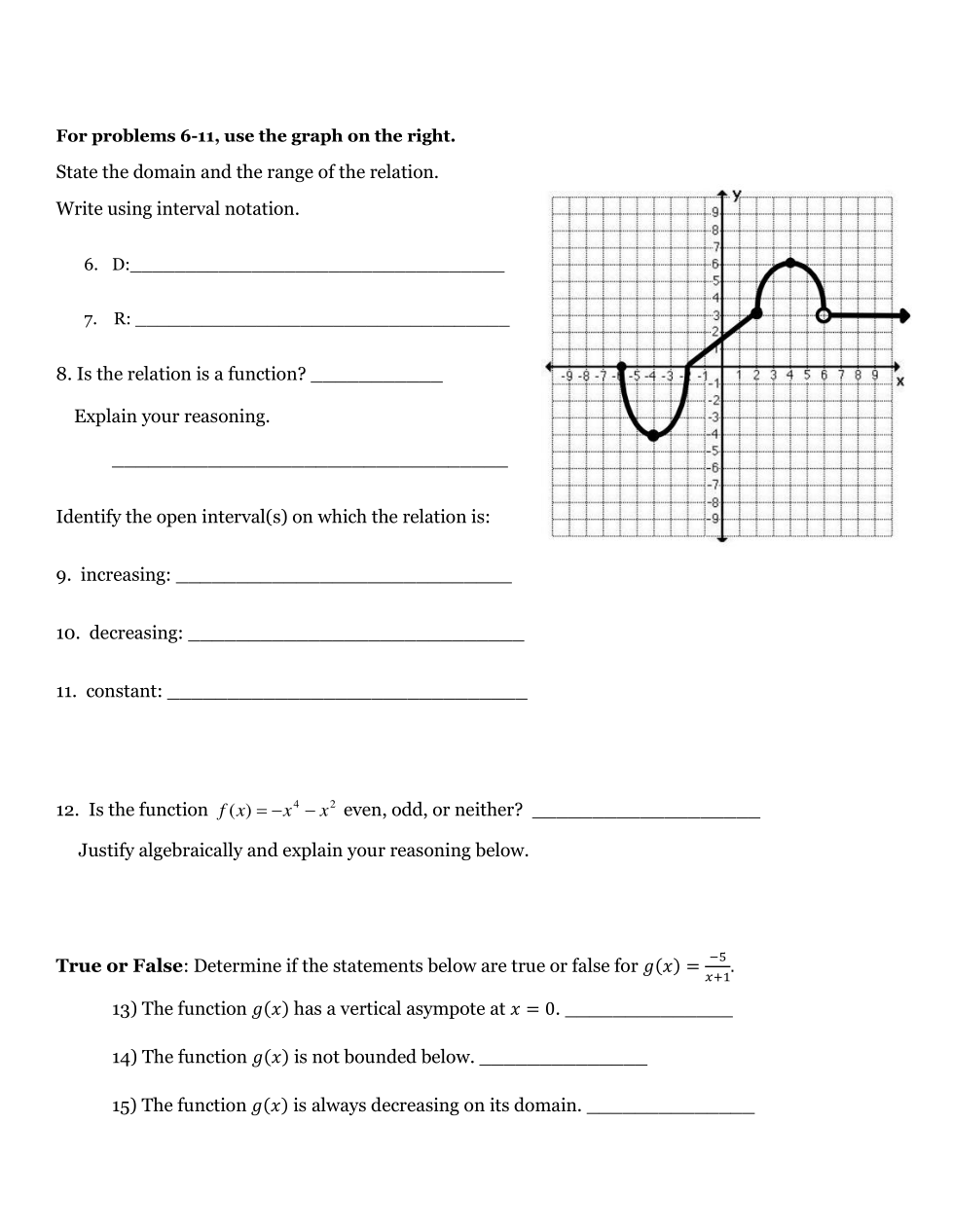
State the domain of the relation in interval notation. Use inf for infinity.
State the range of the relation in interval notation. Use inf for infinity.
Is the relation a function? Explain your reasoning.
Identify the open interval(s) on which the relation is increasing. Use inf for infinity.
Identify the open interval(s) on which the relation is decreasing. Use inf for infinity.
Identify the open interval(s) on which the relation is constant. Use inf for infinity.
Is f(x) even, odd, or neither? Justify your reasoning alegbraically.
The function g(x) has a vertical asympote at x = 0.
The function g(x) is not bounded below.
The function g(x) is always decreasing on its domain.