Log in
Sign up for FREE
arrow_back
Library

Unit 5 Day 7 Linear Model Practice: creating, application, check residual plot

star
star
star
star
star
Last updated almost 5 years ago
24 questions
4
2
4
4
4
4
4
4
4
4
4
4
4
4
4
4
4
4
4
4
4
4
4
4
Question 1
1.

Question 2
2.

In question #1, what variable is being used to predict what variable?

Hint: we use the explanatory variable to predict the response variable...

Question 3
3.

Data was collected from a group of children.
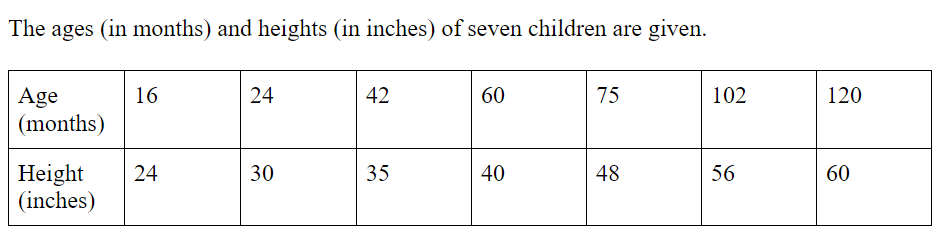
Check the appropriateness of using a linear model by saving the linear equation and graphing the residuals.
1. Stat, calc, #8LinReg, 'store RegEq', VARS, Y-VARS, y=, enter, calculate.
2. Now graph the residuals on a scatterplot:
change the Ylist to RESID (2nd, Stat, choose RESID), zoomstat (zoom9)
What do you see?
Select the two correct answers.

Question 4
4.

Data was collected from a group of children.

Do the linear regression again to find the slope and intercept.
Round the slope (b) and intercept to 2 places past the decimal.
Create the linear model in the space below.
Use ' -hat' to indicate the variable that is being predicted.
Put no spaces between numbers, words and symbols.

Ask me to check your equation if it shows incorrect.

Question 5
5.

Use the linear model (regression equation) from #4 to predict the height of a child who is 4.5 years old.
Hint: you need to change years to months so the units match!

Round your answer as 2 places past the decimal.
Use units in your answer.

Question 6
6.

Use the linear model (regression equation) from #4 to predict the height of someone who is 20 years old.
Hint: you need to change years to months so the units match!

Question 7
7.

Question 8
8.

Clear your y= so the regression equation from previous problems is gone.
Use the data in the following table to decide if doing a linear regression to create a linear model is appropriate:

Create a scatter plot of the data above by entering the data into 2 lists, then check the three conditions.
Is it appropriate to calculate the correlation coefficient and create a linear model?
Select one answer.

Question 9
9.

Question 10
10.

Question 11
11.

Question 12
12.

Question 13
13.

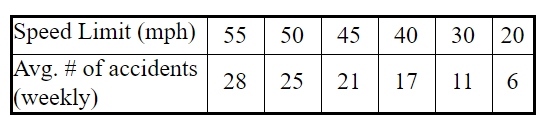
Use the data table below comparing speed limit (mph) vs # accidents(weekly):

Do the linear regression again if you didn't write down the slope and intercept.
Use the 'a' and 'b' values to create the linear model,
round the values to two places past the decimal.

Enter the linear model below with no spaces, be sure to use ' -hat' to indicate which variable is being predicted.

For Speed Limit: use 'speed'
For Avg. # accidents: use 'accidents'

Question 14
14.

Use your linear model for predicting the # of accidents from #13.
Predict the number of accidents that will occur in one week if the speed limit is 35 mph.

Include units in your answer. Keep the places past the decimal.

Question 15
15.

If we had an actual data point for 35 mph of: (35, 18)
Remember ordered pairs are (units x, units y)

What is the residual?
Use units in your answer.

Question 16
16.

What does the residual indicate about the linear model?
(explain the residual)

Question 17
17.

Use the data table below comparing speed limit (mph) vs # accidents(weekly):

Using the regression equation from #13, predict the number of accidents for 55 mph.
Enter your answer below, include units.

Question 18
18.

Explain the residual.
Did the linear model overpredict or underpredict?

Question 19
19.

Question 20
20.

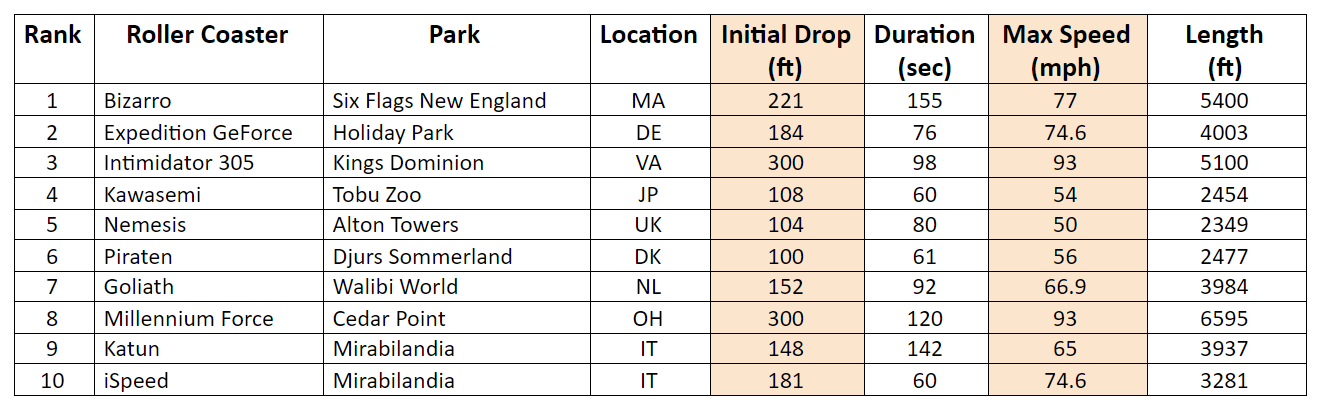
Use the roller coaster data to compare the initial drop height to the maximum speed (the highlighted columns).

Using the linear regression information from #19, create the linear model for predicting the max speed of the roller coaster based on the initial drop height.
Round to two places past the decimal.
Use ' -hat' to indicate which variable is being predicted.
Use 'speed' and 'height' for your variables.

(Ask me to check your equation if it stays red.)

Question 21
21.

Use your equation from #20 to predict the max speed of the roller coaster Supreme Scream at Knottsberry Farm (I've ridden it! There are no shoulder bars).
The Supreme Scream goes straight up for an initial drop of 252 feet.
How fast does our model predict it goes at it's maximum speed?
I remember it being VERY fast and needing hydraulic brakes to slow down.
Use units in your answer, keep the decimal places.

Question 22
22.

Question 23
23.

Use the Linear Regression information from #22 (the 'a' and the 'b') to create a linear model for using the max speed to predict the initial drop height of a roller coaster.
Enter your equation, be sure to use ' -hat' to indicate which variable is being predicted.

Use the variables 'speed' and 'height'.
Round the decimals to two places.
Use no spaces.

Question 24
24.

Use the new linear model from #23 to predict the height of the initial drop for a roller coaster that has a max speed of 70 mph (the speed limit on 1604 and parts of Hwy 35!).

Round your answer to 2 places past the decimal.
Include units of 'ft'.

Data was collected from a group of children.

Enter the data into lists 1 & 2 (stat, edit).
Create a scatter plot (Statplot, scatterplot, make sure Xlist & Ylist are correct, zoomstat),
does it appear that the three conditions are met?
Select the correct answers.
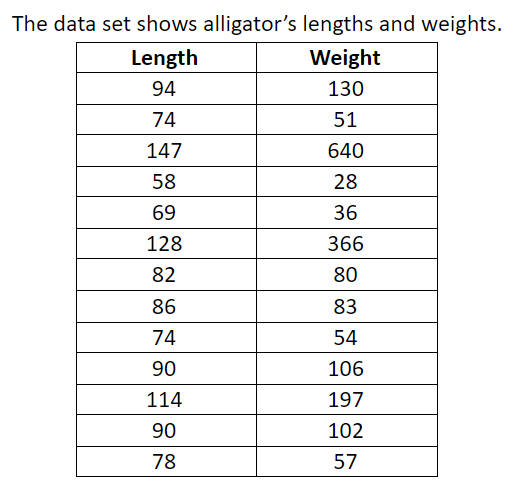
Yes, the scatterplot does not show any large outliers.
Yes, the data is quantitative.
No, the data is not quantitative.
Yes, the scatterplot shows a nearly linear relationship
No, the scatterplot shows large outliers.
No, the scatterplot does not show a nearly linear relationship.
Fairly random scatter.
Possible slight curve, we may need more data to verify.
Purely random scatter.
Strong curve or bend.
Convert your answer from #6 to feet.

Does this make sense?
There are three correct answers.
8.5 feet
Yes, people continue to grow throughout their lives.
No, the model has limitations, people do not continue to grow throughout their lives.
85 feet
This is extrapolation, which is when we make a prediction beyond the range of our x values for our data. Extrapolation does NOT give reliable predictions.
This is not extrapolation, our model is good no matter how old the person is.
5.8 feet
Use the data in the following table to decide if doing a linear regression to create a linear model is appropriate:

Even though the curve in the scatterplot indicates a linear regression is not a good idea, let's create one anyway so we can observe the residuals.
Do a linear regression (stat, calc, #8LinReg)
Make sure to use 'storeRegEqn', VARS, Y-VARS, y=, enter, calculate
Check the Residual Plot - change the ylist to RESID (use 2nd, Stat, select 'RESID'), zoomstat
1. What do you see?
2. What does this mean?
Select BOTH answers.
This means the linear model is definitely NOT appropriate to use to make predictions.
The linear model may not be appropriate to make predictions.
I see a slight curve.
I see a definite curve.
This means the linear model is definitely appropriate to make predictions.
I see random scatter.
Use the data table below comparing speed limit (mph) vs # accidents(weekly):

Create the scatterplot, does it appear appropriate to create a linear model?
Why?
Choose ALL the correct answers.
No, the data is not quantitative.
No, the scatterplot shows a definite curve.
Yes, the data is quantitative.
No, the scatterplot shows large outliers.
Yes, the scatterplot shows a form that is nearly linear.
Yes, the scatterplot shows no large outliers.
Use the data table below comparing speed limit (mph) vs # accidents(weekly):

Now use the data to create the scatterplot of the residuals.

1. Do a linear regression (stat, calc, #8LinReg),
2. store the residuals ('storeRegEqn', VARS, Y-VARS, y=, enter, calculate)
3. For the scatterplot make the YList: RESID (use 2nd, Stat, select RESID)
4. Use zoomstat to show the residual plot.

Does the residual plot show that it is appropriate to use the linear model?
Why, what do you see?
Choose ALL the correct answers.
No, the linear model is not appropriate to use to make predictions.
The residual scatterplot shows mostly random scatter.
The residual scatterplot shows a strong curve.
Yes, the linear model is appropriate to use to make predictions.
The residual scatterplot does not show random scatter.
Yes, but the residual scatterplot shows a possible pattern, we may need to collect more data.
Use the data table below comparing speed limit (mph) vs # accidents(weekly):

Which variable will be the explanatory and which will be the response variable?
How will you use the variables to make a comparison?
Select all the correct answers:
The response variable will be the # of accidents.
I will use the # of accidents to predict the speed limit.
The explanatory variable will be the # of accidents.
I will use the speed limit to predict the # of accidents.
The explanatory variable will be the speed limit.
The response variable will be the speed limit.
I can't use the data to make predictions, it's not possible.
Use the roller coaster data to compare the initial drop height to the maximum speed (the highlighted columns).

1. Observe the scatterplot:
Enter the data into L1 & L2.
Make sure y= is cleared.

2. Now do a linear regression and store the residuals (see #11 for instructions).

3. Create a scatterplot with the residuals, choose Ylist: RESID

Is it appropriate to use the linear model to make predictions?
Choose all correct answers.
No, there is a strong curve to the residual plot.
Yes, the residual plot shows mostly random scatter.
No, the scatterplot has large outliers.
Yes, the scatterplot has a strong linear relationship.
No, the residual plot has random scatter.
Yes, the scatterplot uses quantitative data and no outliers.
Keep the data from the roller coasters in your calculator.
NOW we want to predict the initial drop height of a roller coaster based on its max speed.

Remember what we did in our class activity? We reversed the lists and created a NEW equation.
Do that!
1. Do a linear regression (Stat, Calc, #8LinReg), switch the Xlist to L2 (2nd, 2) and the Ylist to L1 (2nd, 1).

2. Store the residuals while doing the regression ('storeRegEqn', VARS, Y-VARS, y=, enter, calculate).

3. Check the residual scatterplot, is it appropriate to use the linear model to predict the initial drop height?

Select all the correct answers.