Log in
Sign up for FREE
arrow_back
Library

8th Grade Unit 3 Assessment

star
star
star
star
star
Last updated over 5 years ago
27 questions
1
1
1
1
1
1
1
1
1
1
1
1
1
1
1
1
1
1
1
1
1
1
1
1
1
1
1
Question 1
1.

Question 2
2.

Question 3
3.

Question 4
4.

Question 5
5.

Question 6
6.

Question 7
7.

Question 8
8.

Question 9
9.

Question 10
10.

Question 11
11.

Question 12
12.

Question 13
13.

Question 14
14.

Question 15
15.

Question 16
16.

Question 17
17.

Question 18
18.

Question 19
19.

Question 20
20.

Question 21
21.

Question 22
22.

Question 23
23.

Question 24
24.

Question 25
25.

Question 26
26.

Question 27
27.

Read the origin of the word deduce:

From the Latin de- (“down”) + ducere (“lead”)

Based on this information, what is the meaning of the word deduced in paragraph 2?
A. Reached the conclusion
B. Made the assumption
C. Wrote down the rules
D. Established the revolution
The organizational pattern of the selection allows the author to —
F. explain how the revolution unfolded over time
G. highlight the main people involved in the revolution
H. compare different scientists’ experiences of the revolution
J. describe how the revolution affected ordinary people
The section headers in the selection emphasize the idea that the Scientific Revolution —
A. depended primarily on Newton’s discoveries
B. unfolded over more than 200 years
C. centered around the work of astronomers
D. centered around the work of astronomers
Which sentence from the selection best demonstrates that scientists of the revolution risked a great
deal to make their discoveries known to the public?
F. It was only after he received some favorable early reactions to his book that he chose to publish it.
G. In its final published form, the book is credited with advancing and clarifying Copernicus’s theories.
H. Upon his admission that he supported the Copernican theory, he was convicted and spent the rest of his life under house arrest.
J. That is to say that after Newton, the discoveries made during the Scientific Revolution were no longer considered heretical, but factual.
What are paragraphs 7 and 8 mainly about?
A. Newton’s emotional troubles
B. Newton’s laws of physics
C. Newton’s argument with Hooke
D. Newton’s work and life
Read paragraph 1 from the selection. Choose the phrase that best demonstrates why the U.S. and
Russia were in a “race to space.”

Space travel in the 1960s wasn’t just about NASA making progress in their efforts to understand our
world and the galaxy it sits in. Space travel at that time was also about international relations. The
United States and its main rival, Russia, were engaged in a “race to space.” Both countries wanted to
be the first ones in space, and the first to orbit Earth. In April of 1961, Russian cosmonaut Yuri
Gagarin became the first person in space, and his spacecraft orbited Earth one time.
F. its main rival
G. his spacecraft orbited Earth
H. efforts to understand our world
J. NASA making progress
What is paragraph 2 mainly about?
A. John Glenn’s personal and military history
B. The risks and rewards of sending Friendship 7 into space
C. The dangers John Glenn faced during his orbits of Earth
D. The tensions between Russia and the United States
The organizational pattern of the selection allows the author to —
F. highlight how scientific advancement and politics always intersect
G. examine the chronology of events in America’s first Earth orbit
H. compare the space programs of Russia and the United States
J. explain the main factors involved in the first American Earth orbit
Read the origin of the word subsequent.

From the Latin sub- (“closely, up to”) + sequi (“follow”)

Based on this information, what is the meaning of the word subsequently in paragraph 5?
A. Followed
B. Next
C. Closer
D. Eventually
The author mentions Russia in paragraphs 1 and 5 most likely to —
F. put the American space program in historical and political context
G. explain how difficult it was for Americans to lose the race to space
H. show the reader how knowledgeable she is about international relations
J. highlight John Glenn’s military past and wiliness to fight for his country

Which sentence from the selection best states its controlling idea?
A. In April of 1961, Russian cosmonaut Yuri Gagarin became the first person inspace, and his spacecraft orbited Earth one time.
B. Glenn didn’t know it, but this was only the first sign that something wasn’t right, and that his trip around Earth would be bumpy.
C. Had the heat shield torn off, for example, the capsule would have burned up as it reentered Earth’s atmosphere.
D. Hard as it is to believe, more than one man’s life was at stake if this mission had failed.
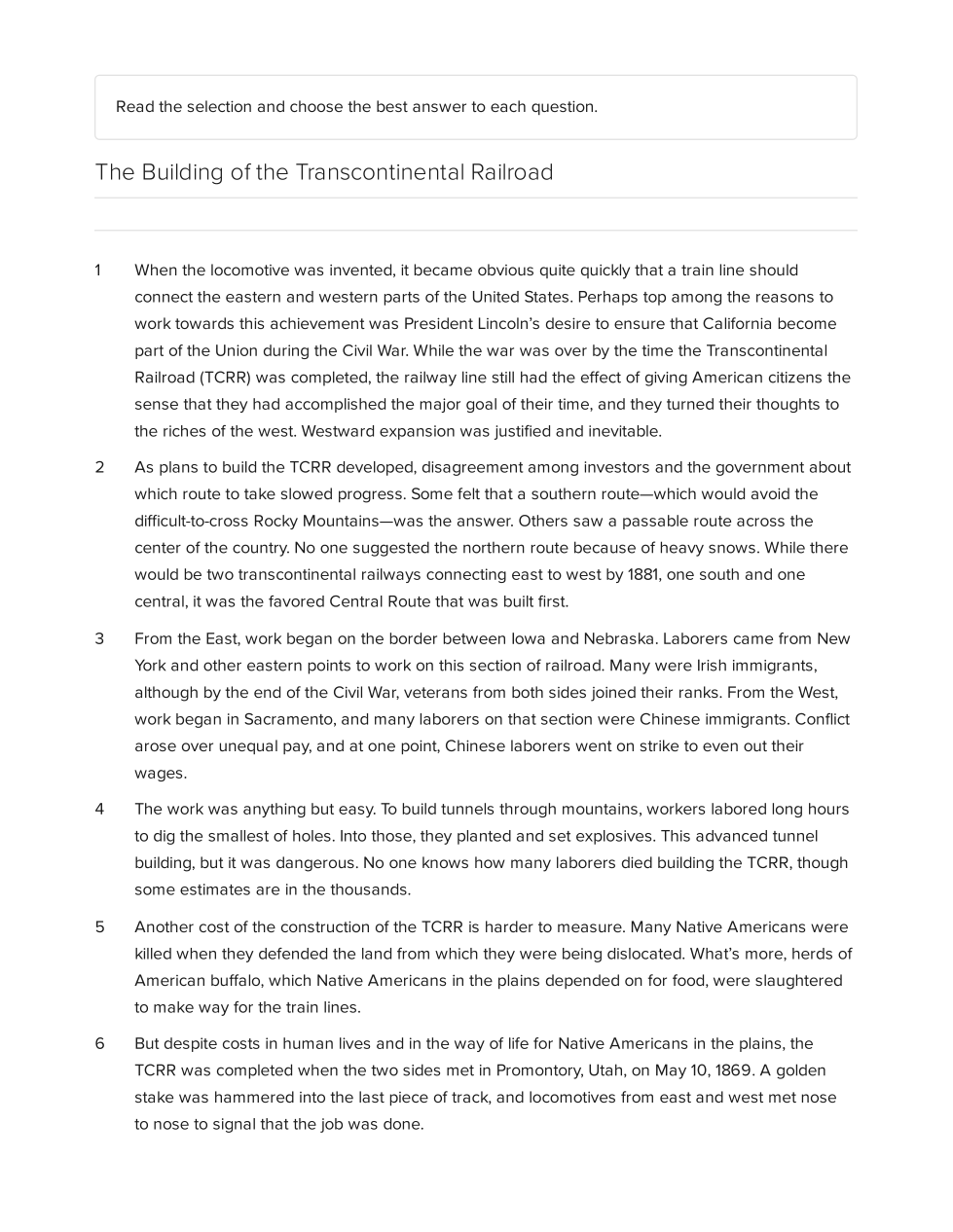
Which sentence from the selection best demonstrates that the Transcontinental Railroad was an
important step in achieving Manifest Destiny?
F. While the war was over by the time the Transcontinental Railroad (TCRR) was completed, the railway line still had the effect of giving American citizens the sense that they had accomplished the major goal of their time.
G. Many were Irish immigrants, although by the end of the Civil War, veterans from both sides joined their ranks.
H. This allowed for increased trade and movement between the regions and, more than anything, brought a feeling of hope and unity to many people in the country.
J. Manifest Destiny was heralded as complete by newspapers across the nation.
Which sentence from the selection best states its thesis?
A. When the locomotive was invented, it became obvious quite quickly that a train line should connect the eastern and western parts of the United States.
B. As plans to build the TCRR developed, disagreement among investors and the government about which route to take slowed progress.
C. A golden stake was hammered into the last piece of track, and locomotives from east and west met nose to nose to signal that the job was done.
D. The TCRR brought the trip between East and West down from six months to two weeks.
What is the best summary of the main idea of paragraph 2?
F. There were many good route options in building the TCRR.
G. There was only one viable route option in building the TCRR.
H. The conflict about the route for the TCRR was both political and economic.
J. The disagreements about route options for the TCRR were resolved.
The author reveals the important historical details of building the TCRR by —
A. giving a chronological account of building the railroad
B. comparing the TCRR with the rail system of the east
C. highlighting the major achievements and challenges of the effort
D. demonstrating the main ideas through graphic features
What is the best summary of the main idea of paragraph 4?
F. Building the TCRR was difficult and dangerous work.
G. Using explosives helped advance tunnel building.
H. Many laborers died while working on the TCRR.
J. Many mountains were damaged by the work on the TCRR.
Read the origin of the word dislocate.

from Latin dis- (“away”) + locare (“to place”)

Based on this information, what is the meaning of the word dislocated in paragraph 5?
A. Removed from
B. Put away
C. Sent along
D. Returned home
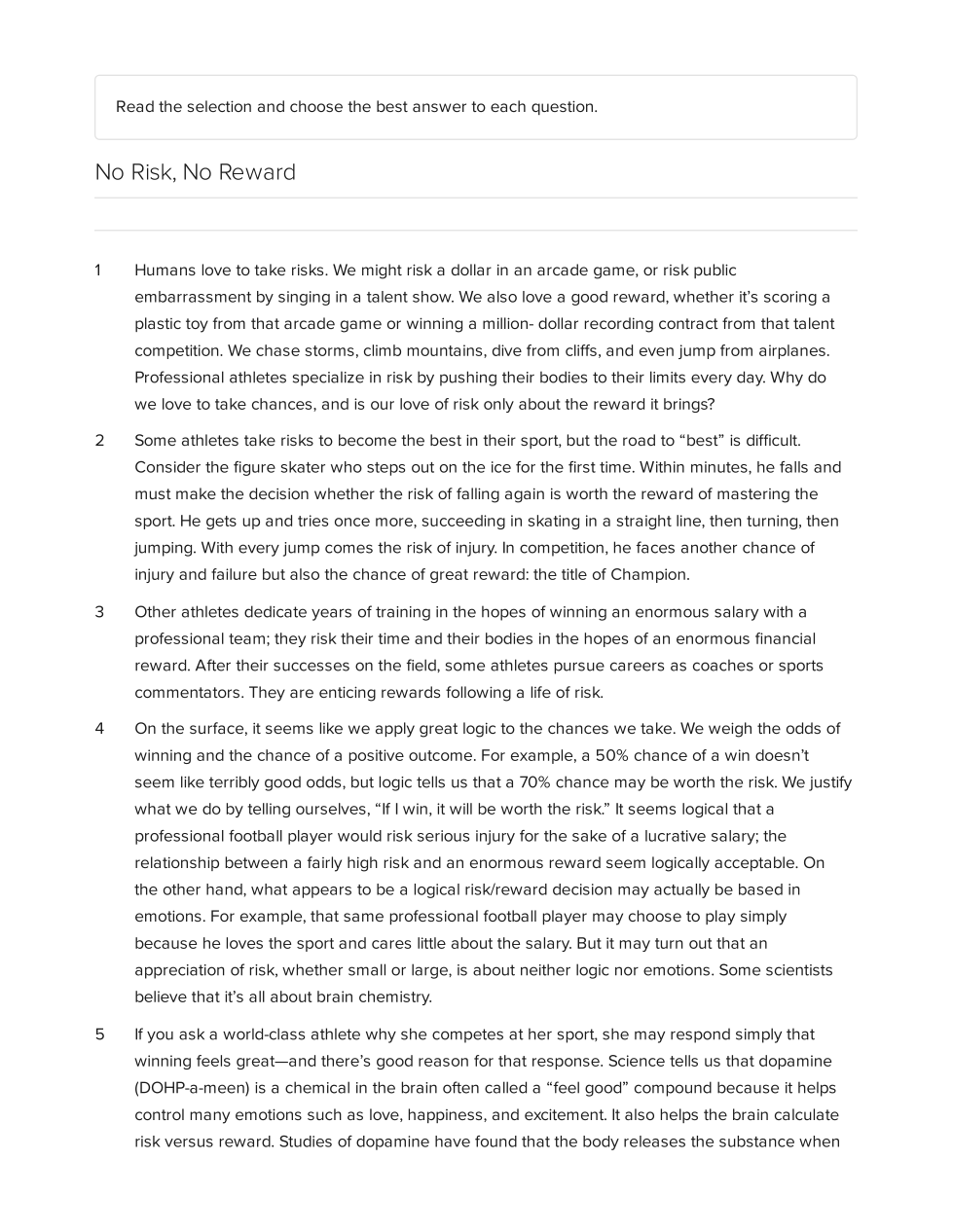
Which sentence from paragraph 1 best states the controlling idea?
F. We also love a good reward, whether it’s scoring a plastic toy from that arcade game or winning a million-dollar recording contract from that talent competition.
G. We chase storms, climb mountains, dive from cliffs, and even jump from airplanes.
H. Professional athletes specialize in risk by pushing their bodies to their limits every day.
J. Why do we love to take chances, and is our love of risk only about the reward it brings?
The author includes information in paragraphs 2 and 3 probably to —
A. explain how people are motivated by different rewards
B. describe how risky professional sports can be
C. demonstrate that all risk comes with great rewards
D. show how hard it is to be a professional figure skater
Which statement best summarizes paragraph 4?
F. The decision to engage in risky behavior is logical.
G. The decision to engage in risky behavior is emotional.
H. The decision to engage in risky behavior is both logical and emotional.
J. The decision to engage in risky behavior appears logical and emotional, but may be rooted in brain chemistry.
What kind of evidence does the author use in paragraph 5 to support the idea that the brain controls
decision making?
A. Personal testimonies
B. Scientific studies
C. Examples
D. Statistics
Read this sentence from paragraph 5.

The same thing might be said about our own brains the first time we nervously ask our crush to the
school dance.

The author compares the brain of an Olympic athlete to the brain of a student in order to —
F. show how dopamine works in the brain for all kinds of risks
G. contrast how dopamine works for Olympic athletes against students
H. compare the risk of snowboarding to the risks of asking someone to dance
J. describe how young brains are different from mature brains
The organization within paragraph 6 allows the author to —
A. show how technology affected the size and shape of parachutes
B. explain the connection between advances in technology over time and risk taking
C. describe how the number of skydiving injuries have lessened
D. compare modern skydiving to its origins
Which phrase best indicates the organizational pattern in paragraph 6?
F. have heavily influenced
G. By the 1970s
H. skydivers added tricks and stunts
J. all-important oxygen and life-support systems
What is the best summary of this selection?
A. People enjoy high-risk activities because, like professional athletes, they love to push their bodies to their limits. If it’s likely that we’ll succeed at doing something and the risk of injury is low, we’re willing to try it for the sake of fame or fortune.
B. In 1797, the first parachutes were used in Paris, and taking risks became much more commonplace. By the time skydivers were jumping from high altitudes, science had discovered that the brain produces a compound called dopamine to help regulate the risks we take.
C. Everyone likes to be a champion, and this is the primary reason why we take risks. Another reason why we take chances is because doing so leads to fame and fortune. Alan Eustace is a great example of someone who gained terrific fame for high-altitude skydiving.
D. While it’s unclear exactly why people like to take risks, we know that reward is a large factor. People often invest time and effort in deciding whether to take a risk, but it could be that brain chemistry contributes to the decision. As technology makes life safer, we often reach for greater risks because we enjoy taking chances.
Which best describes the organizational pattern of paragraph 7?
F. The information in the paragraph follows the order of the selection.
G. The author lists information according to its order of importance.
H. The paragraph order follows a before-and-after pattern.
J. The author narrates a story about how people have taken risks.
The organizational pattern of the selection allows the author to —
A. describe first the costs and then the benefits of taking risks
B. argue one reason why people take risks
C. examine different possible reasons why people take risks
D. support people who choose to take risks