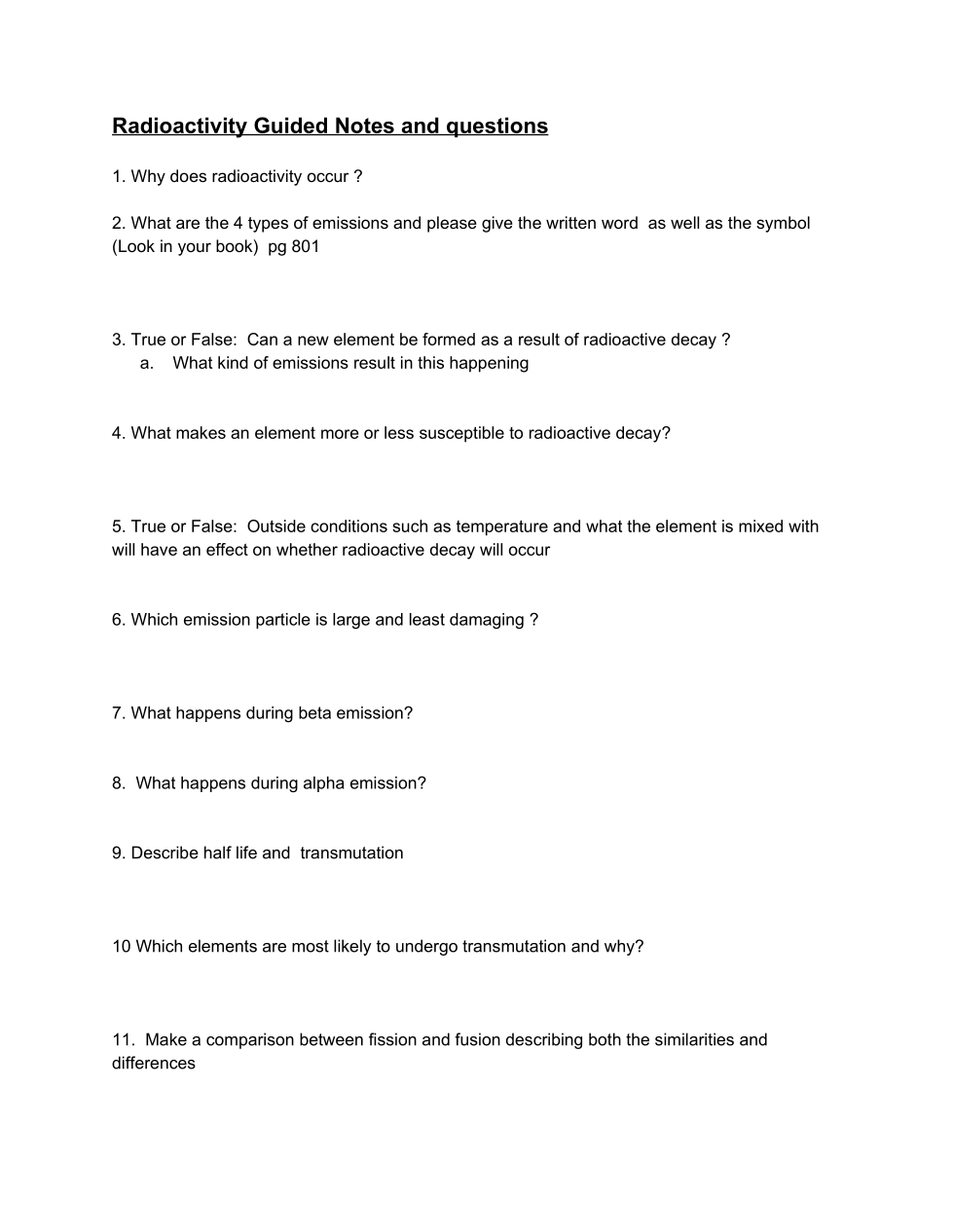
Radioactivity
What is radiation?
Which of the following are ionizing waves
What happens if an atom has too many or too few neutrons in it's nucleus
What do we call an atom with an unstable nuceus
What are the types of radioactive particles
What is radioactive decay
What is half life
There are two types of radiation, one has do do with electomagnetic waves that travel through the air and the other has to do with nuclear unstablilty due to unstable istopes called radioisotopes
Electromagnetic radiation is often harmless and we are exposed to it often
Radiation that has enough energy to remove an electron from an atom is considered dangerous and is called nonionizing radiation.
If you are exposed to a large dose of radiation is can result in
If you are exposed to radiation
What are two ways to reduce your risk to radiation exposure ?
Do you know what causes an element to be radioactive and what we call an element that is radioactive.
Do you clearly understand what nuclear radiation is and how it is different from electromagnetic radiation ?
Do you know the 3 particles that can be emmitted from a radioactive isotope and how to write it out in a nuclear equation?
Do you know what transmutation is and can you predict if it will occur?
Do you know what half life is and how to calculate it?
What would you rate this activity in terms of helping you to know and understand the above objectives.
1 would be didn't help at all and 5 would extremely helpful. Please add comments in addition to rating that describes how it can be improved to help your own personal learning