Unit 5 Day 3 Correlation Practice #2

Last updated over 4 years ago
26 questions
4

Data was collected by an insurance company on the speed driven and accidents reported. Use the table below to analyze the possible relationship between speed and # of accidents.
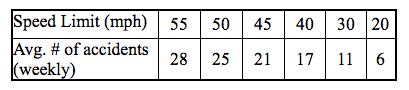
Clear List 1 and List 2, enter the data into L1 & L2.
Create a scatterplot using Statplot #1, ZoomStat (9).
Describe the relationship between speed and average # of accidents.
Select all that apply.

4

Data was collected by an insurance company on the speed driven and accidents reported. Use the table below to analyze the possible relationship between speed and # of accidents.


Use the scatterplot from #15, interpret the relationship between speed and average # of accidents.


4

Data was collected by an insurance company on the speed driven and accidents reported. Use the table below to analyze the possible relationship between speed and # of accidents.


Use the scatterplot from #15:
1. What are the three conditions that need to be met to calculate the correlation coefficient (r)?
2. is it appropriate to calculate the correlation coefficient?
Select all four answers:

4

Data was collected by an insurance company on the speed driven and accidents reported. Use the table below to analyze the possible relationship between speed and # of accidents.


Use the information above (entered in L1 & L2)
Calculate the correlation coefficient (r).
Stat, Calc, #8 LinReg(a+bx)
Round your answer to three places past the decimal.

4

Men's 1500 meter run Olympic Gold Medal times were recorded for comparison in the table below.

Enter the data into your Ti-84, Stat, Edit.
To enter the year, use the number of years since 1900.
Ex. 1920=20, the year 2012= 112
Make sure you remember in which lists you enter the data, it's your choice.

Create a scatterplot of the data to show the relationship between year and time.
Describe the relationship between year and time for the men's 1500m run.

4

Men's 1500 meter run Olympic Gold Medal times were recorded for comparison in the table below.


Use the scatterplot created in #5.
Interpret the relationship between year and time for the men's 1500m run.

4

Men's 1500 meter run Olympic Gold Medal times were recorded for comparison in the table below.

Using the scatterplot created in #5, is it appropriate to calculate the correlation coefficient?

4

Men's 1500 meter run Olympic Gold Medal times were recorded for comparison in the table below.

Calculate the correlation coefficient.
Stat, Calc, #8 LinReg(a+bx).
Enter the correlation coefficent, round to three places past the decimal if needed.

4

Another group of 10 adults were studied, their heights and weights were recorded in the table below.

Enter the data into lists in your calculator. Make sure you remember/know which lists they are in.
Create a scatterplot using Ht. as the Xlist and weight as the Ylist.
Describe the relationship between height and weight for this group of adults.

4

Another group of 10 adults were studied, their heights and weights were recorded in the table below.

Using the scatterplot created in #9, is it appropriate to calculate the correlation coefficient?
Why or why not

4

If a group of data has a correlation coefficient of -0.875, what does this tell you about the description of the scatterplot?
It will be...

4

If a group of data comparing grades and hours studied has a correlation coefficient of 0.452, what does this tell your about the relationship?

4

Your friend conducts a study and reports: 'I have found a strong correlation between eye color and gender'.
Is this statement true or false?
Explain why.
Select both correct answers.

4

Identify what is wrong with each of the following statements.
Match each statement to the reason why it is incorrect.
There will be one left over reason.

Draggable itemCorresponding Item
If we were to measure Olympic gold medal times for the 800 m hurdles in minutes instead of seconds the correlation would be -0.66/60 = -0.011.
Correlation does not have units, it is an r value only.
The correlation between Olympic gold medal times for the 100 m dash and year is -1.37.
Correlation values are only from -1.0 to +1.0, they will never be outside that range.
Since the correlation between Olympic gold medal times for the 800 m hurdles and 100 m dash is -0.41, the correlation between 100 m dash times and the 800 m hurdles is +0.41.
Changing the x & y axis for the scatterplot does not change the correlation coefficient. The correlation remains the same.

The correlation coefficient does not change if different units are used. It is not affected by scaling or shifting.
The correlation between Olympic Gold Medal times for the 800 m hurdles and year is -0.66 seconds per year.
Correlation coefficients cannot be negative.
4

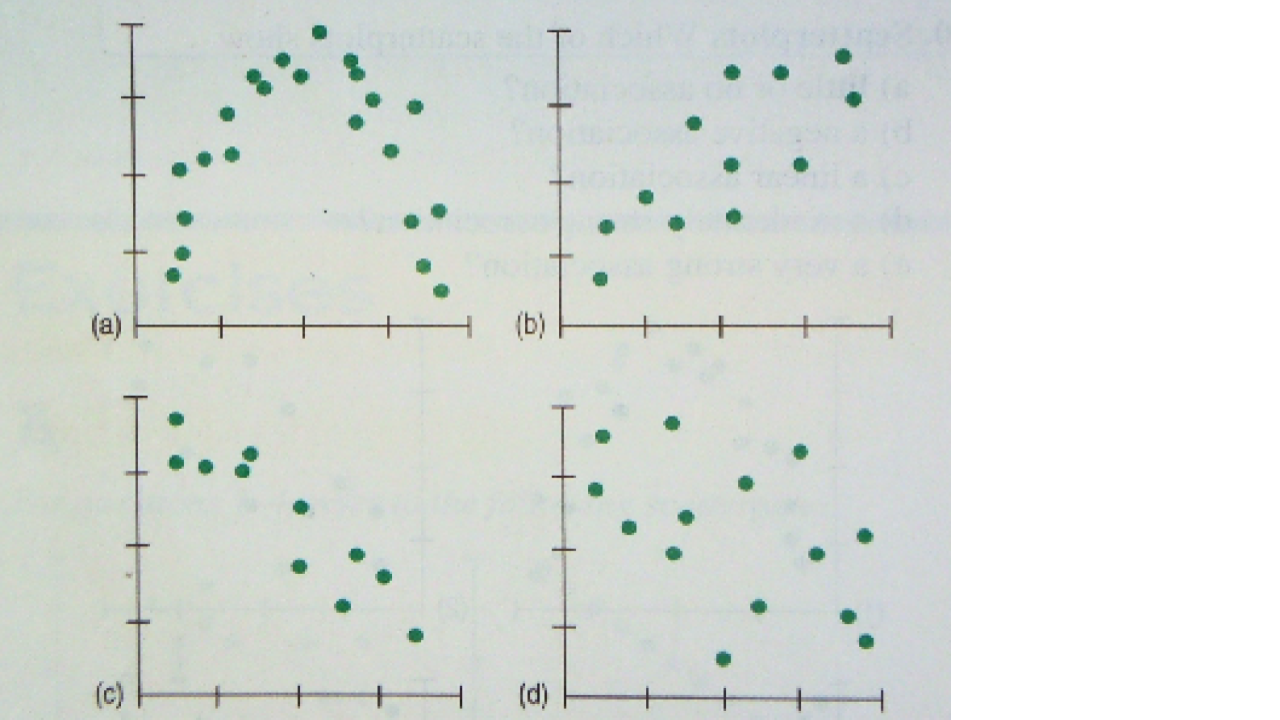
Select the scatterplot that shows a STRONG relationship between x and y,
yet has a correlation coefficient of r=0.
A. B. C. D.

4

A study by a prominent psychologist found a moderately strong positive association between the number of hours of sleep a person gets and the person's ability to memorize information.
What does this positive association mean?

4

A survey of the world's nations in 2004 showed a strong positive correlation between percentage of the country using cell phones and life expectancy in year at birth.
Does this mean cell phones are good for your health?

4

A survey of the world's nations in 2004 showed a strong positive correlation between percentage of the country using cell phones and life expectancy in year at birth.
What might explain the strong correlation?
What might be the lurking variable?

4

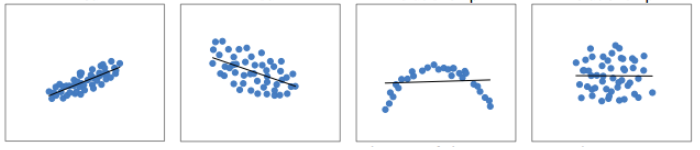
Use the following graphs to answer the question:

Which plot shows a relationship that is approximately linear?

4

Use the following graphs to answer the question:

Which plots show a relationship that is very strong?

4

Use the following graphs to answer the question:

Which plot shows a relationship that is negative?

4

Use the following graphs to answer the question:

Which plot shows a relationship that has a correlation near zero?

4

Use the following graphs to answer the question:

Which plot shows a moderately strong association?

4

Suppose you were to collect data for the variables altitude and temperature when climbing mountains.
Which would be the explanatory variable?
Which would be the response variable?
What form, direction and strength do you think you would observe?

4

Suppose you were to collect data for the variables distance and time delay when predicting how far away a lightening strike occurred.
Which would be the explanatory variable?
Which would be the response variable?
What form, direction and strength do you think you would observe?

4

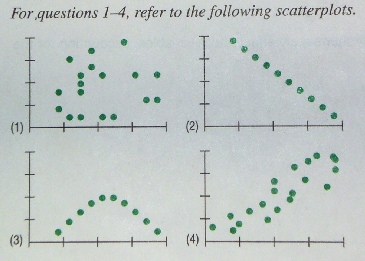
Use the following four graphs, match each graph to the corresponding correlation coefficient (r).

Draggable itemCorresponding Item

0.006
a
0.777
c
-0.923
d
-0.487
b
0.936