What's Regular About Tessellations?
star
star
star
star
star
Last updated about 5 years ago
8 Nsɛmmisa
3
1
1
1
3
1
1
1
Complete the table using the text box.
Explore using the Tessellation Creator. Experiment with the tool by dragging shapes onto the virtual plane, changing colors, zooming, translating, rotating, copying, and deleting shapes.
https://www.nctm.org/Classroom-Resources/Illuminations/Interactives/Tessellation-Creator/
Which regular polygons will tessellate on their own without any spaces or overlaps?
Are there any mathematical reasons why these are the only shapes that tessellate? Hint: how many degrees are there in a circle?
Is it possible to tile the plane using only regular octagons? Why or why not?
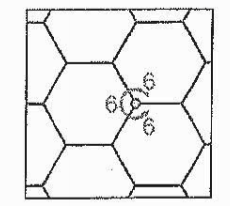
In the previous questions you explored regular tessellations. A regular tessellation is a design covering the plane made using 1 type of regular polygon. A semi-regular tessellation is made using 2 or more types of regular polygons that has a single vertex configuration. With both regular and semi-regular tessellations, the arrangement of polygons around every vertex point must be identical. This arrangement identifies the tessellation. For example, a regular tessellation made of hexagons would have a vertex configuration of {6, 6, 6} because three hexagons surround any random vertex. See the image below.
Use the Tessellation Creator to find at least 2 semi-regular tessellations. Upload a screen shot of your tessellations into the table below. Classify each tessellation by listing the clockwise or counterclockwise configuration of polygons surrounding each vertex. An example has been provided for you.
Jack claims he constructed a semi-regular tessellation with vertex configuration {3, 4, 6}. What do the numbers 3, 4, 6 refer to?
Explain why a semi-regular tessellation with a vertex configuration {3, 4, 6} would not work.
How could Jack revise his vertex configuration so that it would correctly represent a semi-regular tessellation?