Log in
Sign up for FREE
arrow_back
Library

Ohms Law Practice Questions

star
star
star
star
star
Last updated over 5 years ago
25 questions
1
1
1
1
1
1
1
1
1
1
1
1
1
1
1
1
1
1
1
1
1
1
1
1
1
Question 1
1.

The atomic structure of a metal can be describe as

Question 2
2.

Current is

Question 3
3.

Convential current goes from negative to positive

Question 4
4.

The higher the electric potential the more energy can be converted to electron movement (electric current) when there is a closed loop

Question 5
5.

For Current to be present in a circuit

Question 6
6.

The voltage or potential diffence is inversely proportional to the current generated by it

Question 7
7.

Resistance is

Question 8
8.

There is a division of voltage across each branch of circuit components that are in series.

Question 9
9.

The effective resistance of the components in series will be smaller than the largest resistance in the series circuit (all are added together).

Question 10
10.

The total voltage (electrical potential energy) supplied to the circuit.

Question 11
11.

One way of finding the Electromotive Force is by adding all the voltages/potential differences dropped across each component in a circuit.

Question 12
12.

Calculate the current passing through a wire which has a potential difference of 27V flowing through a resistor of 3Ω

Question 13
13.

Calculate the current in a circuit consisting three resistors: 3Ω, 2Ω & 4Ω and a supply voltage of 27V.

Question 14
14.

If there is a break (loose wire) in a series circuit then no current will be in the circuit.

Question 15
15.

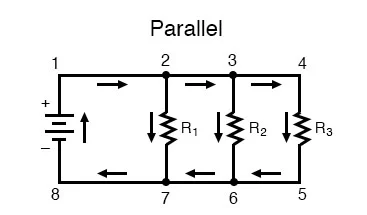
The effective resistance of the components in parallel will be less than the smallest resistance in the parallel configuration.
Question 16
16.

There is no division of voltage across each branch of circuit components that are in parallel.

Question 17
17.

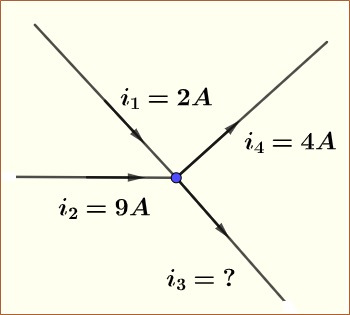
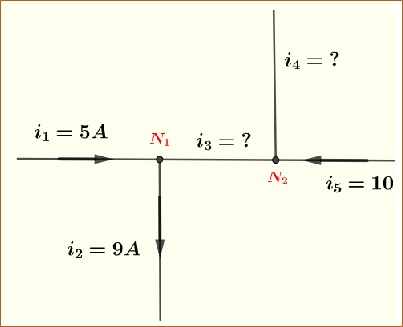
Kirchoff's Current Law states

Question 18
18.

Calculate the value of i3

Question 19
19.

Calculate i4

Question 20
20.

When finding the resultant resistance in a Series/Parallel circuit always resolve parallel loops/branches before tackling series components.

Question 21
21.

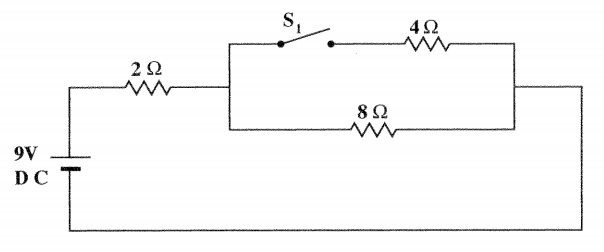
Caculate the Total resistance when switch S1 is open.

Question 22
22.

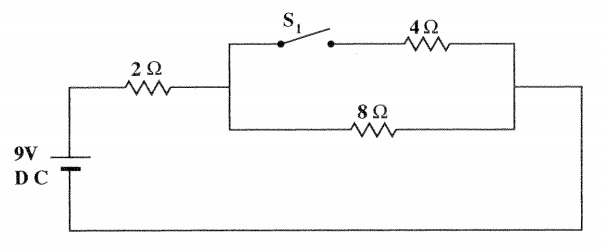
Calculate the total resistance when switch S1 is closed

Question 23
23.

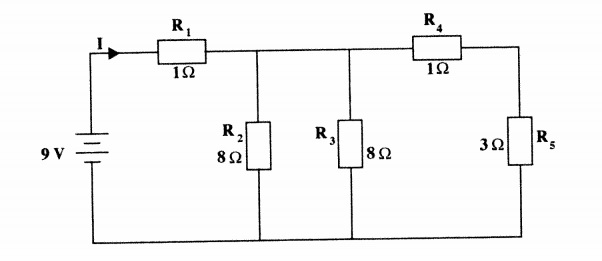
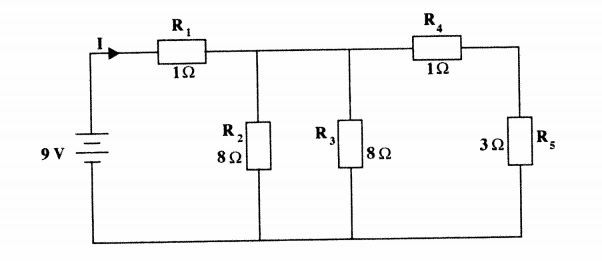
Calculate the total resistance in the circuit above

Question 24
24.

Calculate the voltage drop across resistor R1

Question 25
25.

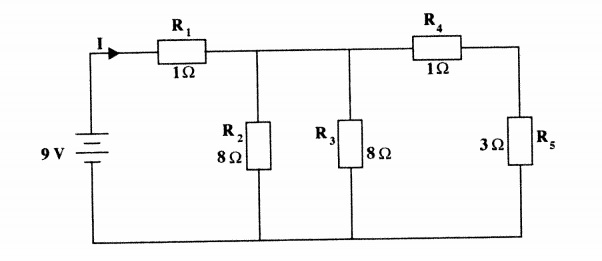
Calculate the voltage drop across resistor R5