Log in
Sign up for FREE
arrow_back
Library

6th Grade Unit 3 Test Reflections

star
star
star
star
star
Last updated over 5 years ago
32 questions
1
1
1
1
1
1
1
1
1
1
1
1
1
1
1
1
1
1
1
1
1
1
1
1
1
1
1
1
1
1
1
1
Question 1
1.

Question 2
2.

Explain, in complete sentences, why you think your answer choice is correct.

Sentence Stem: I chose answer __________ Because ___________.
Question 3
3.

Question 4
4.

Explain, in complete sentences, why you think your answer choice is correct.

Sentence Stem: I chose answer __________ Because ___________.
Question 5
5.

Question 6
6.

Explain, in complete sentences, why you think your answer choice is correct.

Sentence Stem: I chose answer __________ Because ___________.
Question 7
7.

Question 8
8.

Explain, in complete sentences, why you think your answer choice is correct.

Sentence Stem: I chose answer __________ Because ___________.
Question 9
9.

Question 10
10.

Explain, in complete sentences, why you think your answer choice is correct.

Sentence Stem: I chose answer __________ Because ___________.

Question 11
11.

Question 12
12.

Explain, in complete sentences, why you think your answer choice is correct.

Sentence Stem: I chose answer __________ Because ___________.

Question 13
13.

Question 14
14.

Explain, in complete sentences, why you think your answer choice is correct.

Sentence Stem: I chose answer __________ Because ___________.

Question 15
15.

Question 16
16.

Explain, in complete sentences, why you think your answer choice is correct.

Sentence Stem: I chose answer __________ Because ___________.

Question 17
17.

Question 18
18.

Explain, in complete sentences, why you think your answer choice is correct.

Sentence Stem: I chose answer __________ Because ___________.

Question 19
19.

Question 20
20.

Explain, in complete sentences, why you think your answer choice is correct.

Sentence Stem: I chose answer __________ Because ___________.

Question 21
21.

Question 22
22.

Explain, in complete sentences, why you think your answer choice is correct.

Sentence Stem: I chose answer __________ Because ___________.

Question 23
23.

Question 24
24.

Explain, in complete sentences, why you think your answer choice is correct.

Sentence Stem: I chose answer __________ Because ___________.

Question 25
25.

Question 26
26.

Explain, in complete sentences, why you think your answer choice is correct.

Sentence Stem: I chose answer __________ Because ___________.

Question 27
27.

Question 28
28.

Explain, in complete sentences, why you think your answer choice is correct.

Sentence Stem: I chose answer __________ Because ___________.

Question 29
29.

Question 30
30.

Explain, in complete sentences, why you think your answer choice is correct.

Sentence Stem: I chose answer __________ Because ___________.

Question 31
31.

Question 32
32.

Explain, in complete sentences, why you think your answer choice is correct.

Sentence Stem: I chose answer __________ Because ___________.

Read this sentence from paragraph 1.

These reformers developed institutions and practices that enabled a broader group of people to
seek and receive quality schooling.

Which statement from the article best supports the idea in the sentence?
A. At the seminary, students learned science, math, and social studies—subjects not typically taught to girls.
B. In 1831, the New-England Institution for Education of the Blind made Samuel Gridley Howe its new director.
C. By the end of his nearly decade-long tenure as secretary, the amount of money devoted to schools had nearly doubled.
D. As a direct result of Mann’s influence, Massachusetts also became the first state to offer schools specifically designed for training teachers.
How does the author organize this selection?
F. By contrasting the contributions of different education reformers and then providing evidence that one contribution was better than the others
G. By providing examples of people who made significant improvements to the school system
H. By describing the weaknesses of past school systems
J. By evaluating the viewpoints about education of different educators
The bold headings in the selection are included to —
A. help readers determine the main focus of each section
B. list information according to the order of importance
C. provide a preview of what the whole passage is about
D. allow readers to connect to ideas that are already familiar to them
The reader can conclude that the author —
F. considers nineteenth-century schools inferior to present-day schools
G. believes that nineteenth-century boys and girls should have received different kinds of education
H. supports the idea that nineteenth-century education reformers were superior to other teachers
J. admires the accomplishments of nineteenth-century education reformers
Which idea does the author develop throughout the selection?
A. Education reformers believed that boys and girls should receive an equal education.
B. Education reformers thought every child should receive an education through the use of taxes.
C. Education reformers were instrumental in developing better students as well as better teachers.
D. Education reformers made it possible for more diverse groups of people to receive an education.
The Latin word advocare, meaning “to call, summon, invite,” helps the reader understand that the word
advocate in paragraph 5 means —
F. plead in favor of
G. establish
H. develop a plan for
J. reform
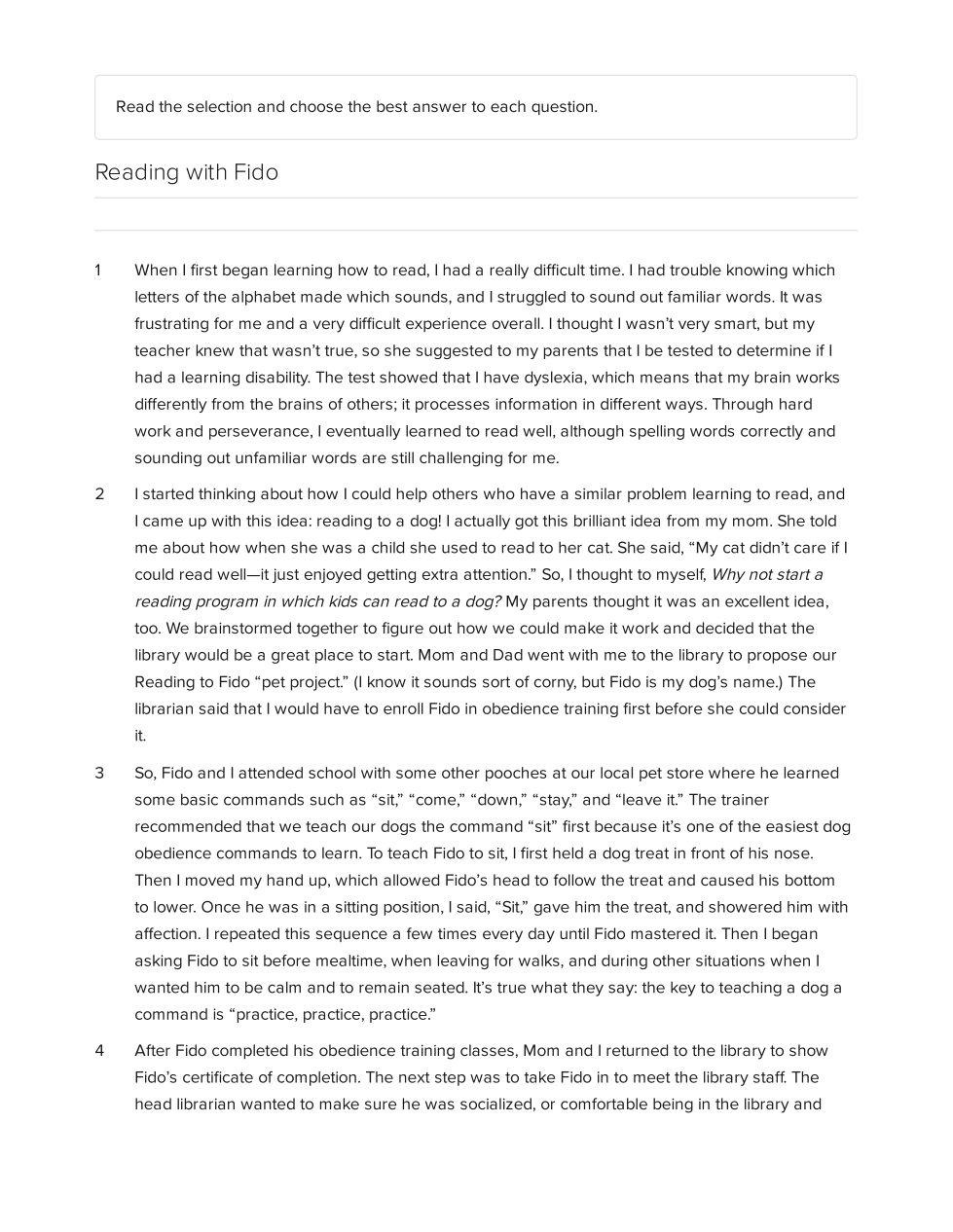
Based on paragraph 1, what can the reader infer about Asim?
A. He lacks self-confidence.
B. He doesn’t like to work hard.
C. He resents that he was chosen.
D. He doesn’t want to see the king.
The word compulsory comes from the Latin word compulsorius, which means “obligatory or required.”
What does compulsory mean in paragraph 1?
F. Necessary
G. Corrected
H. Optional
J. Unjust
Asim’s feelings about working on the pyramids begin to become more positive when he —
A. embarks on his journey to Giza
B. he hears his wife’s reassurances
C. observes the men working in the rock quarry
D. becomes adept at pulling the sledges
Which statement expresses a main theme in the story?
F. Rulers should not force people to work for them.
G. One should take pride in one’s work, no matter how menial it may seem.
H. Some people have more sacrifices and challenges in life than others.
J. One should enjoy life now because things can change in an instant.
How is Asim’s main problem solved?
A. He gets a job working on the pyramid.
B. He learns how to pull a sledge.
C. He realizes that he can do anything if he tries.
D. He is allowed to return home after three months.
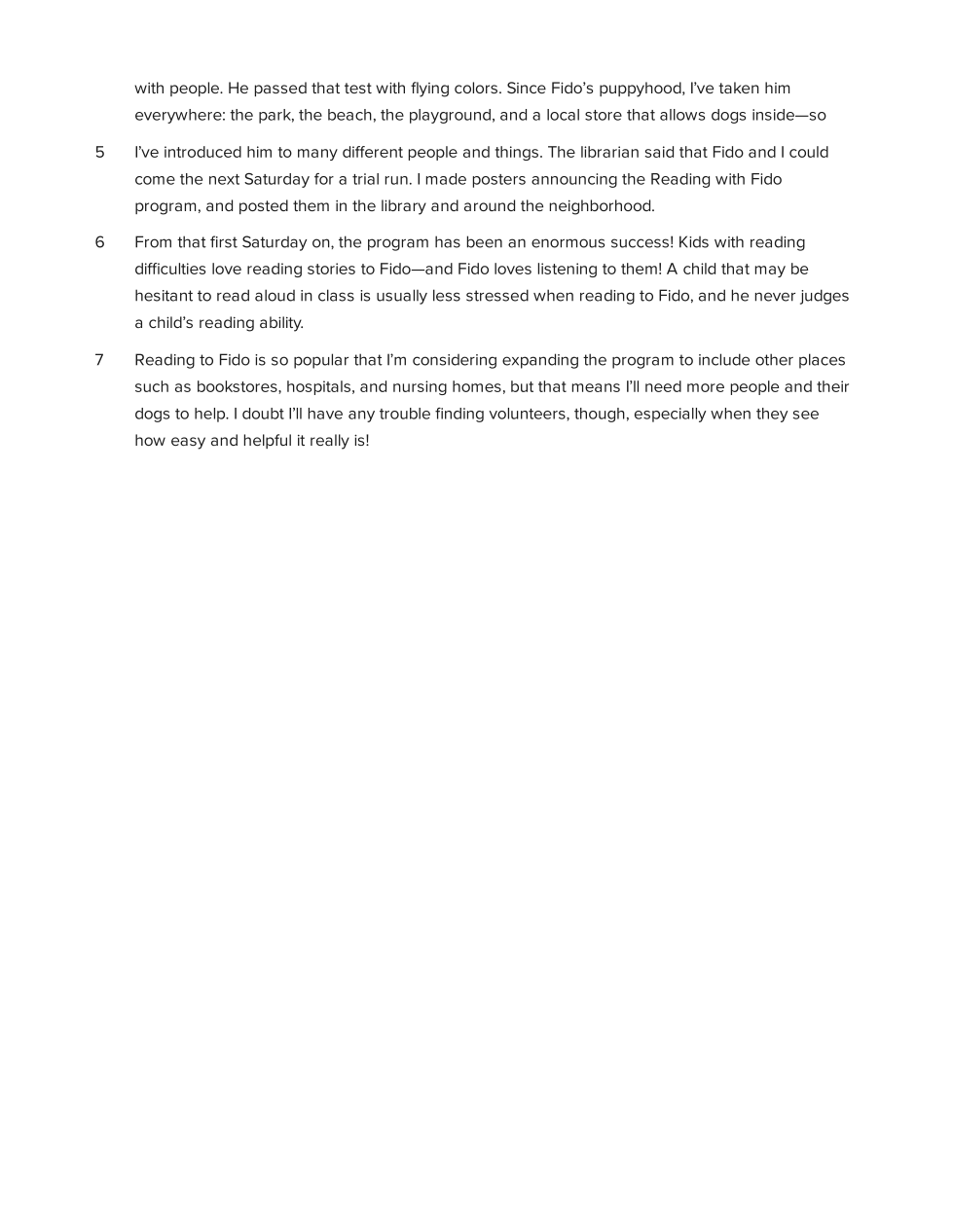
Which statement from paragraph 3 best supports the inference that success in dog training is
dependent on the person training the dog?
F. So, Fido attended school with some other pooches at our local pet store, where he learned some basic commands such as “sit,” “come,” “down,” “stay,” and “leave it.”
G. The trainer recommended that we teach our dogs the command “sit” first because it’s one of the easiest dog obedience commands to learn.
H. Once he was in a sitting position, I said, “Sit,” gave him the treat, and showered him with my affection.
J. I repeated this sequence a few times every day until Fido mastered it.
Which word best describes the author’s style of writing?
A. Direct
B. Exaggerated
C. Childish
D. Argumentative
Which statement expresses a main theme of the selection?
F. Sometimes a problem can turn into an opportunity.
G. Fear of failure can often keep one from succeeding.
H. Overcoming a learning disability is usually quite simple.
J. Always try to be yourself instead of what others want you to be.
Based on paragraphs 3 and 4, what can the reader tell about the narrator?
A. She believes Fido is the smartest dog in the world.
B. She is willing to work hard for something she believes in.
C. She feels the librarian is making too many requests of her and Fido.
D. She thinks obedience training is too much hard work.
What is hidden from the reader as a result of the story being told from a first-person point of view?
F. The actions of the narrator and her parents
G. The process involved with training Fido
H. The obedience trainer’s opinion of Fido
J. The obedience trainer’s opinion of Fido