Infinitive Phrases Notes
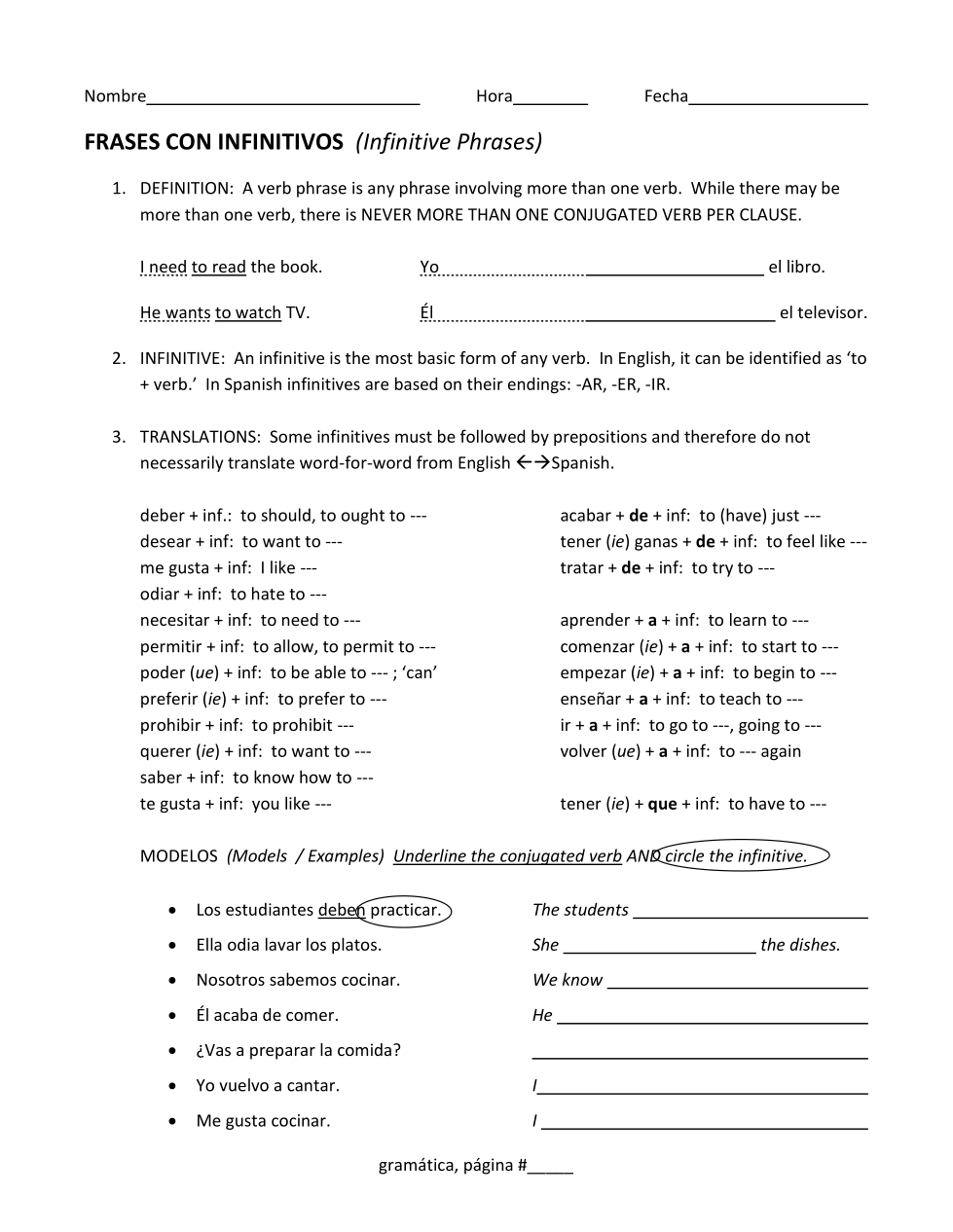
DEFINITION: A verb phrase is any phrase involving more than one verb . While there may be more than one verb, there is NEVER --- per clause.
ALGUNOS EJEMPLOS (SOME EXAMPLES):
I need to read the book.
He wants to read the book.
I need to read the book.
Yo --- --- el libro.
He wants to watch TV.
Él --- --- el televisor.
CATEGORIZE Match the infinitive to its preposition required.
poder
enseñar
tratar
ir
deber
tener ganas
tener
--- + infinitive
--- + A + infinitive
--- + DE + infinitive
--- + QUE + infinitive
Los estudiantes DEBEN practicar.
Ella ODIA lavar los platos.
Nosotros sabemos COCINAR.
Él ACABA DE comer.
¿Vas a PREPARAR la comida?
Yo VUELVO A cantar.
Me gusta COCINAR.
MODELOS
Check out the sentence completions:
The students OUGHT TO STUDY.
She HATES TO WASH the dishes.
We know HOW TO COOK.
He JUST ATE.
ARE YOU GOING TO PREPARE THE MEAL?
I SING AGAIN.
I LIKE TO COOK.
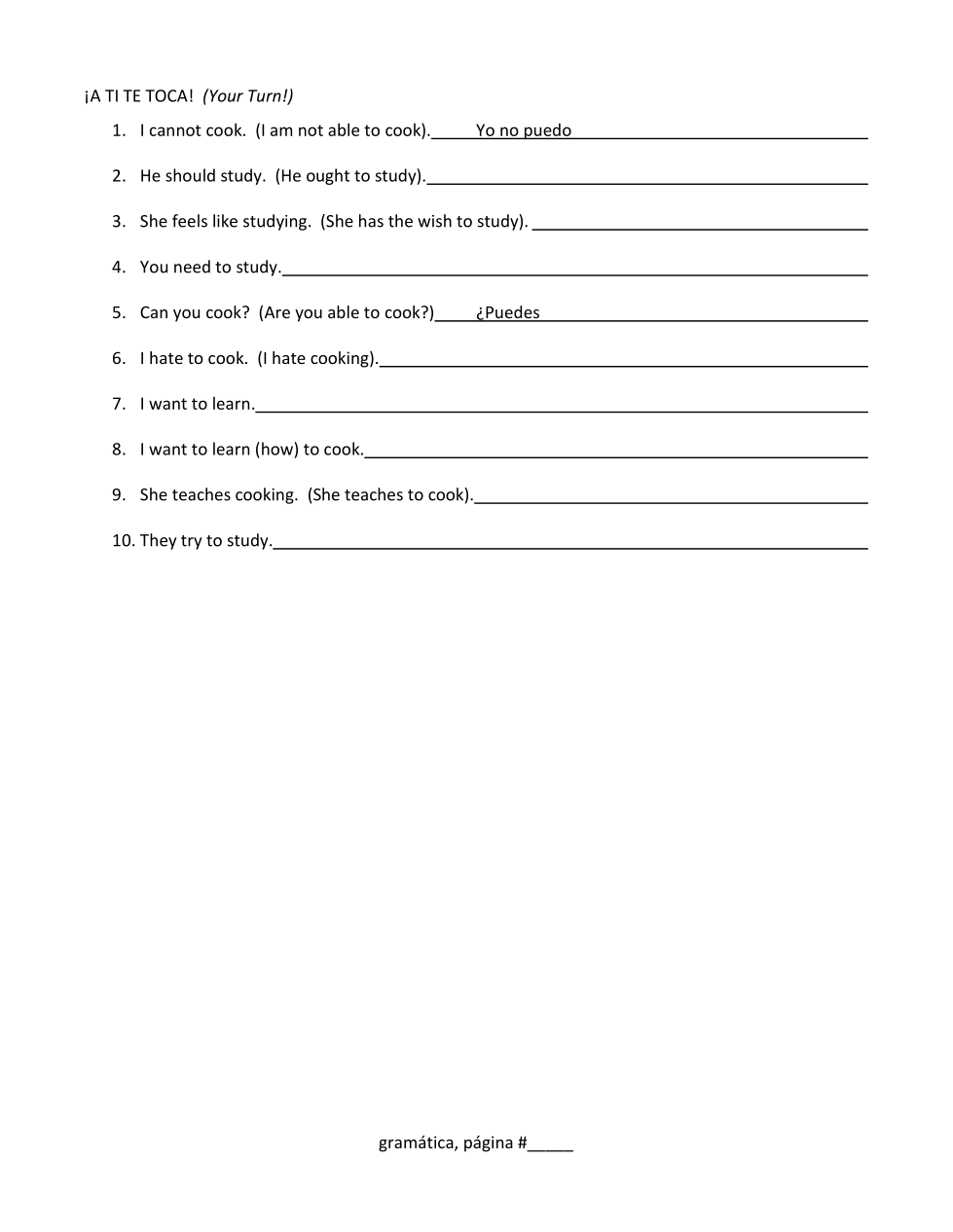
I cannot cook.
He should study.
She feels like studying.
You need to study.
Can you cook?
I hate to cook.
I want to learn.
I want to learn to cook.
She teaches cooking.
They try to study.