Preskoči na glavni sadržaj
Prijava
Sign up for FREE
arrow_back
Biblioteka

A5-3 A/B Factoring with Negatives and a=/1

star
star
star
star
star
Posljednje ažuriranje about 5 years ago
21

Lesson Objective:

Students will be ale to factor quadratics that contain negative numbers.

Students will be able to factor quadratic equations when the "a" value is not equal to 1 (A/B level)

1
1
1
1

Finding factors that add to a specific number is part of this process. Some people can do this pretty easily, but others need a more clear process, especially when negative numbers are involved. Try the problems below.

1
1
1

If that part was difficult, the video below describes an organizational tool and process to help figure out those numbers.

Use the skill you just learned and the patterns you recognized from A5-2 to factor the quadratics below.

1
1
1

If you struggled with those, watch the video below. The C-level of A5-3 has more practice with a=1 quadratics.

1
1

Now we're going to factor out a GCF. To see how to do that, watch the video below.

1
1
1
1
1

Now, we need to put all this together so we can factor quadratics where "a" isn't equal to zero. There are several methods people use for this, but the video below will show you a helpful tool for factoring these types of quadratics.

The practice for these will require that you show work. You can either do the work on the "Show your work" board, or take a picture of your paper and put it on the board.

1
1
1
1

Multiply out (either with an area model or distribution) the four pairs of binomials below. You should do them on your own paper; you'll want to be able to look back at them to answer the questions below.

Remember that quadratics often have the form:

In these examples, the "a" value is 1.
Pitanje 1
1.

When both numbers (the 9 and 5 in the example above) are positive, what is true about the "b" and "c" values?

Pitanje 2
2.

When the "bigger" number (9 in this case) is negative and the smaller number (5) is positive, what is true about the "b" and "c" values?

Pitanje 3
3.

When the "bigger" number (9 in this case) is positive and the smaller number (5) is negative, what is true about the "b" and "c" values?

Pitanje 4
4.

When both numbers are negative, what is true about the "b" and "c" values?

Pitanje 5
5.

What two numbers multiply to equal 20 and add to equal 12?

Pitanje 6
6.

What two numbers multiply to equal -30 and add to equal -1

Pitanje 7
7.

What two numbers multiply to equal 30 and add to equal -13

Pitanje 8
8.

Factor the equation below.

Pitanje 9
9.

Factor the equation below.

Pitanje 10
10.

Factor the equation below.

The next part will start to get into the A/B level skill for this unit. We need to make sure you know what "greatest common factor" means. The greatest common factor (referred to as GCF after this) is the largest number that two numbers can be divided by to get a whole number. For example, the GCF of 8 and 10 is 2.

Sometimes, the greatest common factor is one of the numbers. For example, the GCF of 3 and 9 is 3. And sometimes, the only number both numbers can be divided by is 1.

Pitanje 11
11.

What is the greatest common factor of 12 and 20?

Pitanje 12
12.

What is the greatest common factor of 7 and 21?

Pitanje 13
13.

Find the factored form of the expression below by factoring out the GCF.

Pitanje 14
14.

Find the factored form of the expression below by factoring out the GCF.

Pitanje 15
15.

Find the factored form of the expression below by factoring out the GCF.

Pitanje 16
16.

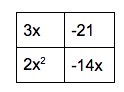
Find the factored form of the quadratic represented in the area model below. You can do your work on paper or on the "Show Your Work" board.

Type your answer in without spaces.

Pitanje 17
17.

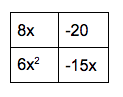
Find the factored form of the quadratic represented in the area model below. You can do your work on paper or on the "Show Your Work" board.

Type your answer in without spaces.

Pitanje 18
18.

Factor the following quadratic.

Pitanje 19
19.

Factor the following quadratic.

Pitanje 20
20.

Factor the following quadratic.

Pitanje 21
21.

Factor the following quadratic.