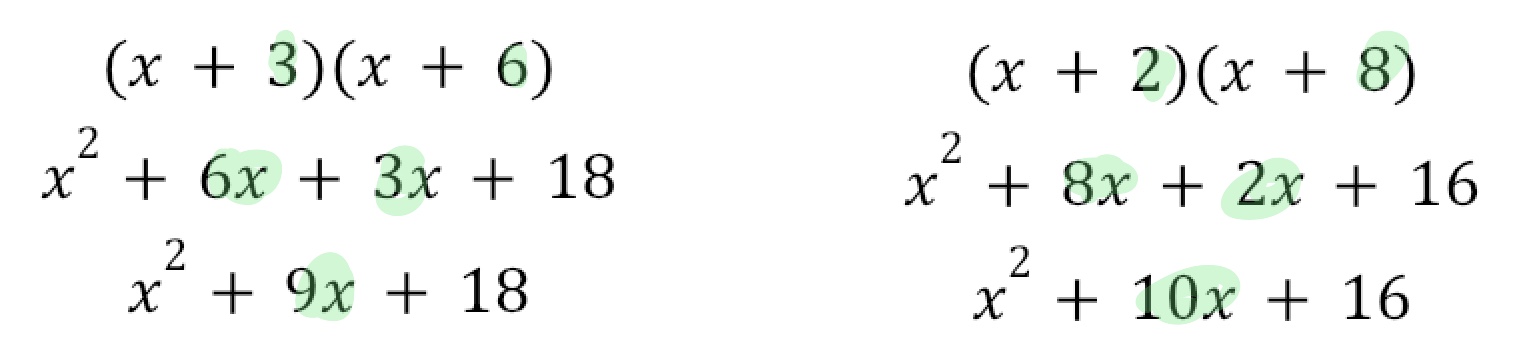
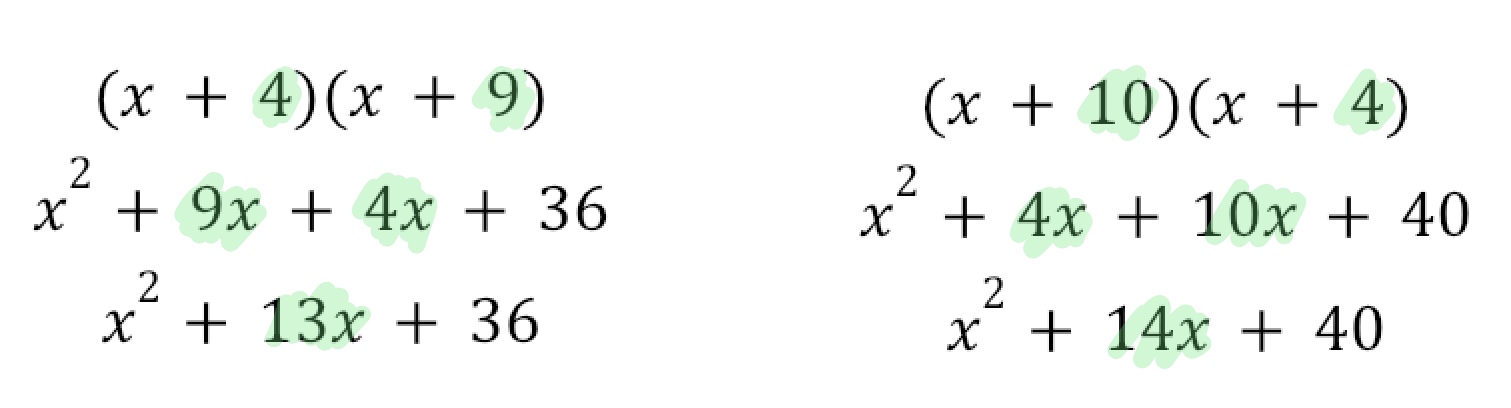
Look at the four problems below. What pattern do you notice about the parts highlighted in green? (you don't need to enter an answer, just think about it.
To watch a video of examples of multiplying binomials in two different ways, see the video below. You may not need to watch the entire thing. When I watch the video, some of the writing doesn't show, but I'm not sure if that is just a glitch for me.
For the next few problems, you'll be multiplying binomials.
When we multiply these binomials, we get
To enter the answer, you will enter only the middle and last term (for now, the x-squared won't change). So, for this answer, you would type in 5x, 6
Multiply and simplify
To type in your answer, fill in the blanks, separated by a comma, then a space.
Multiply and simplify
To type in your answer, fill in the blanks, separated by a comma, then a space.
Multiply and simplify
To type in your answer, fill in the blanks, separated by a comma, then a space.
Look at the four problems below. What pattern do you notice about the parts highlighted in green? (you don't need to enter an answer, just think about it.
Let's generalize (create a formula) for multiplying two binomials
When multiplied out, the "b" value for this quadratic expression is:
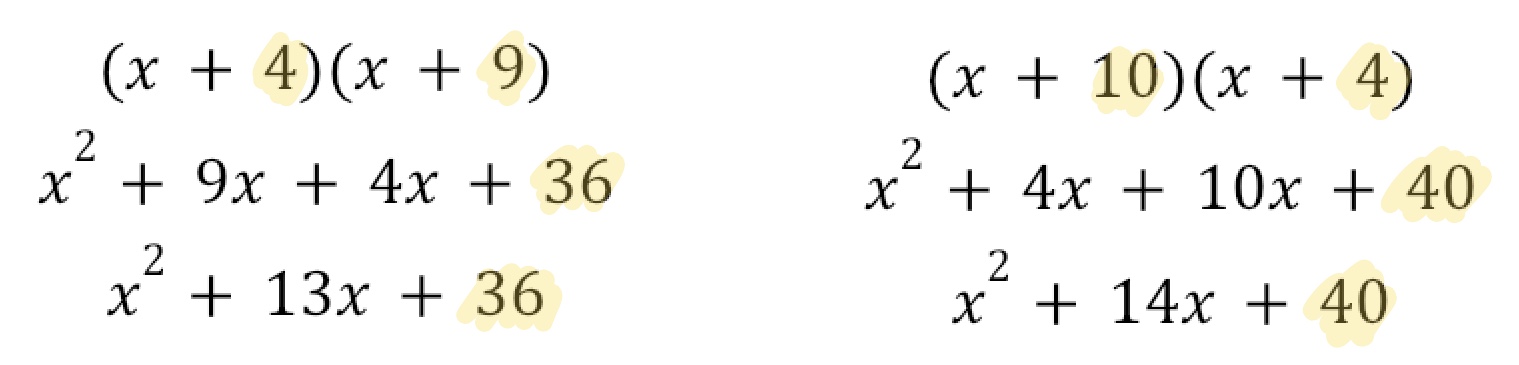
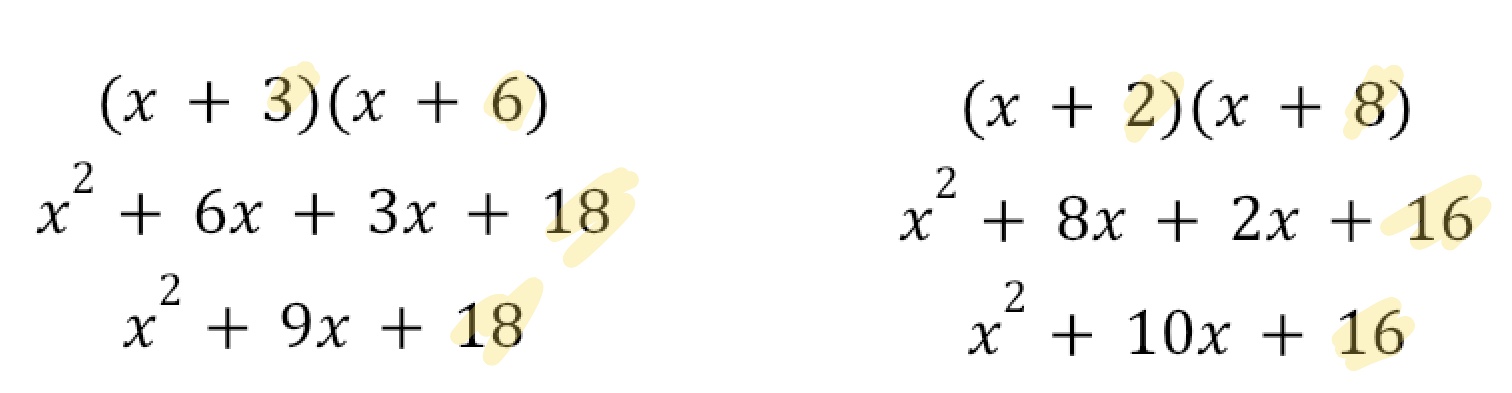
Look at the four problems below. What pattern do you notice about the parts highlighted in yellow?
Multiply the factored form
to find the standard form
When both the 9 and 5 are positive, what is true about the "b" and "c" values?
Let's generalize (create a formula) for multiplying two binomials
When multiplied out, the "c" value for this quadratic expression is:
Multiply the factored form
to find the standard form
When the "bigger" number (9) is negative and the smaller number (5) is positive, what is true about the "b" and "c" values?
Multiply the factored form
to find the standard form
When the "bigger" number (9) is positive and the smaller number (5) is negative, what is true about the "b" and "c" values?
Multiply the factored form
to find the standard form
When both numbers are negative, what is true about the "b" and "c" values?