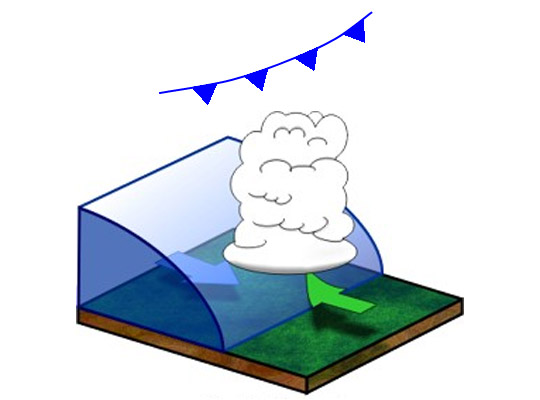
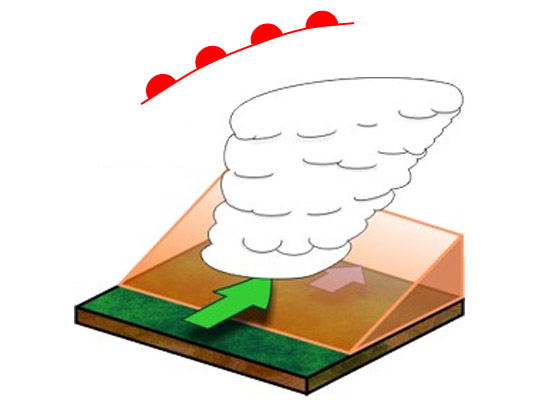
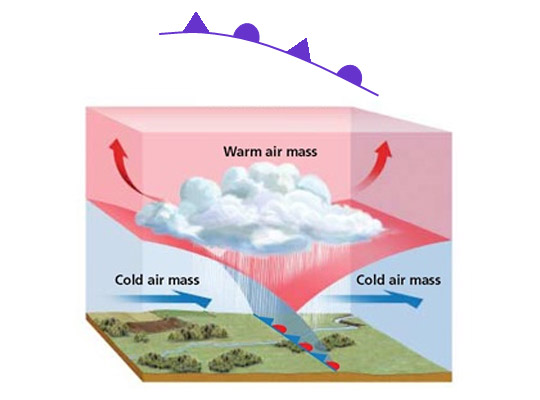
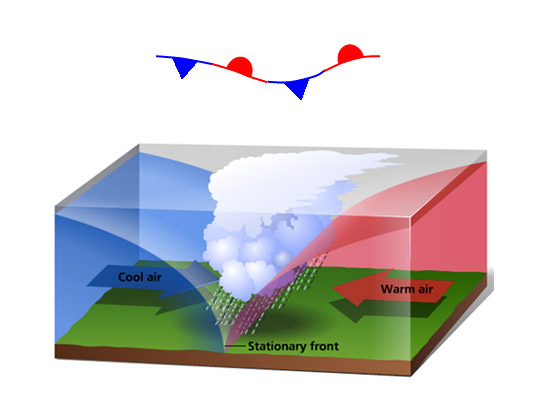
Match the front to the appropriate diagram.
Match the front to the appropriate diagram.
| Draggable item | arrow_right_alt | Corresponding Item |
|---|---|---|
Warm | arrow_right_alt |
|
Stationary | arrow_right_alt |
|
Cold | arrow_right_alt |
|
Occluded | arrow_right_alt |
|
Draw isobars (lines) that connect identical values of sea level pressure at increments of every 4 millibars (your isobars will have values of 1000, 1004, 1008, etc.). Isobars are a type of isoline; an isoline is a line on a map where there is a constant value of a parameter (barometric pressure, temperature, elevation, precipitation, etc.).
Rules regarding isobars (and other types of isolines):
1. Isobars are drawn in 4-millibar intervals.
2. Always label the isobar value.
3. Pressures lower than the isobar value are always on one side of the isobar and higher pressures are consistently on the other side.
4. Draw an isobar until it reaches the end of the plotted data or closes off a loop as it encircles data.
5. Neighboring isobars tend to take similar paths.
6. Isobars never cross and never split or fork.
7. More than one isobar of the same value can appear on a map.
Hint: begin drawing the 1024 millibar isobar starting in Four Corners region. Repeat the procedure with the next isobar value (1020 millibar). Then continue with the remaining values until you have isobars that connect all of the stations on the map.
Once you have drawn your lines, identify the areas of high and low pressures with a blue H or a red L.
What kind of weather can be expected around the area of high pressure?
What kind of weather can be expected around the area of low pressure?
Match the front to the appropriate diagram.
| Draggable item | arrow_right_alt | Corresponding Item |
|---|---|---|
Warm | arrow_right_alt |
|
Stationary | arrow_right_alt |
|
Cold | arrow_right_alt |
|
Occluded | arrow_right_alt |
|
Identify the characteristics of each front
Warm air in front of it, cold air behind it
Cumulonimbus clouds and severe weather
Warm air is rapidly forced upward
Warm front is overtaken by a cold front
Warm air is gradually forced upward
Cold air in front of it, warm air behind it
No significant movement between air masses
High clouds, followed by middle clouds, followed by nimbostratus clouds
Cold Front (should have 3)
Warm Front (should have 3)
Occluded Front (should have 1)
Stationary Front (should have 1)
Describe the process of forecasting severe weather. Who does it? What sort of tools do they use? What's the timeline? How do they communicate tthe forecast to the general public?