2.Tectonic Predictions Lab
star
star
star
star
star
Last updated about 5 years ago
18 Nsɛmmisa
1
1
1
1
1
1
1
1
1
1
2
3
3
0
3
3
2
0
PART I. SCAVENGER HUNT
Earthquakes and volcanoes are happening daily around the world. Both are caused by tectonic activity of the planet's crust. Tracking these earthquakes and volcanoes, small or large, help us learn about the earth's structure and predict future disasters.
Today you'll get to explore two online databases that track these natural disasters across the globe:
USGS Earthquakes Catalog - https://earthquake.usgs.gov/earthquakes/
Smithsonian Institute: Global Volcanism Project - https://volcano.si.edu/
For Part I, work with your group to track down as many answers as you can before I close breakout rooms. Work together to figure out how to navigate these databases. There are 10 questions, but you can work in any order. Part I is not graded.
What was the magnitude & location of the largest recorded earthquake?
See: Lists, Maps & Statistics --> Top 20 Largest.
What was the magnitude & location of the largest earthquake in the last month?
See "latest earthquakes" - use "settings" -->"30 days: significant worldwide."
How many earthquakes total happened last week globally?
See "latest earthquakes"--> "settings" --> "last 7 days."
Which two U.S. states seem to have the most earthquakes overall? Add a screenshot of a map to show how you decided.
See "latest earthquakes."
Which volcano was the most recent to erupt with a VEI (Volcanic Eruption Index) of 4? Write the name of the volcano and location. Bonus: add a screenshot of it in-action.
See "database --> eruption search."
In 2020, which country experienced the most eruptions? (hint: at least 11).
From the homepage, find "Eruptions in 2020" under "New activity."
In 2020, how many eruptions took place in the US? (Bonus: in which state?)
From the homepage, find "Eruptions in 2020" under "New activity."
On average, how many volcanoes are erupting on any particular day?
See "current eruptions."
When was the last eruption on Mt. Hood & what type of volcano is it?
See "database - volcano search - Hood."
Bonus: Add another fun fact you found from either website.
PART II. DATA MAPPING, INTERPRETATION & ANALYSIS (Graded, Criteria C)
Part II asks you to map recent earthquake and volcanic activity. Then, you'll use your map to identify a pattern and to describe how that pattern might be related to tectonic plate boundaries.
In Part III, you'll get to propose your own scientific question that could be answered using this data.
Gather data
Step 1. Return to the earthquake database and select: "last 7 days: 4.5 or higher." Choose 10 of the strongest earthquakes that have taken place from the list. Copy their location carefully onto the map below using the suggested symbols.
Step 2. Return to the volcanic activity database. Find the 5 most recent eruptions, and add them to the map. For this, you will need to click on each volcano and find their latitude (north/south) and longitude (east/west). Use splitscreen to add them to your map at the correct point (as exact as you can get).
Interpret.
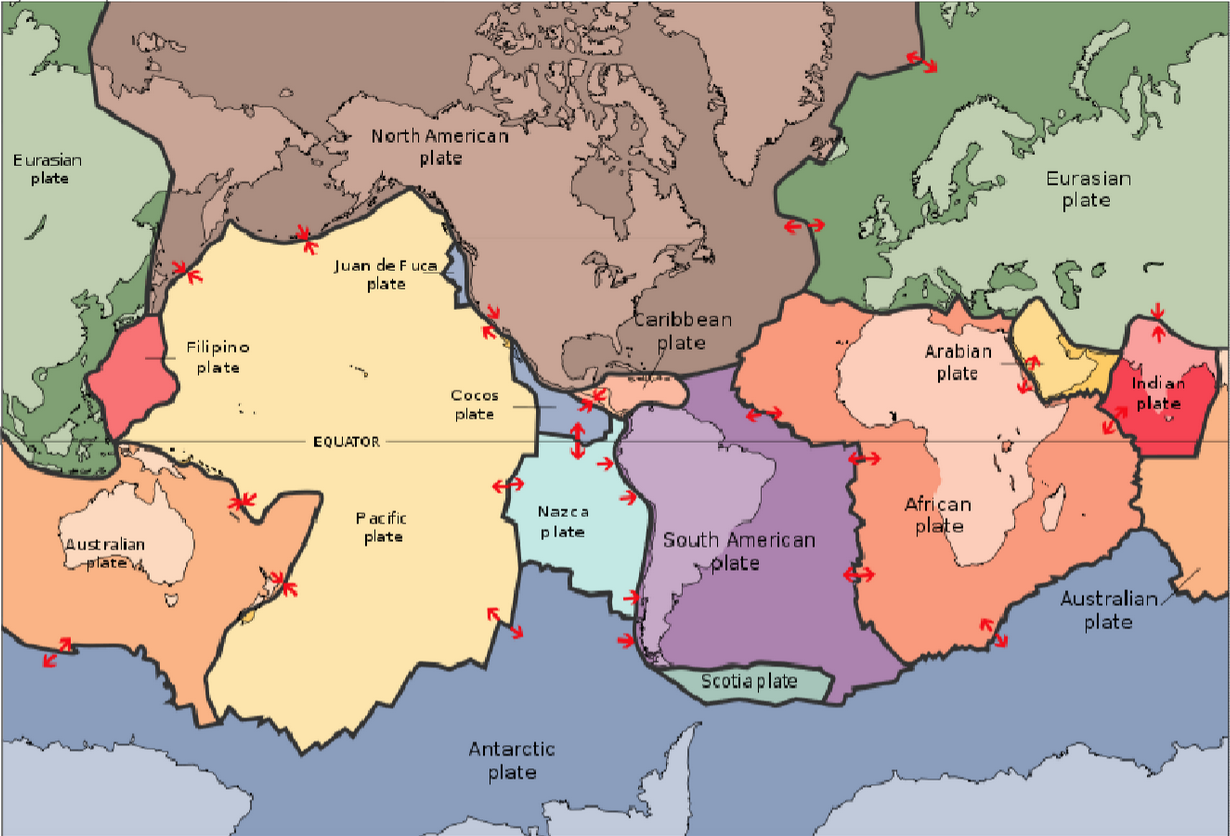
Now compare the map you have created with the map below. This shows the tectonic boundaries - with arrows showing whether the are convergent, divergent or transform. To compare the maps side-by-side using splitscreen, open the map in this separate link.
What do you notice when you look at the two maps? How are the most recent earthquakes and volcanic eruptions related to tectonic plate boundaries? Do they happen at boundaries? Away from them? More often at certain types of boundaries? Write a claim about what you observe and include at least 2 specific examples to support your idea.
Sentence starters you may use: I notice that... / Most earthquakes and volcanoes seem to happen... / While __ of the earthquakes happen..., __ happen... / For example....
Reason.
What is a possible explanation for this observation? Write 2-3 sentences explaining why earthquakes and volcanic eruptions show the pattern you identified. Try to use what you've learned from the last month.
Try: More earthquakes happened in... because... / Some volcanoes erupted at.... because... / It is possible that... / This can be explained by...
Evaluate your work on questions 12-14. (Check all that apply, then go back and improve your work if needed).
PART III. Design an Inquiry (Graded, Criteria B)
Scientists use this type of data not just to learn about what has happened in the past. They also use it to predict what will happen in the future so that communities can be prepared for disaster.
I want you to play the role of a geophysicist. You are going to make a prediction about future tectonic activity based on what you have discovered today. Imagine that you will return to these databases in the future to see whether you were correct.
Question.
With your group, brainstorm some questions that you could ask using these data sets.
Examples:
Do earthquakes / volcanoes happen more frequently __ or ___?
Are volcanoes more likely to happen when...?
Where there are ___ boundaries, is it more likely that...?
Do stronger earthquakes happen ... or ...?
Then, select one that you think shows your best thinking and record it below.
Your question should be answer-able by analyzing these databases. To answer it, you should need to use at least 2 of the following:
the earthquake database
the volcano database
the tectonic plate map
Procedure.
Describe how you will use the data to answer your question using numbered steps.
1. What information will you look for in the databases? (Will you look at all data, or only some regions / earthquake magnitudes / types of plate boundaries?)
2. What information will you record?
3. How will you use it to answer your question?
Hypothesis.
Write your prediction of what you think the data will show AND explain why. Use this sentence structure:
If I analyze earthquake and volcanic data from..., then I will observe... This is because...
Grade yourself on questions 16-18. (Check all that apply, then go back and improve your work if needed)