Coulomb's Law and electrostatics Modified
star
star
star
star
star
Last updated about 5 years ago
14 Nsɛmmisa
4

1
1

1
1
1
1
1
1
1
1
1

1
1
These are some of the terms associated with the study of electric charges. Find which terms match with which definitions. Keep at it until you get green dots for each set.
| Draggable item | arrow_right_alt | Corresponding Item |
|---|---|---|
Coulomb's law | arrow_right_alt | the space around a charge that is influenced by that charge |
static electricity | arrow_right_alt | an equation that relates the strength of the force exerted by one charge on another with respect to the distance between them; an inverse square law |
electric field | arrow_right_alt | the study of phenomena created by electric charges at rest |
electrostatics | arrow_right_alt | electricity held in place by a material with an electric charge |
A large electrostatic generator is commonly called a(n) _____.
What occurs when charges build up on a surface?
Charge q is 1 unit of distance away from the source charge S. Charge p is three times farther away than q. The force of S on p is ______ the force of S on q.
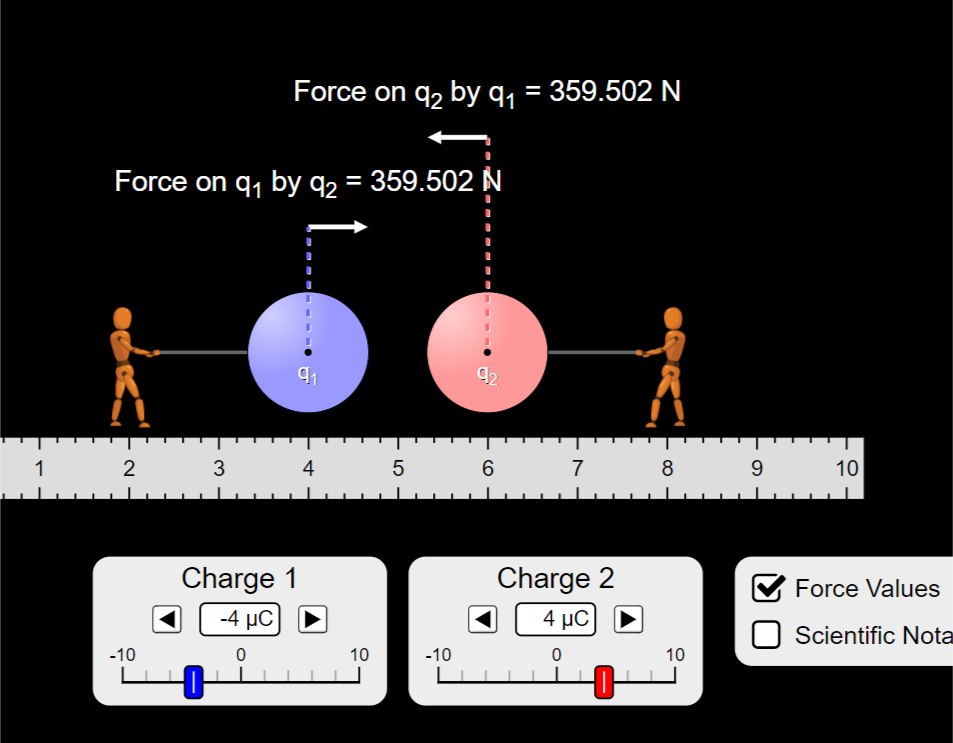
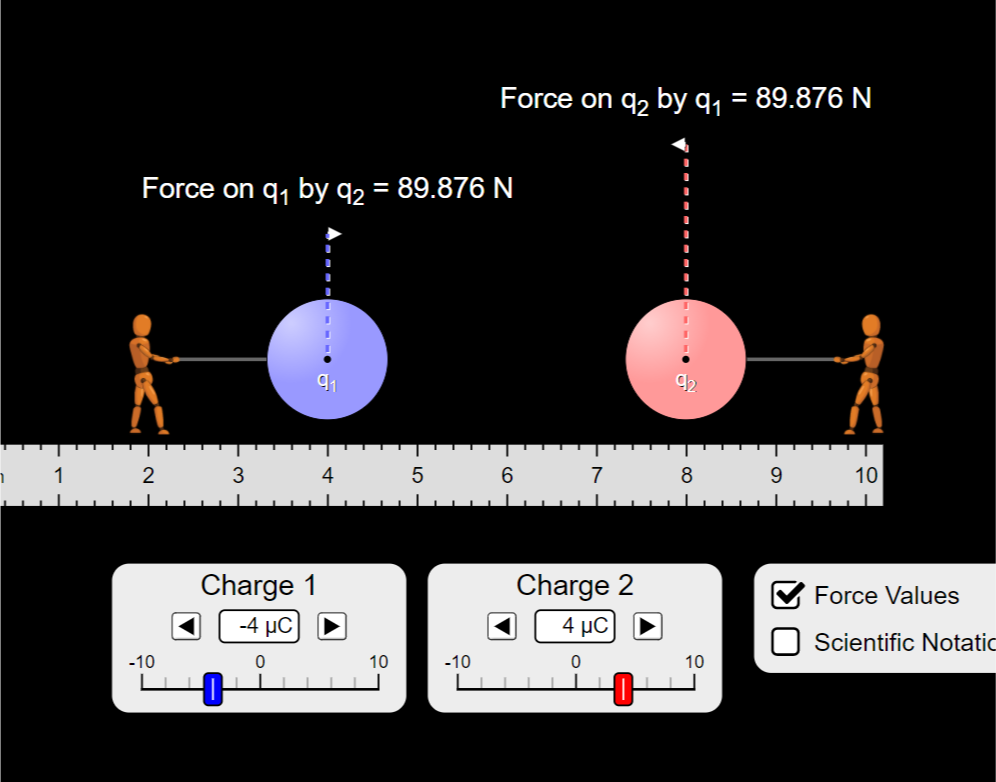
Create the following scenarios using the Coulomb's Law PHeT simulation and then answer the question. Make sure to check the force values box. Copy this link and paste into browser to access the simulation: https://phet.colorado.edu/sims/html/coulombs-law/latest/coulombs-law_en.html
The crash dummies either have to push or pull the charged objects to keep them at a set distance. The force above the object shows how much force is needed in the push or pull.
Set both charge 1 and charge 2 to -4 microcoulombs (the only charge available). Do the dummies push or pull?
Do the charges attract or repel each other?
Leave charge 1 at -4 microcoulombs and set charge 2 to 4 microcoulombs. Do the dummies push or pull?
Do the charges attract or repel each other?
Place charge 1 on the 4 cm mark and charge 2 on the 6 cm mark. What is the force value of charge 2?
Now double the distance between the charges by moving charge 2 to the 8 cm mark. What is the force value of charge 2?
Compare the value of 4 cm apart to 2 cm apart? (divide answer to 10 by the answer to 9). Which number is closest to your answer?
Explain how the answer to #11 follows or does not follow Coulomb's Law. You might want to scroll up and look at the chart and the summary under it.
Who invented lightning rods to protect buildings from lightning?
An atmospheric discharge of static electricity is called _____.