Look at the distance-time graph below. Distance is on the y axis and time is is on the x axis.
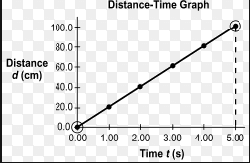
What is the total distance traveled?
Look at the distance-time graph below. Distance is on the y axis and time is is on the x axis.

What is the total time traveled?
Look at the graph above. Given that speed = distance / time, calculate the speed of the object. Show your work in the space below.
A kayaker paddles along a river for 4 hours. In that time, she manages to move a total of 20 miles. What is the time of this trip?
A kayaker paddles along a river for 4 hours. In that time, she manages to move a total of 20 miles. What is the distance the kayaker travels?
A kayaker paddles along a river for 4 hours. In that time, she manages to move a total of 20 miles. What is the average speed of the kayak for this trip?
A runner covers 1.25 km in 0.25 hours (15 minutes) away from the school. What is the velocity of the runner?
What is acceleration? Type a definition for this term in your own words.
What is the formula (equation) for acceleration? Make sure your answer includes: a, vf, vi, and t.
A stationary ball begins rolling down a hill. After 5 seconds, its velocity is 10 meters per second. What is the vi (or initial velocity)?
A stationary ball begins rolling down a hill. After 5 seconds, its velocity is 10 meters per second. What is the vf (or final velocity)?
A stationary ball begins rolling down a hill. After 5 seconds, its velocity is 10 meters per second. What is the change in velocity?
A stationary ball begins rolling down a hill. After 5 seconds, its velocity is 10 meters per second. How much time (T=) did it take to reach this speed?
A stationary ball begins rolling down a hill. After 5 seconds, its velocity is 10 meters per second. What is the acceleration?
A vehicle brakes from 30 mph to 5 mph over a period of 10 seconds. What is the vehicle's acceleration?