Kelso High-Chem H-PHET - Build an Atom Simulation
star
star
star
star
star
Last updated over 5 years ago
44 Nsɛmmisa
1
1
1
1
1
1
1
1
1
1
1
1
1
1
1
1

1
1
1
Go to Build an Atom Simulation then click the play button. Once open, click on the Atom icon.
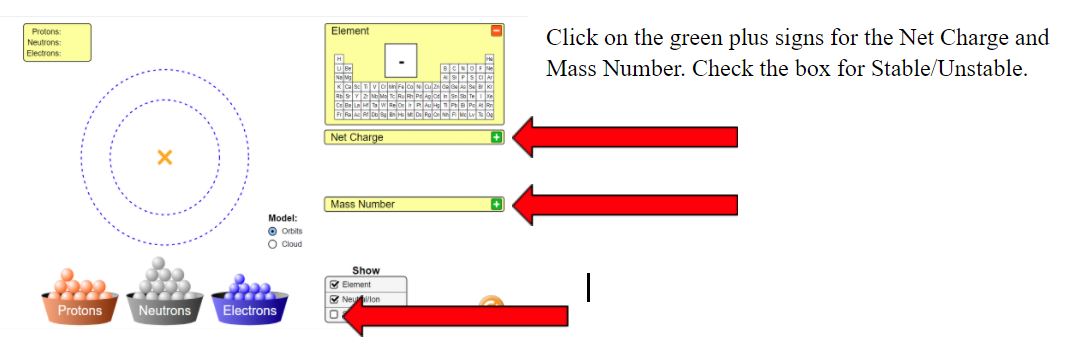
Explore the Build an Atom simulation for a few minutes.
What particles go in the center of the atom?
What is the center of the atom called?
Use the protons, neutrons, and electrons to create three different atoms (of your choice) and fill in the table below.
Everything around us is made up of different elements. The air has Oxygen and Nitrogen. Plants and people have lots of Carbon. Helium is in balloons. Hydrogen is in water.
Play until you discover a rule for what part of an atom determines the name of the element you build. What did you find determines the element?
Test your idea by identifying the element for the cases in the next three questions. (The name is shown in the middle of the atom)
# of protons: 6
# of neutrons: 6
# of electrons: 6
# of protons: 7
# of neutrons: 6
# of electrons: 6
# of protons: 6
# of neutrons: 7
# of electrons: 7
Play until you discover some good rules about the charge of your atom.
What makes the charge of the atom go up (become more positive)? Pick two.
Play until you discover some good rules about the charge of your atom.
What makes the charge of the atom go down (become more negative)? Pick two.
Play until you discover some good rules about the charge of your atom.
To make sure an atom is neutral (doesn’t have a charge), you need to have the exact same number of...
Which equation best describes how to calculate the charge on an atom/ion?
Play until you discover some good rules about the mass of your atom.
What makes the mass of the atom go up?
Play until you discover some good rules about the mass of your atom.
What makes the mass of the atom go down?
Play until you discover some good rules about the mass of your atom.
Which particle seems to have no effect on the mass?
Which equation best describes how to calculate the mass of an atom/ion?
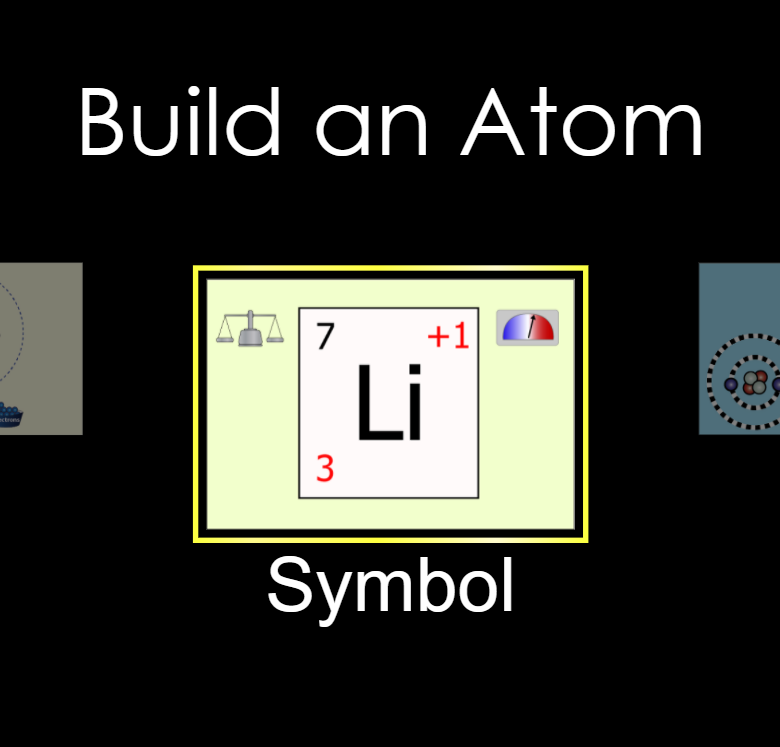
In the symbol portion of the simulation, play around with the particles until you can identify each part of the symbol, which particles (proton, neutron and/or electron) that affects that part and how the value of the number is determined. Use the text box to add the labels. The terms to label are mass number, atomic number, charge and symbol.
Which particle affects the stability of an atom?
What are the names of the stable forms of oxygen?
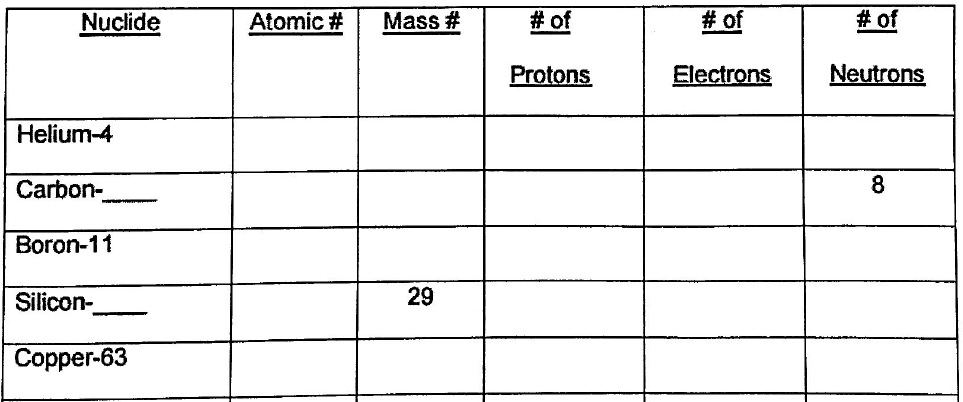
In addition to atomic symbol, we can represent atoms by name and mass number. Complete the table.
atomic number
mass number
number of protons
number of electrons
number of neutrons
atomic number
mass number
# of protons
# of electrons
Complete the name of this carbon isotope.
atomic #
mass #
# of protons
# of electrons
# of neutrons
atomic #
# of protons
# of electrons
# of neutrons
Complete the name of the isotope.
atomic #
mass #
# of protons
# of electrons
# of neutrons