Please write your response to either Short Response #1 or #2 in this space.
0
1
Question 43
43.
I certify that all of the answers I have submitted on the Unit 1 Exam are purely my own. While I may have used my readings and notes as guidance, the ideas and writing are purely my own.
Sign your name in the "Show Your Work" space.
Question 1
1.
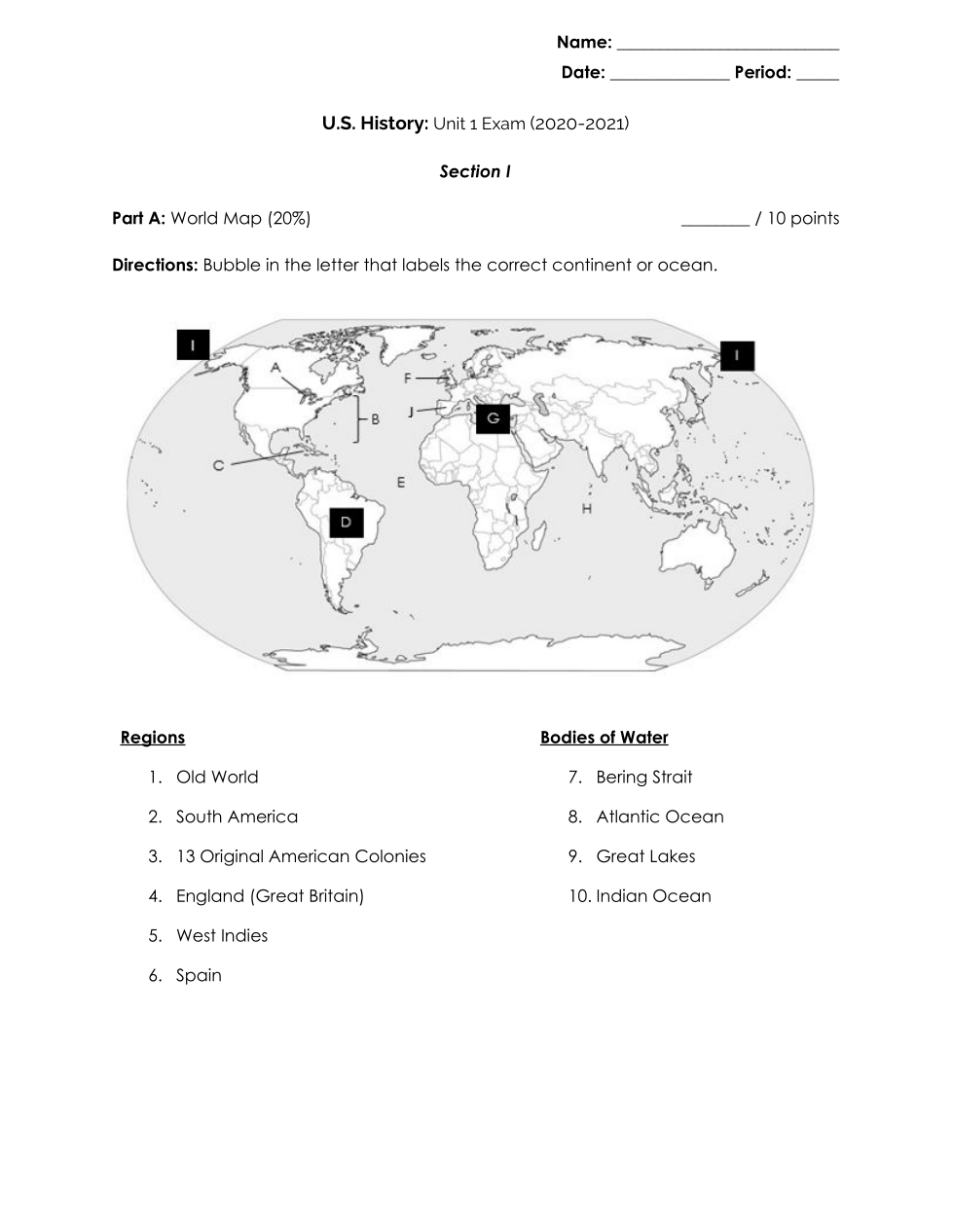
Identify the letter that correctly labels the Old World.
Question 2
2.
Identify the letter that correctly labels South America.
Question 3
3.
Identify the letter that correctly labels the 13 Original American Colonies.
Question 4
4.
Identify the letter that correctly labels England (Great Britain).
Question 5
5.
Identify the letter that correctly labels the West Indies.
Question 6
6.
Identify the letter that correctly labels Spain.
Question 7
7.
Identify the letter that correctly labels the Bering Strait, a.k.a. the Bering Ice Bridge.
Question 8
8.
Identify the letter that correctly labels the Atlantic Ocean.
Question 9
9.
Identify the letter that correctly labels the Great Lakes.
Question 10
10.
Identify the letter that correctly labels the Indian Ocean.
Question 11
11.
Question 12
12.
Question 13
13.
Question 14
14.
Question 15
15.
Question 16
16.
Question 17
17.
Question 18
18.
Question 19
19.
Question 20
20.
Question 21
21.
Question 22
22.
Question 23
23.
Question 24
24.
Question 25
25.
Question 26
26.
Question 27
27.
Question 28
28.
Question 29
29.
Question 30
30.
Question 31
31.
Question 32
32.
Question 33
33.
Question 34
34.
Question 35
35.
Question 36
36.
Question 37
37.
Question 38
38.
Question 39
39.
Question 40
40.
Question 42
42.
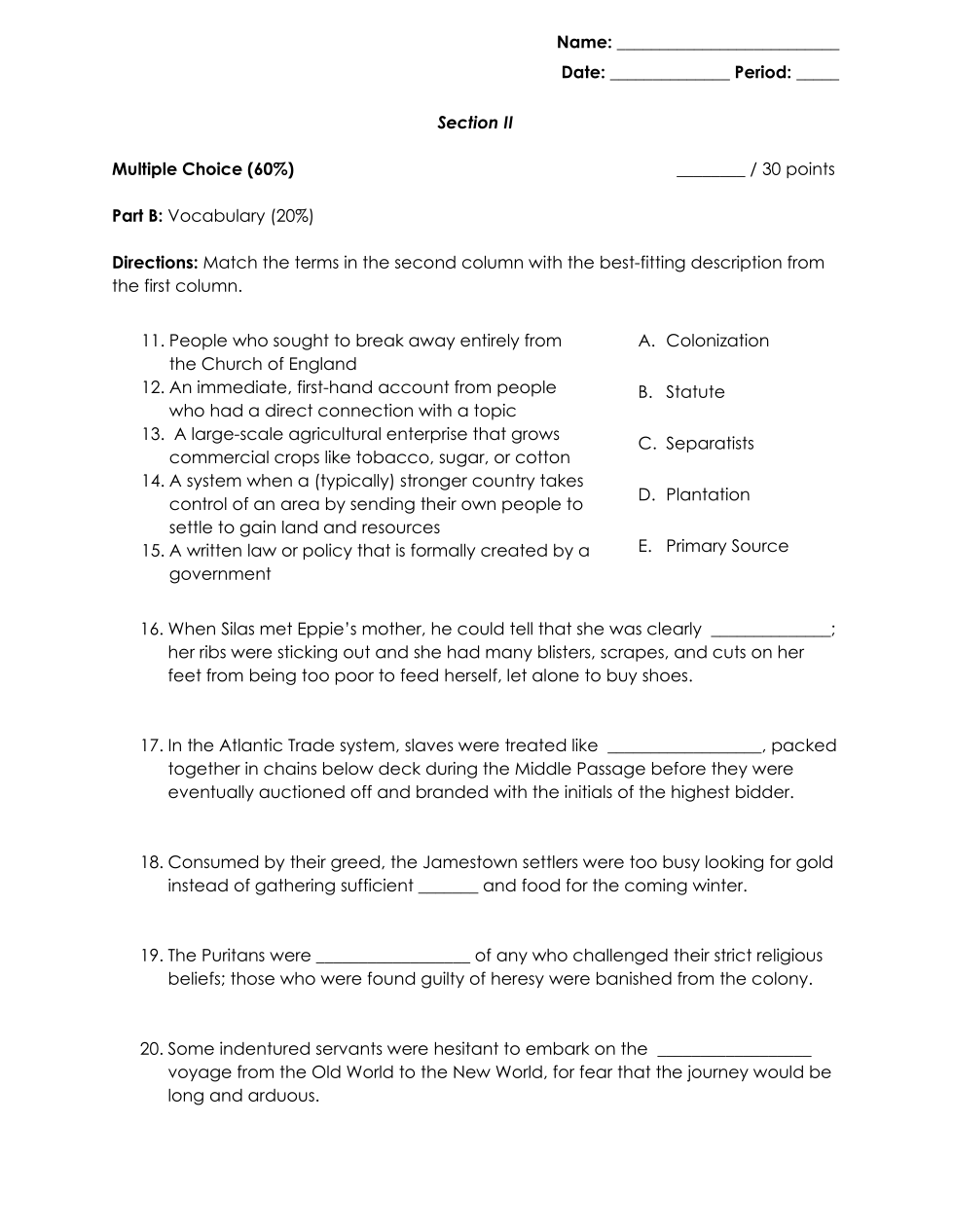
People who sought to break away entirely from the Church of England are known as
colonization.
statute.
plantation.
primary source.
Separatists.
An immediate, first-hand account from people who had a direct connection with a topic is a
primary source.
Separatists.
statute.
plantation.
colonization.
A large-scale agricultural enterprise that grows commercial crops like tobacco, sugar, or cotton is known as a
statute.
primary source.
Separatists.
plantation.
colonization.
A system when a (typically) stronger country takes control of an area by sending their own people to settle to gain land and resources is known as
statute.
colonization.
primary source.
plantation.
Separatists.
A written law or policy that is formally created by a government is called a
statute.
Separatists.
plantation.
colonization.
primary source.
When Silas met Eppie’s mother, he could tell that she was clearly ______________; her ribs were sticking out and she had many blisters, scrapes, and cuts on her feet from being too poor to feed herself, let alone to buy shoes.
chattel
impoverished
arduous
fertile
In the Atlantic Trade system, slaves were treated like __________________, packed together in chains below deck during the Middle Passage before they were eventually auctioned off and branded with the initials of the highest bidder.
chattel.
middle men.
squatters.
indentured servants.
Consumed by their greed, the Jamestown settlers were too busy looking for gold instead of gathering sufficient _______ and food for the coming winter.
commerce
revenue
commissions
provisions
The Puritans were __________________ of any who challenged their strict religious beliefs; those who were found guilty of heresy were banished from the colony.
pre-destined
pious
Separatist
intolerant
Some indentured servants were hesitant to embark on the __________________ voyage from the Old World to the New World, for fear that the journey would be long and arduous.
epochal
hysterical
trans-Atlantic
charter
The greatest threat to indigenous populations in the New World was
isolation.
enslavement.
disease.
genocide.
All of the following are causes of Spanish colonization of the New World EXCEPT
acquire riches for themselves and the country they represent.
convert the native people to Catholicism.
escaping persecution from the Spanish political system.
bring power and prestige to Spain.
The early years at Jamestown were mainly characterized by
major technological advancements.
peace with the Native Americans.
starvation, disease, and frequent Native American raids.
booming trade and economic prosperity.
Virginia, Maryland, the Carolinas, and Georgia were similar in that they were all
dependent on the export of agricultural cash crops.
founded as refuges for persecuted religious sects in England.
diverse communities centered around urban cities.
able to live in peace with the Native Americans.
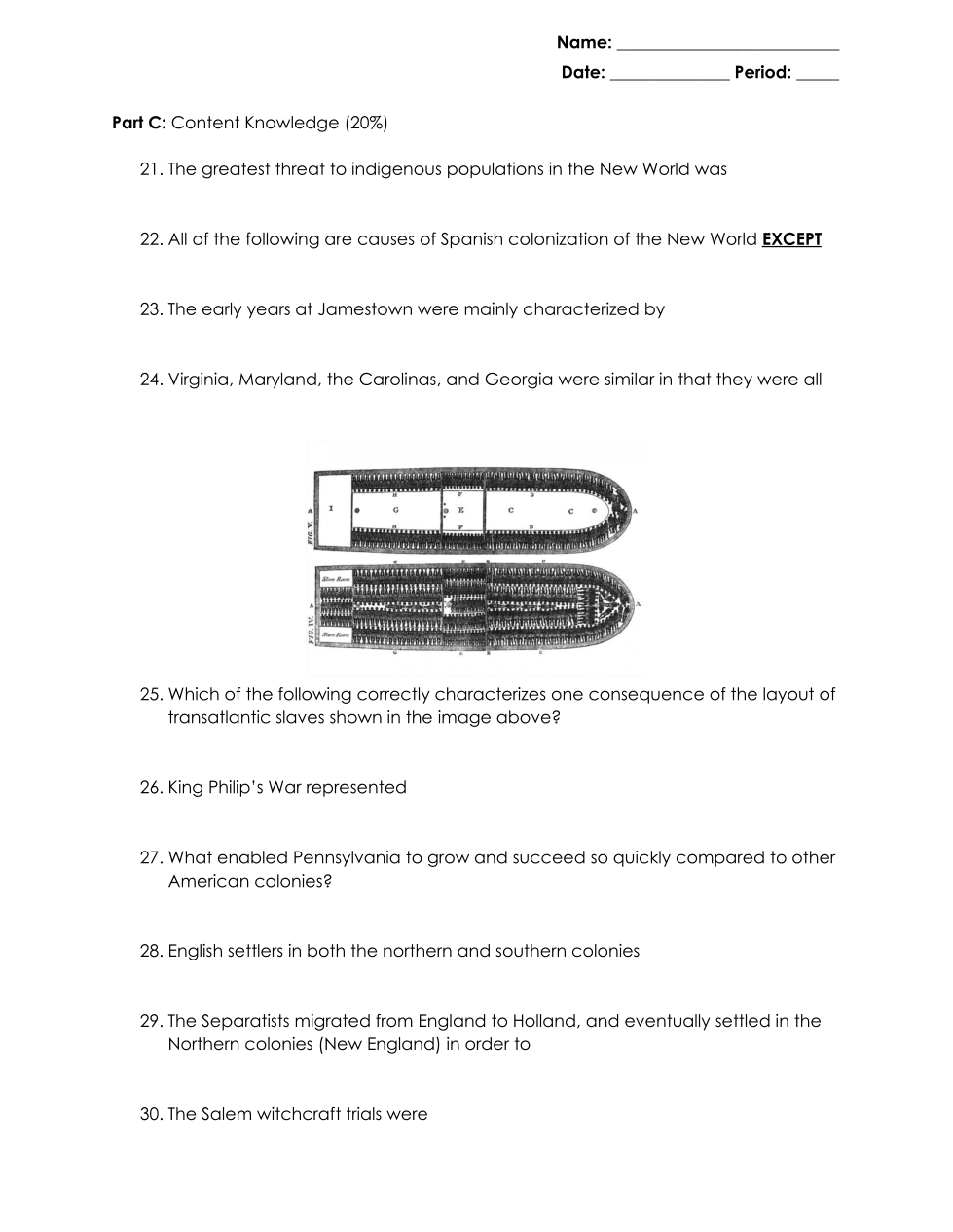
Which of the following correctly characterizes one consequence of the layout of transatlantic slaves shown in the image above?
Slave ships were manned by tribal officials as well as white crewmembers.
Slaves were forced to assist in the rowing of the slave ships.
Many slaves died of disease in the crowded hulls of tightly packed ships.
Slave ships often sank due to overcrowding and imbalance in weight.
King Philip’s War represented
growing tensions between the Indians of New England and English settlers.
the tension between freedmen and landowners.
the growing tension between Protestants and Catholics.
a war fueled by the rivalry of Queen Elizabeth and King Philip.
What enabled Pennsylvania to grow and succeed so quickly compared to other American colonies?
well-designed economic policies enabled the cultivation of a cash crop.
Founder William Penn widely advertised the opportunities available in his new colony, and especially recruited skilled craftsmen.
religious tolerance drew immigrants from overseas as well as nearby colonies that were less tolerant.
Conservative land policies attracted a large influx of immigrants.
English settlers in both the northern and southern colonies
had similar economic systems that resulted in national wealth.
were drawn to the promise of riches, especially tobacco.
had a shared common language and heritage.
were fleeing religious persecution from their home country.
The Separatists migrated from England to Holland, and eventually settled in the Northern colonies (New England) in order to
foster Calvinism as an international religion.
practice their purified Protestantism without persecution.
escape the jurisdiction of the Virginia Company.
avoid the coming war with France.
The Salem witchcraft trials were
a reaction against the introduction of Quaker communism.
the result of unsettled social and religious conditions in rapidly evolving Massachusetts.
a response to Roger Williams' attempt to encourage religious virtues.
an effect of men attempting to maintain power and eliminate outspoken women.
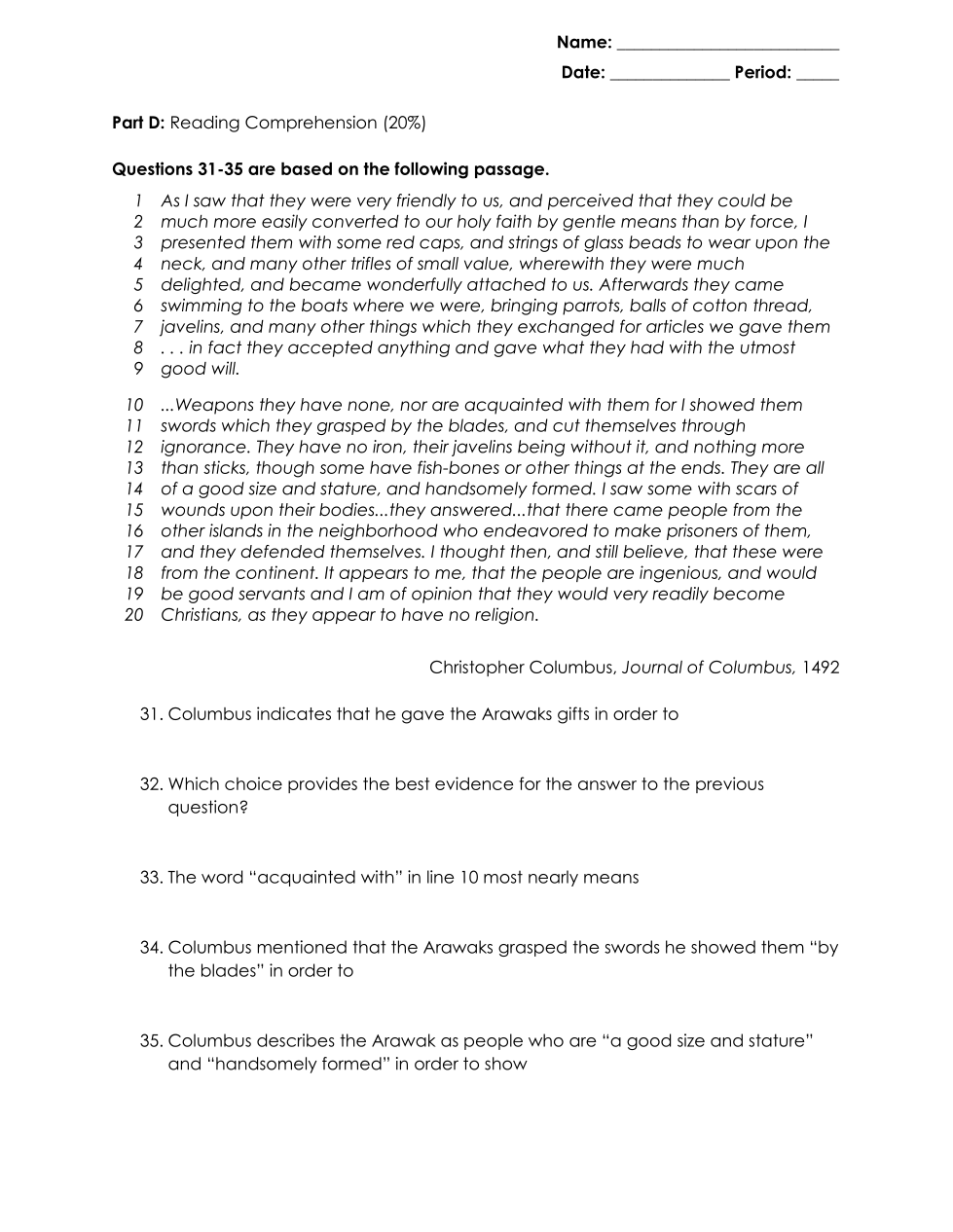
Columbus indicates that he gave the Arawaks gifts in order to
educate an ignorant group of people.
develop a deep friendship with the native people.
trick the indigenous people into viewing the Spaniards as Gods.
convince them to become Christians.
Which choice provides the best evidence for the answer to the previous question?
Lines 1-2, “As I...by force,”
Lines 4-5, “...they were...to us.”
Lines 8-9, “they accepted...good will.”
Lines 10-12, “Weapons they… through ignorance.”
The word “acquainted with” in line 10 most nearly means
advised with.
obtained for.
familiar with.
secure in.
Columbus mentioned that the Arawaks grasped the swords he showed them “by the blades” in order to
demonstrate their ignorance about tools used for labor.
flaunt the Arawaks’ instinctual knowledge of hunting.
highlight the inferiority of Arawak weapons.
indicate the Arawaks would make poor soldiers.
Columbus describes the Arawak as people who are “a good size and stature” and “handsomely formed” in order to show
why they would make good servants.
how much more physically fit they were than the Spaniards.
how the Spaniards were sympathetic to the Arawaks.
why they did not use weapons made of iron.
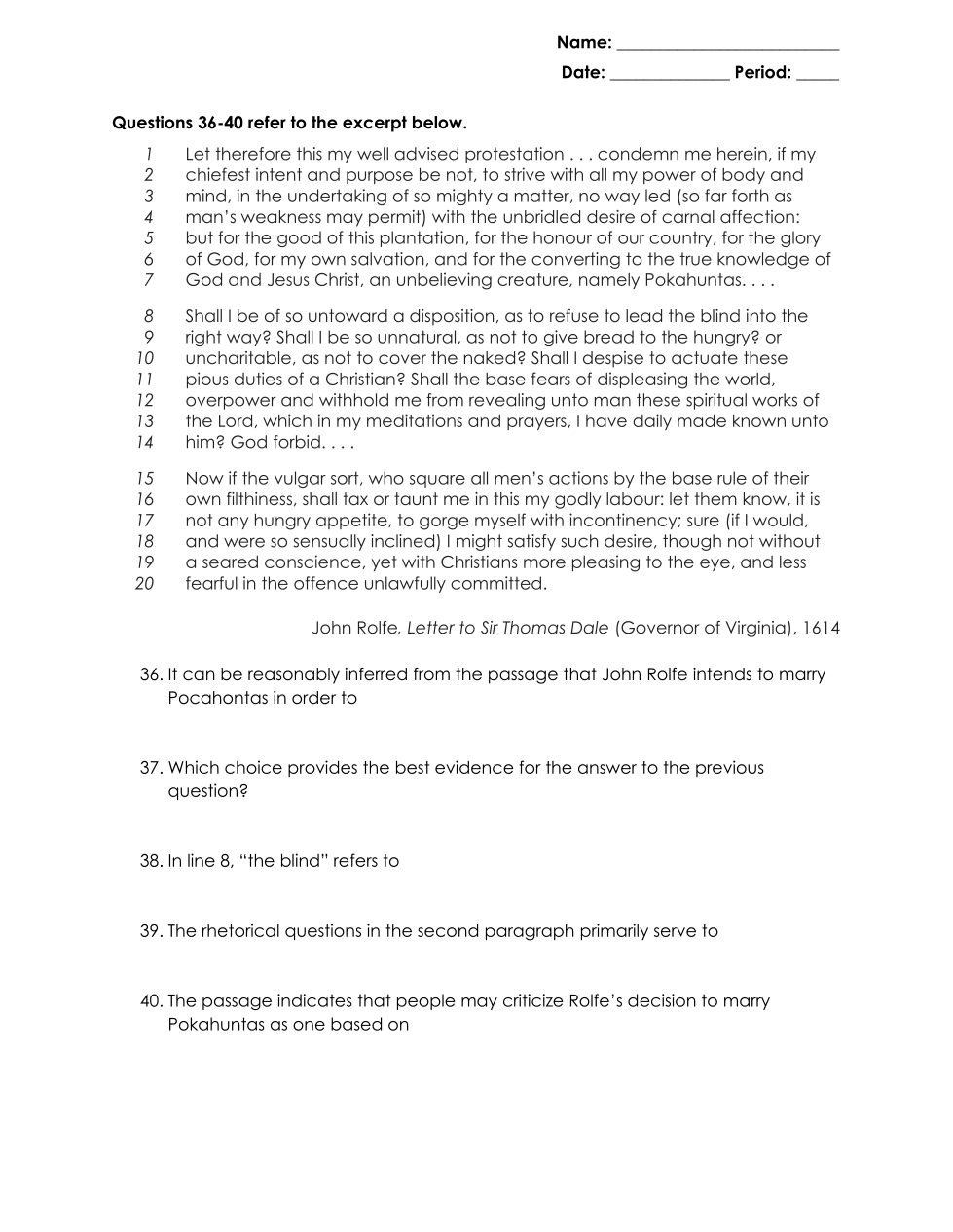
It can be reasonably inferred from the passage that John Rolfe intends to marry Pocahontas in order to
desire for her to bear his children and create a superior mixed race.
loves her in spite of God’s disapproval of their union.
help spread Christianity among Native Americans.
deceive her people and steal their land.
Which choice provides the best evidence for the answer to the previous question?
Lines 3-4, “No way…carnal affection”
Lines 9-10, Shall I...the naked?”
Lines 15-16“Now if…godly labour”
Lines 5-7, ”but for...namely Pokahuntas.”
In line 8, “the blind” refers to
People who are not Christian.
Native Americans who have yet to meet European settlers.
Pokahuntas.
Native Americans who cannot see.
The rhetorical questions in the second paragraph primarily serve to
ask Sir Thomas Dales for his advice regarding these matters.
evoke his own sense of morality in order to decide what he should do.
reinforce the decision he has already made as the right thing to do.
second guess the consequences of the decision he has already made.
The passage indicates that people may criticize Rolfe’s decision to marry Pokahuntas as one based on
greed and arrogance.
ignorance and contempt.
fame and power.
lust and passion.
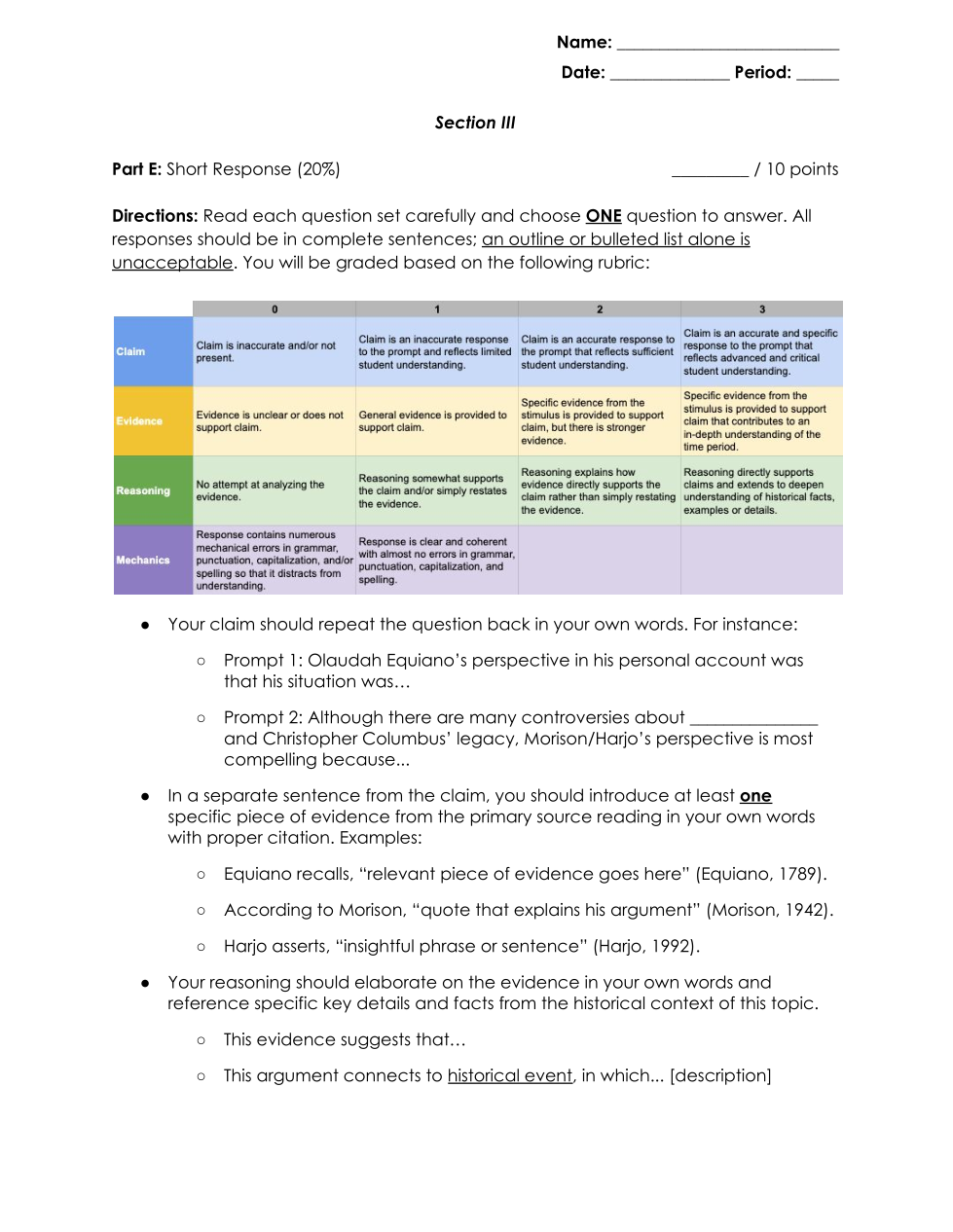
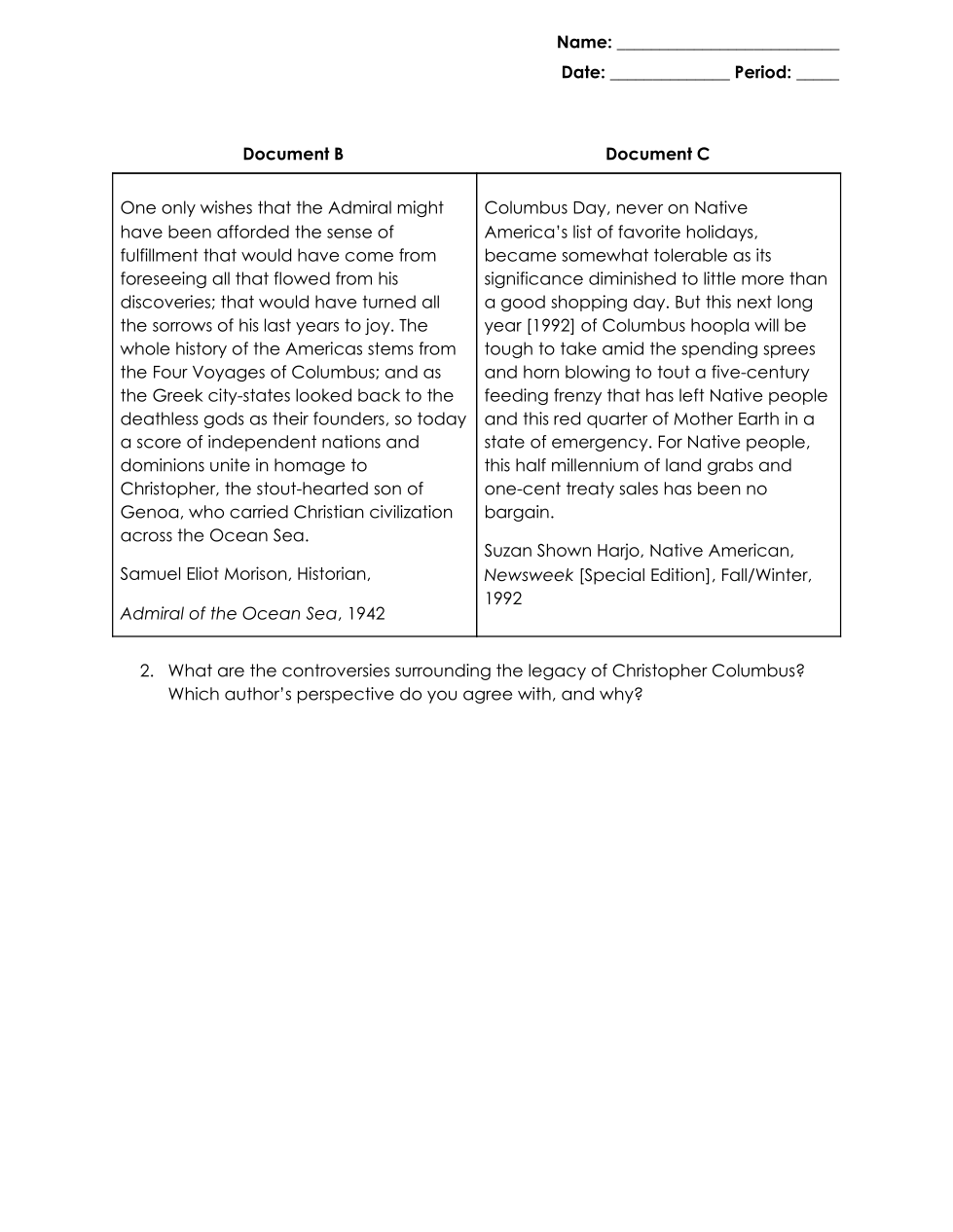
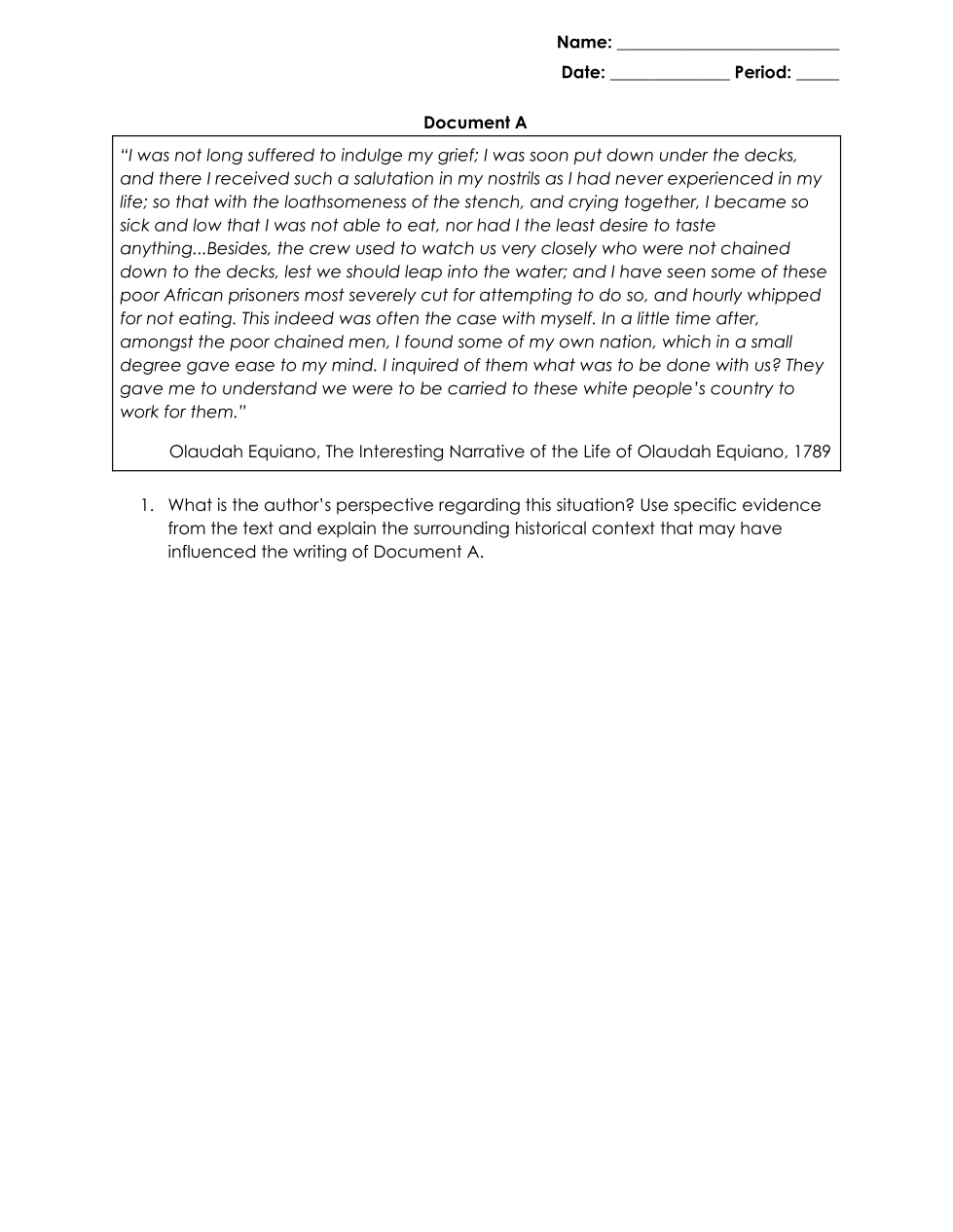
Which Short Response question did you decide to answer?
1) What is the author’s perspective regarding this situation? Use specific evidence from the text and explain the surrounding historical context that may have influenced the writing of Document A.
2) What are the controversies surrounding the legacy of Christopher Columbus? Which author’s perspective do you agree with, and why?