Thermal Energy and Chemical Processes - HMH Module J: Unit 3 , Lesson 3:
star
star
star
star
star
Last updated over 5 years ago
9 Nsɛmmisa
1
1
1
1
1
1
1
1
1
A system is a set of interacting parts. Systems can include matter, energy, and information. By grouping a set of related parts or events into a system, scientists and engineers can study how matter and energy behave.
A system can have inputs (things that enter the system) and outputs (things that leave the system). Inputs and outputs can be matter, energy, or information. New matter or energy cannot be created nor destroyed. Instead, matter and energy can only be transformed into new forms or be introduced from outside the system. To accurately model a system, you must understand the inputs and outputs of that system. You also have to understand the flow of matter, energy, and information through the system.
What is a system?
A syste can have ...
Matter and energy can only ...
For example, an automobile engine uses energy to make a car move. The inputs of the system are gasoline and air. When gasoline and air enter the engine system, they react with one another. The chemical energy of the gasoline-air reaction is converted into thermal energy and then mechanical energy by the engine. The mechanical energy is an output of the engine system and is used to move a car. By tracing the flow of energy, we can understand how the system functions.
How is an automobile engine a "system"?
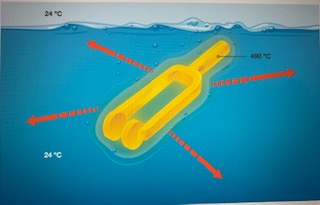
Look at the temperatures of the water, the metal object, and the air to explain the flow of thermal energy in this system. What do the arrows show?
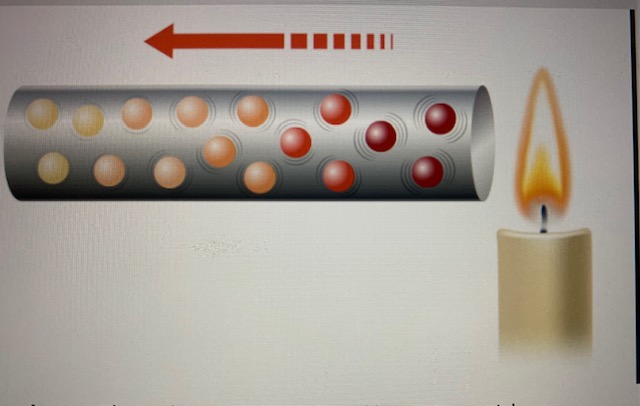
All matter is made up of tiny particles that are in constant motion. The particles of matter in an object move faster when the object is warm than when the object is cold. When thermal energy flows from one object to another, it always flows from the warmer object to the cooler object. As a result, the motion of the particles in the two objects changes. Thermal energy can be transferred between objects in several different ways
What is one example of conduction?
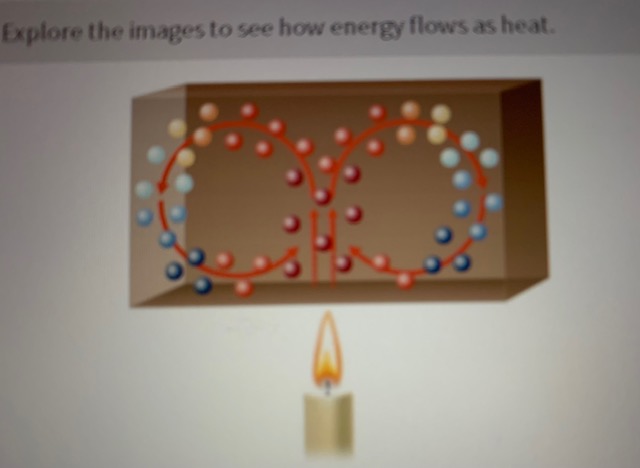
Convection Thermal energy is transferred throughout liquids and gases through convection. In this example, the candle is heating the box. As air in the box warms, the air particles begin to move faster, and the air becomes less dense. The colder, denser air sinks and pushes up the warmer air. This movement transfers thermal energy through liquids and gases.
What is convection?
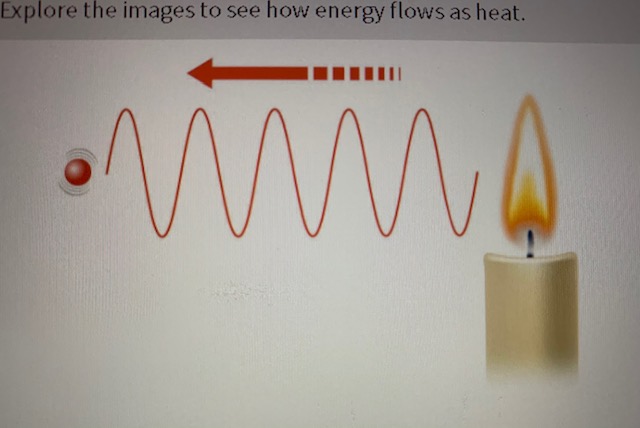
Radiation Radiation is the transfer of energy through electromagnetic waves. In this example, the candle produces infrared radiation. This radiation travels through empty space until it hits a particle. The particle then absorbs this radiation, and the radiation is converted into thermal energy. This process is how thermal energy is transferred through space.
What is radiation?
Thermal energy is not the only form of energy. Many systems produce thermal energy when a different form of energy is transformed into thermal energy. For example, some of the radiant energy of sunlight is changed into thermal energy in the particles of matter that make up the atmosphere. Other forms of energy that can be changed into thermal energy include chemical, kinetic, and electrical energy.
Besides Thermal Energy, what other forms of energy can be changed to thermal energy?